What "banning" someone on TikTok actually means
The word does a lot of work. When people search for how to ban someone on TikTok, they usually mean one of three different things: a full account-level ban issued by TikTok, a temporary suspension of a specific feature, or the built-in host controls inside a TikTok Live room. Only one of those is what most callers imagine, and it is not something an outside user can force.
An account-level ban is a permanent removal of a person's TikTok profile by TikTok's Trust and Safety systems. It is generated by TikTok itself — either automated review of a video that its content classifiers judged to violate the Community Guidelines, or human review that agreed after a report. This guide, reviewed by our editorial and legal team, is written to be honest about what that means: no third-party service, and no ordinary user, can add "banned" as an outcome to another account. The button does not exist on the outside.
The question arrives under dozens of phrasings. How to ban someone on TikTok, how do you ban someone on TikTok, how do I ban someone on TikTok, how do u ban someone on TikTok, and how can you ban someone on TikTok all describe the same act. So do how to ban someone in TikTok and how to ban someone from TikTok, and the same when the target is possessive — how to ban someone's TikTok, how to ban someone's TikTok account, how to ban someone's account on TikTok, alongside the misspelled how to banned someone on TikTok and how to banned someone TikTok account. Ranked as an outcome — how to get someone banned from TikTok, how to get someone account banned on TikTok, how to get someones account banned on TikTok, or how to ban someone on TikTok quickly — the phrasing changes; the goal does not. Three real ends sit behind every one of them: an account-level ban only TikTok can issue, a per-user block inside your live stream or your own comments, or the removal of a specific piece of content that has caused harm.
Can you actually get someone banned on TikTok?
Short answer: not as a service, and not on demand. TikTok bans are algorithmic strikes issued when its systems detect that specific content — a video, a comment, a livestream, a DM — violates the Community Guidelines. Whether that detection is triggered by TikTok's classifiers alone or by a user report, the ban decision rests with TikTok. According to the platform's own transparency reporting, TikTok removed roughly 176 million videos globally in Q4 2024, of which about 88 percent were flagged and removed automatically before a single user reported them (TikTok Community Guidelines Enforcement Report, Q4 2024). Human reports are the smaller lane. That fact reframes the question. "How do I ban someone on TikTok" becomes: "how do I get TikTok's systems to review the specific content they posted?"
That reframe is the honest one. It is also where the trouble usually starts. We routinely talk to people who paid a "ban service" to get someone's account taken down and got neither the ban nor a refund — a boundary we set out clearly in our service disclaimer. If you have been sold a promise like "I can get anyone banned on TikTok fast", the answer is no. Anyone claiming otherwise is either misrepresenting a routine report they submitted for you, or coordinating a mass-report brigade — which we cover next.
Does mass reporting work on TikTok?
This is the most persistent myth in the cluster. It is what searches like how to get someone banned on TikTok fast and how to get someone banned on TikTok reddit are usually asking. The short version: no, mass reporting does not force a ban, and there is no report count that unlocks one. TikTok has stated across its Community Guidelines pages that reports do not cause automatic action — the content is queued for review, and a strike is issued only if that review finds a genuine violation.
That means five friends reporting the same video does not do more than one careful report of the same video. It may do less. Coordinated brigading is itself a violation of TikTok's rules on inauthentic behaviour, and repeat reports that a reviewer treats as bad-faith can flag the reporting accounts, not the target. There is no threshold — no "seven reports and they are gone" figure — that shortens a review.
The practical implication: the way to increase the chance that a video is actioned is not more reports; it is one accurate, specific, evidenced report filed under the correct category. Send us the case for a confidential review if you want a second pair of eyes on it before you file.
What actually gets a TikTok account banned
TikTok's public policy documents describe a strike-based system. The current model, published in TikTok's Community Guidelines enforcement pages, has three tiers before a permanent ban and one shortcut past all of them.
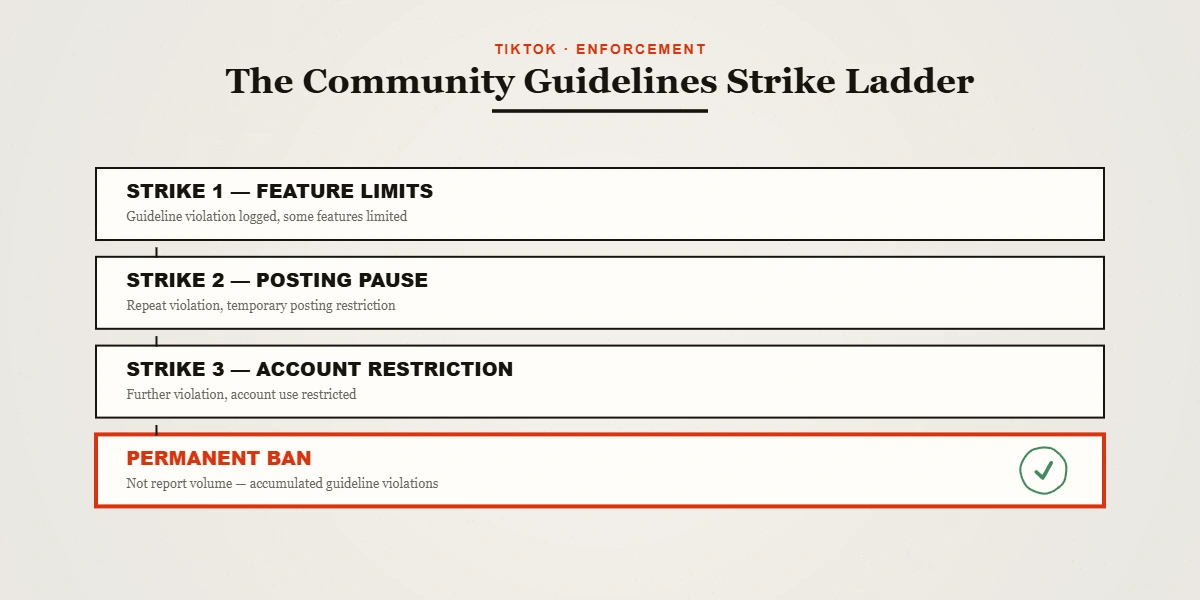
Tier one is a warning strike, usually paired with a short feature limit — the account cannot post, comment, or livestream for a period ranging from twenty-four hours to seven days. Tier two, a repeat violation within a rolling ninety-day window, extends those limits and can include a Direct Message suspension. Tier three is an account-level restriction: the account is placed under a permanent ban if a further violation is detected. The shortcut is a "zero-tolerance" violation — child safety content, terrorism, and violent extremism — where TikTok says a single detected instance results in a permanent ban with no strike ladder at all.
Two things follow. First, most of what a member of the public sees as "getting someone banned" is really strike accumulation over weeks or months, not a single report doing the whole job. Second, that ladder is what determines the answer to how to know if someone got banned on TikTok and how to tell if someone is banned on TikTok. There is no in-app "banned" notice for other users. What you see is the profile returning "This account was banned" or, more often, the profile URL simply loading a not-found page. We handle case evidence on our side under our privacy notice, because "was this account banned or did they change usernames?" is a real evidentiary question we get asked several times a week.
How to report someone on TikTok for a real violation
If the content is genuinely against the Community Guidelines, this is the correct route. The report is anonymous — the reported person cannot see who filed it. On the video, tap the arrow icon, then Report, then choose the category (Hate speech, Bullying and harassment, Nudity and sexual activity, and so on). Add a specific written description in the free-text box; reviewers weight that description heavily. On a comment, long-press it, choose Report, and pick the same category structure. On a Direct Message, open the conversation, tap the profile at the top, and choose Report. Our scope of engagement and fees covers when we take this on for a client — most of the time we file only when a legal or defamation ground is also in play.
How to ban someone on TikTok Live as a moderator
This is a different feature and it works the way the search implies. As the host of a live stream, tap the viewer's avatar or username during the broadcast and choose Block or Kick out. As a nominated moderator, you can do the same from the moderator toolbar during your host's stream. Neither action is an account-level ban — it removes the viewer from that room, and depending on your setting, blocks them from the host's future live streams.
How to ban someone from commenting on your TikTok
Under Settings and Privacy → Privacy → Comments, you can add specific usernames to a comment filter. Comments from those accounts are hidden from your videos by default. This is a private-to-your-account action, invisible to the blocked user.
If the real goal is stopping harmful content about you
This is where most cases we open at Obscura actually sit. Someone posted a video that names you falsely. An ex uploaded intimate footage. A competitor is running fake reviews on your business. An anonymous account is running a defamation campaign. The right question is not how do you ban someone on TikTok — it is how do I get this specific content removed from TikTok, and if it cannot be removed, how do I keep it off the first page of search.
There are four levers we use, in this rough order of speed. A Community Guidelines report under the correct category, with a written case attached, is the fastest lawful step for hate, harassment, and minor-safety content. A DMCA takedown notice, filed under the US Copyright Office's standard procedure at copyright.gov, is the route when you own copyright in something the video used — often a photograph or clip that has been re-uploaded without permission. A defamation letter through counsel is the route when the video makes a false statement of fact about a named person or business — we coordinate with media-law counsel on those. For non-consensual intimate images, the StopNCII.org hash-matching service and the US Take It Down Act (FTC enforcement began 19 May 2026) are the primary routes; we never ask a client to send the image. This is why we run an editorial takedown desk rather than a report-farm, and it is what our other takedown briefings return to again and again. The same honest reframe carries across platforms — our companion briefing on getting someone banned on Instagram walks the equivalent Meta routes end-to-end.
Bad-faith reporting: getting someone banned "for no reason"
Some of the searches in this cluster ask how to get someone banned on TikTok for no reason. The straightforward answer is you should not, and here is why it backfires. TikTok's reporter-integrity systems flag accounts that submit a run of reports found to be unsupported — the reports lose weight, and in aggravated cases the reporting account itself is limited. Filing a false Community Guidelines report is a breach of TikTok's terms. Filing a knowingly false DMCA notice is a federal offence under 17 U.S.C. § 512(f) that carries civil liability for damages and attorneys' fees. And forging a defamation letter without a real legal basis exposes the sender to a counter-claim. None of these are hypothetical. All of them are things we see clients discover the hard way after paying an outside "reputation" operator to run them — one of the reasons we do not touch this kind of work.
How to know if someone got banned on TikTok
There is no notification. What you look for is the profile URL returning a "banned" message or a 404, comments and videos from the account disappearing across other users' threads, and the account no longer being searchable by username. A banned account cannot be restored under the same handle, so if you see the same person posting again, it is a new account. In our practice as of July 2026, roughly one in four "banned" accounts we are asked to verify turn out to be self-deactivated or renamed rather than platform-banned.
That gap between "gone" and "banned" is small. It matters for anyone building a legal record — the two need different evidence, and only one is defensible in court.