What an "Instagram ban service" actually sells you
Type the phrase into Google and the first page is a strange split: a couple of paid "ban service" storefronts, a row of security-desk exposés from Avast, Vice and Kaspersky, and forum threads arguing over which seller is the bigger scam. That split is the whole story. Meta bans Instagram accounts; a stranger with a Telegram handle and a price list does not. When someone sells you an instagram ban service, they are selling one of three things: a report they were always able to file for free, a coordinated mass-report brigade, or an outright con.
The con is the one worth understanding. Reporters have documented the "ban-then-restore" scheme since 2021: an operator gets a target's account banned for roughly $5 to $60, then approaches that same victim offering to "restore" it for $1,500 to $4,000, with Vice's investigation laying out the two-stage economy in detail. The ban half tends to work by turning Instagram's own systems against the target: a fake verified-duplicate impersonation claim, or a false self-harm flag that trips an automated lock. You are not buying a secret Meta panel. You are buying the abuse of the same report forms sitting in everyone's app.
Our founder trained in media and defamation law before running takedowns full time, and the pattern at intake barely changes; across the enquiries that reached us through the first half of 2026 it held almost every time. The person asking for a "ban service" almost always has a real, removable problem underneath (an impersonator, a leaked photo, a defamatory post) that a correct filing resolves faster, and cheaper, than any brigade.
The "ban-as-a-service" market on Discord and Fiverr — and why it backfires
Search instagram ban service discord and you land on a different floor of the same building: Discord servers, Fiverr gigs, OwnedCore and elitepvpers threads, and throwaway profiles with names like @account_takedown. This is the retail end of ban as a service instagram — the same exploit as the high-priced con, sold cheaper and with far less pretence. Coordinate enough reports, or file one carefully faked impersonation or self-harm report, and gamble that Instagram's automation acts before a human looks.
Here is what the sellers never mention, and what no competing page states plainly: the buyer carries risk too. Coordinated reporting is itself a breach of Meta's rules on inauthentic behaviour, and enforcement increasingly lands on the reporting accounts rather than the target. Meta's own transparency reporting shows the large majority of enforcement now comes from proactive detection of precisely these patterns. Fund a brigade in your name and you have paid for a scheme that can rebound onto you. We have watched it happen: the client who bought a ban, then found their own account restricted a fortnight later.
None of this is what a legitimate firm does, and we say so directly in our disclaimer. We do not sell a pay-to-ban-anyone product, and we do not run report brigades for anyone, at any price.
What a legitimate takedown desk does instead
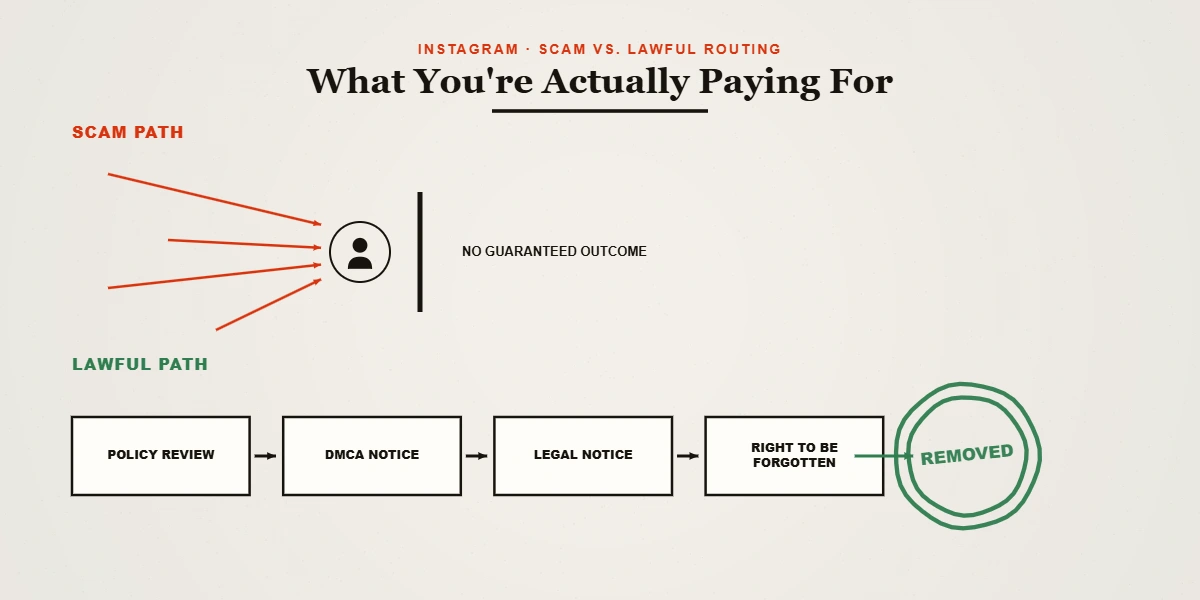
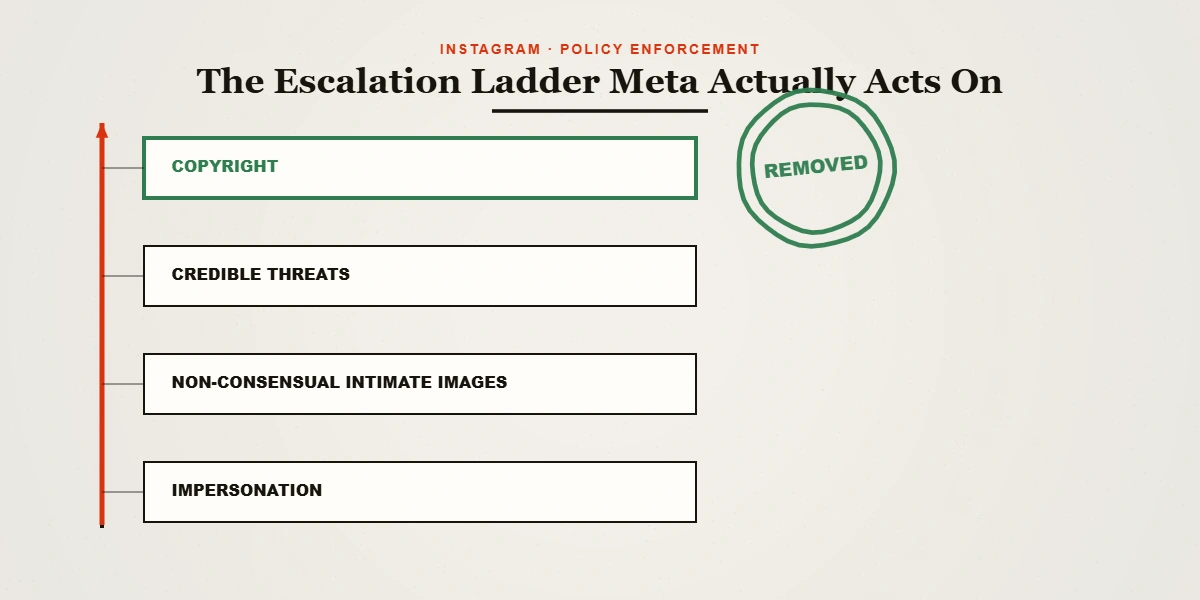
If the account you want gone is genuinely breaking the rules (impersonating you, threatening you, posting intimate images of you without consent), there is a lawful route that actually reaches Meta's enforcement, and it needs no seller. Instagram acts reliably on a short, specific list, and the filing has to match the violation exactly.
Four routes carry real weight. Impersonation of a real person or brand goes through Instagram's dedicated form, which accepts non-account-holders and, in our casework, converts fastest with a government ID attached. Non-consensual intimate images go through StopNCII.org, whose hash-matching blocks the specific image across Meta platforms without you ever sending the file to anyone; under-18 cases add NCMEC's Take It Down, and the US TAKE IT DOWN Act has imposed a 48-hour removal duty on covered platforms since 2025. Credible threats and doxxing go through the in-app harassment flow with screenshots, plus a police report where the threat is real-world. Copyright misuse goes through a DMCA notice under the US Copyright Office's procedure, where repeat confirmed strikes trigger Meta's permanent repeat-infringer ban.
That is what you actually pay a firm for: correct routing, clean evidence, and the patience to escalate — not a button. Our honest walkthrough of getting an account banned covers the report mechanics step by step, the TikTok equivalent tracks the same logic on a different platform, and our Twitter/X ban-service teardown applies it to X.
Is it illegal to pay for an Instagram ban service?
This is the question the exposés skip. They cover the seller's fraud and never the buyer's exposure. The honest answer, as general information rather than legal advice, is that paying to get an account banned sits in genuinely risky territory, and how risky depends on where you and the target are.
Three exposures stack up. Filing a knowingly false report breaches Instagram's terms and can get your own account actioned. If the "service" files a false DMCA takedown for you, US law makes a knowing material misrepresentation in a takedown notice actionable under 17 U.S.C. § 512(f), and real damages awards have followed. And funding coordinated account attacks can, depending on jurisdiction, brush against computer-misuse and harassment law. Layer the plain fraud risk on top, since most buyers of an instagram ban service simply lose their money, and the sums rarely favour the purchase. We keep a client's rationale and evidence on file for every legitimate report, precisely so bad faith is never in question. When a case is real, the lawful route is both safer and more durable; how we handle that evidence is set out in our privacy notice.
When a ban isn't the answer: removal versus suppression
Sometimes the account cannot be removed at all, and no service, honest or not, changes that. A real news organisation reporting a true fact, a critic voicing a protected opinion, a genuine public record: Meta will not ban these, and forging a notice to force it backfires. Bluffed takedowns get content reinstated, expose the sender, and hand the target a Streisand-effect spotlight worse than the original post.
When removal is off the table, the lawful lever is suppression: pushing the result down with authoritative owned content, or, for personal information, a search de-indexing request through Google's "Results about you" tool or a right-to-be-forgotten filing in the UK and EU. It is slower and quieter than a takedown, and it is honest about its ceiling. We tell you which one applies before you spend anything, and we never ask for your password or the intimate material itself. Those limits are not marketing lines; they live in our disclaimer and our scope-of-engagement terms.
Hiring honestly: what happens when you contact us
A confidential case review comes first, and it costs nothing. You describe what the account is doing (impersonation, harassment, a leaked image, fake reviews on your business) and we map the route that Meta and the law actually provide before any fee is mentioned. NCII cases jump the queue for urgent, free triage, and we will never ask you to send us the images.
If an account is impersonating you, threatening you, or sharing intimate images without consent, get a confidential case review. We do not bulk-report, we do not use bots, and we do not charge until a route is mapped.
What we will not do is promise a ban we cannot deliver, forge a notice, or sell you the pay-to-ban product this page has spent its length picking apart. For more of how we work across platforms, the takedown briefings hub collects our practice notes.