Instagram Spam Report Bot: Myth, Risk and the Real Route

An Instagram spam report bot promises to mass-report an account until it's banned, but no legitimate one exists — Instagram has no bulk-report tool by design, and automated report floods are flagged as coordinated inauthentic behaviour that can action the person running them, not the target. The phrase also covers a real, lawful need: reporting the spam-bot accounts swarming you, which you do through Instagram's own in-app report flow.

EW
An editorial press desk where an 'instagram spam report bot' advert is stamped unreliable beside Instagram's real in-app report flow.

What an "Instagram spam report bot" actually is

An Instagram spam report bot is advertised as software that fires a flood of spam reports at a chosen account until Instagram bans it. It is sold as open-source scripts on GitHub and on cut-price panels charging a few cents per report, and the pitch never changes: point it at a profile, let the volume do the work. It does not work the way the advert says, and the reason is structural. Instagram has never built a bulk-report button, for anyone, on purpose. Reporting is one account, one report, one review — a design choice, not an oversight, because a bulk button is exactly what an abuser would reach for first.

The phrase turns up in every word order a search box will take. Instagram report spam bot, instagram spam bot report, spam bot instagram report, spam report bot instagram, report spam bot instagram, and the ones that add a word or go plural: spam report instagram account bot, spam report instagram bot, report spam instagram bot, instagram spam reports bot, spam report instagram bots. They resolve to two very different questions. The first is offensive — can a bot spam-report someone else off the platform for you? The second is defensive — how do you report the spam bots swarming your own comments, DMs and followers? One is a myth that can rebound onto you. The other has a real answer. This briefing, written by our media-law-trained takedown lead, takes them in that order.
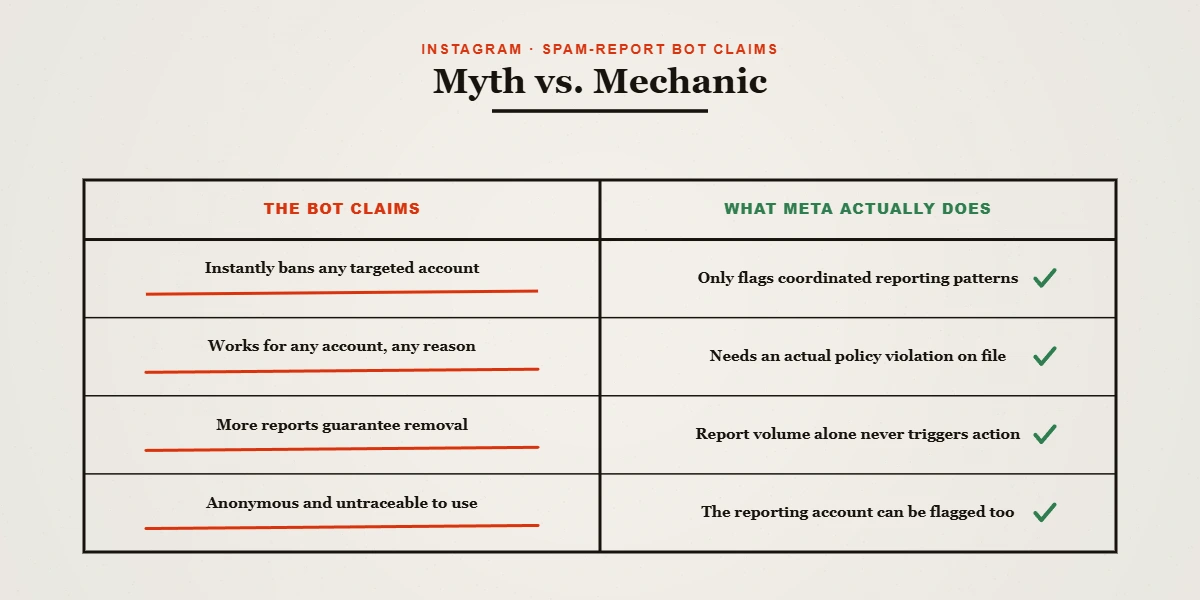
Broadsheet ledger contrasting what an instagram spam report bot claims against Meta's coordinated-inauthentic-behaviour system.

Report spam bot Instagram accounts: the route that works

Start with the defensive case, because it is the one this whole topic can actually solve. If bot accounts are the problem — mass follows from egg profiles, copy-paste scam comments, giveaway impersonators sliding into your DMs — Instagram gives you a genuine report flow, and it is the single route here that reliably does something. The path below is current as of July 2026.

  1. Open the offending profile, tap the three-dot menu, choose Report, then "It's a bot or fake account" or "Spam".
  2. For a scam comment, long-press it, tap the exclamation icon, and report or delete it. For a DM, open the thread, tap the sender's name at the top, and report from there.
  3. To clear a wave of bot followers, remove them from your profile (their account → three dots → "Remove follower"), or switch to a private account so every future follow needs your approval.
  4. Turn on the standing filters. Settings → Privacy → Hidden Words, enable advanced comment filtering, and add the scam phrases the bots keep reusing so they auto-hide before you ever see them.

No legitimate app bulk-reports these for you, and you do not need one. Meta's own abuse and spam reporting pages run the identical flow, and the platform's automated systems act on the underlying pattern — the network of fake accounts behind a spam wave — far more than on any one report you file. When we clear bot swarms off a client's business account, the standing filters do more lasting work than the individual reports; they stop the next wave, not just this one.
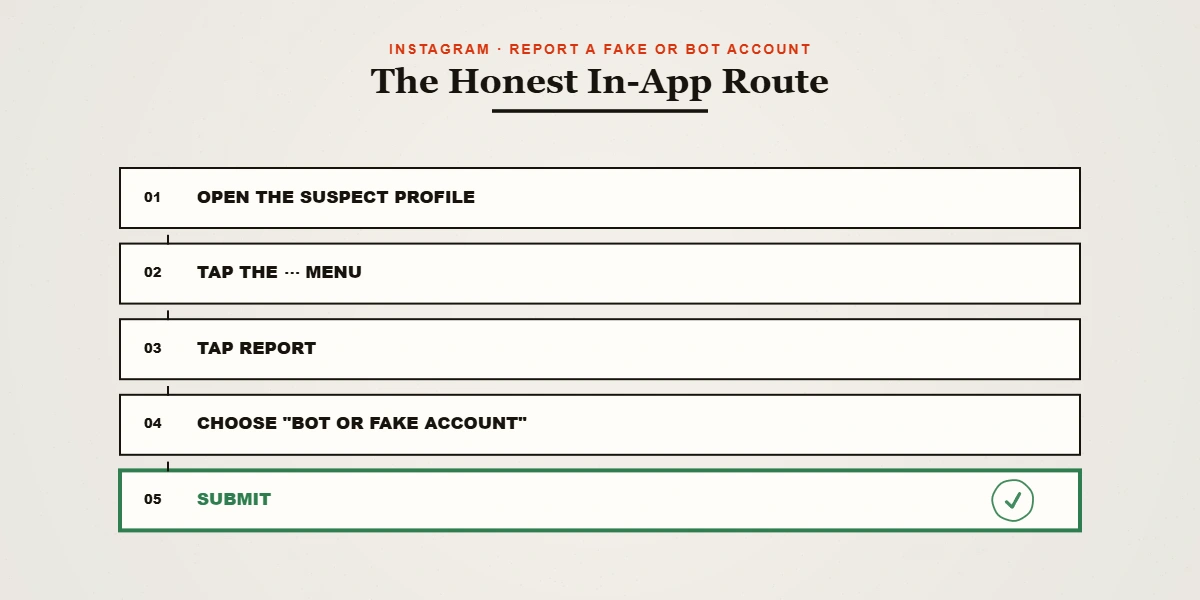
Step-ladder diagram of the honest in-app route to report spam bot Instagram accounts, from profile menu to submitted report.

Is there really a bot that spam-reports an account for you?

Now the offensive version, which is what most searches for an instagram spam report bot are really after. Can you buy a bot that reports a target enough times to get it banned? No — and not because the tools do not exist, but because the model they are sold on is wrong. Report volume is not a vote. Instagram queues reported content for review and acts only if a reviewer, or a classifier, finds that it breaks the Community Guidelines. Fifty reports against a post that breaks no rule get the post nothing. One report against a genuine violation gets it reviewed. The number was never the lever.

There is a second, quieter problem. Automating reports breaches Instagram's Terms of Use, which prohibit accessing the service through unauthorised automated means. The scripts on GitHub and the panels charging by the report are not a grey area; they are the behaviour the rule names. And they leave a fingerprint — bursts of near-identical reports from low-trust or throwaway accounts — that Meta's inauthentic-behaviour enforcement is built specifically to detect. Meta's Community Standards Enforcement reporting shows the large majority of action against fake and spam accounts on Instagram comes from proactive detection before a single user reports anything (Meta Transparency Center, 2026). The market selling the opposite — a button that bans on demand — is the same one we took apart in what an Instagram ban service actually sells you: resold free reports, brigades, and the occasional outright con. A price of a few cents per report is not a bargain. It is the tell.

Why a spam-report bot backfires on the person running it

Here is the part the sellers leave out, and the reason we will not touch this work. Coordinated reporting is itself a policy violation, and enforcement increasingly lands on the accounts doing the reporting rather than on the account they targeted. Run a bot in your own name, or pay someone to run one linked to you, and you have funded a scheme Meta's systems read as the abuse — not the defence. The boomerang is not a rare edge case; it is the designed response to the exact pattern a report bot produces.
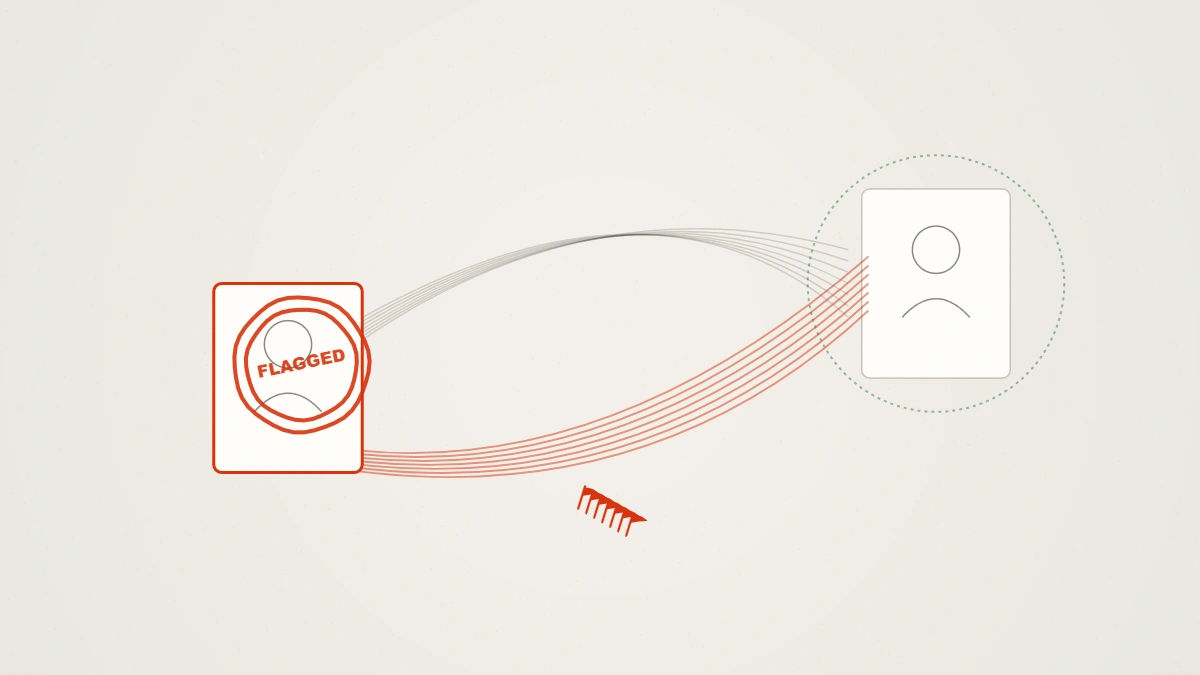
Conceptual illustration of a spam report bot Instagram brigade boomeranging its report requests back to flag the reporter's own account.

When we are asked at intake to look at a stalled "ban campaign", the picture is almost always the same: the target is still posting, and the client's own account has picked up a restriction or a warning it cannot explain. Across the enquiries that reached us in the first half of 2026, the person who paid for a bot was more often the one left worse off. We say plainly in our disclaimer that we do not run report brigades or bots for anyone, at any price. The honest alternative — the report categories Meta acts on, without bots — takes longer to describe and works faster in practice.

What to do when a spam-report bot is aimed at you

The traffic for this keyword is not all attackers. A large share is people on the receiving end: a rival business, an ex, a harassment ring that bought a cheap "ban service" and pointed automated reports at an account until Instagram restricted it. If that is you, three things matter, in order.

First, appeal in-app immediately. The window is short, and reinstatement odds drop with every day the action sits unchallenged. Second, preserve evidence that the reports were coordinated and false: screenshots of the reporting accounts where you can see them, timestamps, any advert or chat where the brigade was organised or sold. Third, understand that being the target of a manufactured report campaign is not only a platform problem — it can be actionable. A knowingly false DMCA notice used to trip a takedown is a misrepresentation under 17 U.S.C. § 512(f), which US courts have awarded real damages on. A sustained false-report campaign can amount to harassment, and where it travels with false statements about you, to defamation. That overlap — a bot attack carrying a smear — is squarely our casework, not a platform ticket.

If a spam-report bot or a bought "ban service" has been aimed at your account, or someone is impersonating you, threatening you, or sharing intimate images without consent, get a confidential case review. We map the lawful route before any fee is named, and we never ask for your password or the material itself.

When the account can't be removed at all

Sometimes the account you want gone is breaking no rule. A true report of a real fact, a critic's protected opinion, a genuine public record: no report and no bot takes those down, and forging a notice to force it backfires. A bluffed takedown gets the content reinstated, exposes the sender, and hands the target a Streisand-effect spotlight worse than the original post. We will not file a report we do not believe to be true, and for non-consensual intimate images we never ask you to send the material — the StopNCII.org hash-matching service blocks the specific image without a human viewing your file.

When removal is off the table, the honest lever is suppression: pushing the result down with authoritative owned content, or, for personal information, a de-indexing request through Google's "Results about you" tool or a right-to-be-forgotten filing in the UK and EU. It is slower and quieter than a takedown, and it is honest about its ceiling. Which lever fits depends on what the account actually posted. How we handle your case evidence is set out in our privacy notice, and our scope-of-engagement terms cover the lawful-use side of the work.

The same pattern on every other platform

The mechanics travel. Mass-reporting does not force a ban on TikTok either, where the strike ladder is the platform's alone to run; our TikTok briefing walks the equivalent route. The "ban for hire" market on X sells the same three products under a bluer logo, and our Twitter ban-service teardown takes it apart. Across all of them the honest answer holds: report the genuine violation cleanly, use the law where the harm is defamation or a privacy breach, and suppress what cannot lawfully be removed. For more of how we work, the takedown briefings hub collects our practice notes; when a real account is causing you real harm, bring it to our desk.

Straight answers

No. No legitimate Instagram spam report bot can ban an account to order, and the tools advertised as one — whether marketed as an instagram spam report bot or an instagram spam reports bot — cannot deliver what they promise. Instagram alone decides account-level enforcement, using automated classifiers and human review against its Community Guidelines, and there is no bulk-report button anywhere in the app for a bot to automate. Report volume is not a threshold that unlocks a ban; a report queues content for review, and action follows only if that review finds a genuine violation. Fifty automated reports against a post that breaks no rule achieve nothing. One clean report against a real violation gets it reviewed. Anything charging a few cents per report is selling either a script that breaches Instagram's terms or an outright con, and neither buys you the outcome on the label.

To report spam bot Instagram accounts, open the profile, tap the three-dot menu, choose Report, then select "It's a bot or fake account" or "Spam". To report spam instagram bot comments, long-press the comment, tap the exclamation icon, and report or delete it; for a bot in your DMs, open the thread, tap the sender's name, and report from there. If spam report instagram bots are following you in waves, remove them from your follower list or switch to a private account so future follows need approval, and turn on Hidden Words under Settings then Privacy to auto-hide the scam phrases they reuse. There is no legitimate app that bulk-reports them for you, and you do not need one — Instagram's automated systems act on the network behind a spam wave far more than on any single report, so clean reporting plus standing filters is the durable fix.

Yes, that is the real risk almost no seller mentions. Running an instagram report spam bot — or any instagram spam bot report tool — means automating reports, which breaches Instagram's Terms of Use on unauthorised automated access. Worse, a spam bot instagram report burst leaves exactly the fingerprint Meta's coordinated-inauthentic-behaviour systems are built to catch: clusters of near-identical reports from low-trust or throwaway accounts. Enforcement increasingly lands on the accounts doing the reporting rather than on the target, so the person most reliably harmed by a report bot is often the one running it. At intake we frequently see the pattern: the target is still posting, and the client's own account has picked up a restriction. If someone else is selling to run the bot on your behalf and in your name, that exposure attaches to you, not to them. The honest report routes carry none of this risk.

Using a spam report bot instagram tool is not usually a criminal act in itself, but it stacks up real exposure, and this is general information rather than legal advice. Filing a spam report instagram bot flood breaches Instagram's terms and can get your own account actioned. If the automation manufactures a takedown with a knowingly false DMCA notice, that is a misrepresentation under 17 U.S.C. § 512(f), and US courts have awarded damages and legal costs for it. A sustained false-report campaign against a named person or business can also shade into harassment or, where it carries false statements, defamation, depending on the jurisdictions involved. Layer the plain fraud risk on top — most buyers of these tools simply lose their money — and the arithmetic rarely favours it. When a real violation exists, filing it correctly is safer, cheaper, and far more likely to stick than paying for a bot that breaks the rules on your behalf.

There is no fixed number, and nobody selling a threshold has seen Instagram's review logic. Instagram's position is that reports do not trigger automatic action: a report routes content for review, and removal follows only if that review confirms a Community Guidelines breach. For genuine spam bots, most enforcement never depends on your report at all — Meta's Community Standards Enforcement reporting shows the large majority of action against fake and spam accounts comes from proactive detection before anyone files. So the honest answer to "how many reports" is that count is the wrong metric. One accurate report that names the specific behaviour — bot follows, copy-paste scam links, impersonation — carries more weight than a hundred vague ones, and a coordinated burst designed to hit a number tends to lose weight rather than gain it. If a genuine spam-bot network is targeting you, report it cleanly once and let the platform's own detection do the heavier work.

If a spam report instagram account bot has been aimed at you and your account was restricted, act in this order. First, appeal in-app immediately — the window is short and reinstatement odds fall with every day the action goes unchallenged. Second, preserve evidence that the reports were coordinated and false: screenshots of the reporting accounts, timestamps, and any advert or chat where the brigade was organised or sold. Third, treat it as more than a platform problem, because it can be actionable: a knowingly false DMCA notice is a misrepresentation under 17 U.S.C. § 512(f), and a sustained false-report campaign can amount to harassment or, where it carries false claims about you, defamation. This overlap — an automated attack paired with a smear — is our core casework rather than a support ticket. We map the lawful route before any fee, and we never ask for your password or the material behind the case.

A few reliable tells separate a spam bot from a real person. Bot accounts usually have no profile photo or a stolen stock one, a handle padded with random numbers, a near-empty or scraped feed, and a follower-to-following ratio that is wildly lopsided. Their engagement is generic and repetitive — the same emoji string, the same "check my page" comment, the same giveaway or crypto link dropped across many posts within seconds. Real accounts vary; bots do not. Checking matters because reporting a genuine account as spam in a spam bot instagram report is itself a false report, and a run of those can cost your own account credibility with Instagram's systems. When you are confident it is a bot, use the in-app "It's a bot or fake account" report reason rather than a generic one, since the specific category routes the account into the right review queue and feeds the fake-account detection that clears the wider network behind it.

EW

Eleanor Whitfield

Media-law-trained content removal lead who routes each case to the fastest lawful path — platform policy, DMCA, or defamation counsel.

Related briefings

How to Get Someone Banned on Instagram Without Bots

To get someone banned on Instagram you file the specific reports Meta actually acts on — impersonation, harassment, non-consensual intimate images, credible threats, or copyright — via the in-app menu or the dedicated form for your case. There is no fixed report count, no user-invokable IP ban, and no legitimate mass-report bot. A single well-evidenced report from a genuine victim outperforms a hundred noisy ones, and coordinated brigades often get the reporters actioned instead of the target.

Instagram Ban Service: What You're Actually Buying

An "Instagram ban service" that promises to ban any account to order does not legitimately exist. Meta issues account bans, not a seller you pay, and the versions sold on Discord or Fiverr are mass-report scams or the ban-then-restore con documented since 2021. What a genuine takedown firm buys you is different: the specific evidenced reports Meta acts on — impersonation, non-consensual images, threats, copyright — plus lawful removal or suppression when reporting won't.

How to Get Someone Banned on TikTok: The Honest Answer

You cannot actually get someone banned on TikTok — account bans are algorithmic strikes issued by TikTok itself, not something any outside user can trigger on demand. A Community Guidelines report flags a specific violation for review, but volume alone does not decide the outcome. If your real goal is stopping harmful content about you, the lawful levers are removal notices — DMCA, defamation, NCII takedowns under the Take It Down Act.

Send us the link. We'll tell you honestly whether it comes down.

Every case starts with a private review: we look at the content, tell you which route can work — platform policy, DMCA, legal notice, right to be forgotten, or suppression — and give you a plain assessment before any commitment.