What an Instagram account takedown actually is
Start with the word, because it settles everything that follows. An Instagram account takedown is the removal of an account, or a specific post on it, by Meta, after a report or a legal notice matches something the platform already enforces against. It is a decision Meta makes on the content. It is not a product a stranger sells you. Typed the other way round, as takedown instagram account, the query means the same thing and returns the same short list of legitimate routes.
I run the search-and-suppression side at Obscura, which means I meet most of these cases from the far end: after the report, when a client wants to know why the account is still up or why its posts keep surfacing somewhere else. So this guide, written with our takedown desk, starts from what genuinely reaches Meta's enforcement, then covers the part almost every other guide drops: what to do when the official route stalls, or never applied in the first place.
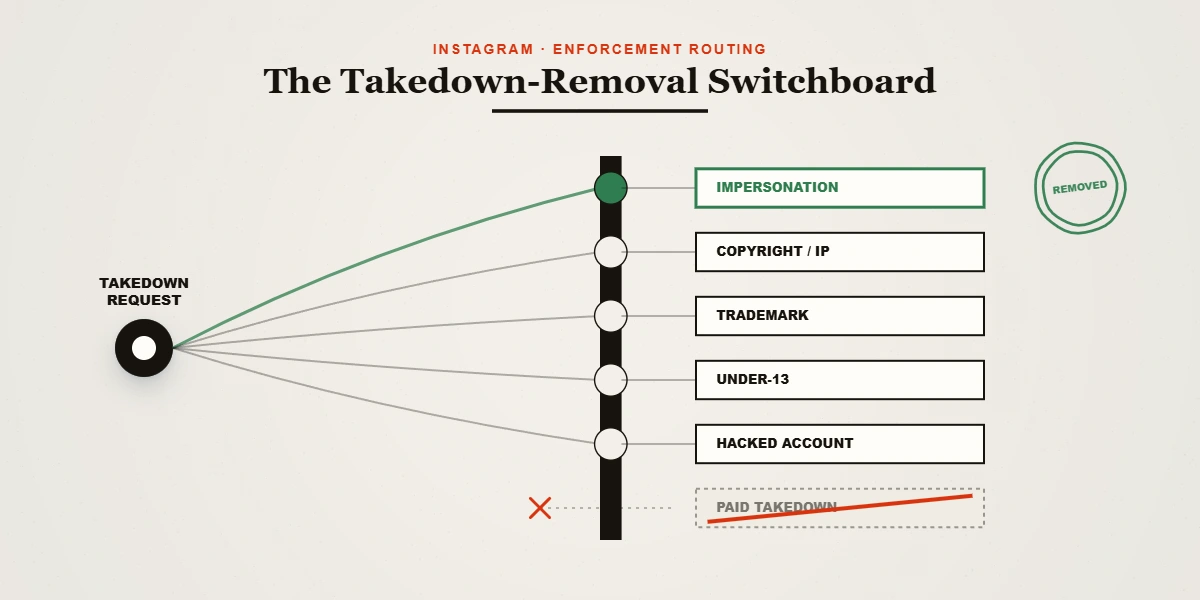
Five routes reach Meta's enforcement with any reliability, and each carries its own form, its own evidence bar, and its own queue. Impersonation of a real person or brand. Copyright infringement. Trademark misuse. Non-consensual intimate imagery. And content Meta's own classifiers already flag, such as credible threats or coordinated harassment. Everything outside that list sits in a general queue where volume changes nothing. The report routes Meta actually acts on are laid out in our companion briefing on getting an account banned; the switchboard below is the short version.
Removed, or only suppressed? What "taken down" really means
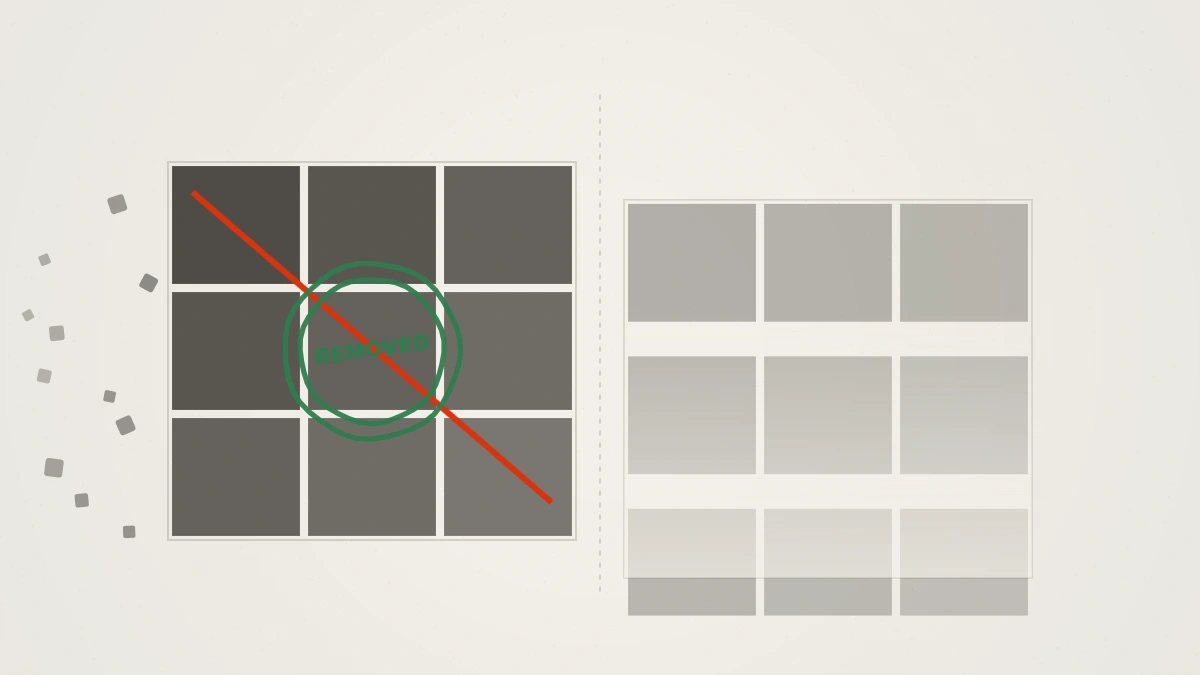
Here is the distinction that decides whether a takedown will ever satisfy you, and the one no paid advert mentions. "Taken down" splits into two very different outcomes. Removal means the account or post is gone from Instagram, deleted at the source, returning a "page isn't available" state to everyone. Suppression means it still exists but stops surfacing: de-indexed from Google, pushed down under other results, quietly buried. To a frightened searcher they feel the same. They are not the same remedy, they run on different timelines, and only one is available for any given problem.
Which one you get is not a preference you set. It is fixed by what the content is. If an account impersonates you or posts an intimate image without consent, removal is on the table, because Meta enforces against both. If the "harm" is a true news report, a genuine public record, or a critic's protected opinion, removal is not available at all. Meta will not act, and no notice forces it. There the only lawful lever is suppression, and how we handle your evidence either way is set out in our privacy notice.
The part clients underestimate is persistence. In my casework as of July 2026, the account coming down is rarely the end of the story. Screenshots were taken. The post was quote-reposted onto other timelines. Google cached the profile and a scraper archived it. Instagram hands you no tool that reaches any of that, so a takedown can remove the account and still leave the claim alive three clicks away. That gap is where the search-side work begins.
What the "ban service" and Reddit threads actually tell you
Search around the takedown question long enough and you hit the other market, the paid one. An instagram ban service, an instagram banning service, a ban service instagram gig on a forum: the wording rotates, the offer does not. These promise to take an account down for a fee, and they are a different animal from the routes above. We took that market apart in full in what you are actually buying from an Instagram ban service; the short version belongs here, because the searches overlap so heavily.
No instagram ban services can remove an account to order. Meta decides bans; a seller does not. The fee buys one of three things: a report you could file yourself for free, a coordinated brigade Meta's systems are built to catch, or the ban-then-restore con that security reporters have tracked since 2021, in which a roughly $60 ban is followed by a four-figure "restore" offer aimed at the same victim (Vice, 2021). The same script runs elsewhere. The ban-for-hire market on X sells the identical products under a bluer logo.
How do Instagram ban-for-service operations work?
People search how do Instagram ban for service work expecting a hidden panel. There is none. An instagram account ban service, or an instagram account banning service as some relabel it, works by abusing the same report forms sitting in everyone's app: a faked impersonation claim, or a false self-harm flag that trips an automated lock before a human looks. Because the method leans on volume and timing, it leaves the exact fingerprint Meta's coordinated-inauthentic-behaviour detection is tuned to flag, which is why report floods tend to hit the reporter instead of the target.
What "instagram ban service reddit" threads really say
Look up instagram ban service reddit and the discussion, where Google surfaces it at all, lands where the evidence does: threads full of people who paid and got nothing, or who watched their own account get restricted a fortnight later. Treating ban as a service instagram as a purchase is usually the tell that a real, removable problem underneath, an impersonator or a leaked photo, is being routed to the worst possible fix. Our scope-of-engagement terms rule out running brigades for anyone, at any price.
If an account is impersonating you, threatening you, or sharing intimate images without consent, get a confidential case review. We map the lawful route before any fee is named, we never ask for your password, and NCII cases jump the queue for urgent, free triage.
When the report is rejected: the escalation layer
Most guides end at "file the report". The cases that reach me start where that sentence stops, when the report came back rejected or the harm never fit a Meta category to begin with. This is the escalation layer, and it is what a legitimate takedown partner is genuinely for.
Three moves live here. First, re-scope the complaint: a rejected "harassment" report is sometimes a valid impersonation or copyright claim wearing the wrong label, and the correct Instagram impersonation form with government ID attached converts where a generic report stalled. Second, where you own the photo or video the account reused, a copyright takedown under the US Copyright Office's DMCA procedure reaches Meta's repeat-infringer policy, which removes accounts that collect confirmed strikes. Third, and this is the lever the platform forms never touch, when the content is defamatory rather than policy-breaking, or the account is gone but the search result is not, the work moves to search: de-indexing the URL for your name, and in the UK and EU a right-to-be-forgotten filing under the ICO's right to erasure.
When I pull a de-indexing request after an account is removed, the reposts and the screenshots are what remain. The account dies; the claim does not. Closing that gap is most of what I do, and it is honest about its ceiling: de-indexing hides a result from search, it does not erase the underlying page. That trade-off is the whole reason we scope a case before quoting it.
How long a takedown takes, and why nothing is guaranteed
There is no fixed clock, and anyone quoting one to the hour is guessing. What I can give you is observed range. Non-consensual intimate imagery filed through StopNCII.org, which hash-matches the image and blocks it across Meta platforms without a human ever viewing your file, is the fastest lever we hold, often same-day. Impersonation with ID attached tends to resolve in a few days in our casework as of July 2026. Copyright claims run longer, and anything defamation-based is a matter of weeks, because it leaves the platform for a legal process.
Volume shortens none of this, and that is the point most searchers arrive with backwards. Meta's own Community Standards Enforcement reporting shows the large majority of action on Instagram now comes from proactive detection before any user reports anything (Meta Transparency Center, 2026). Report count is a signal weighted by reporter trust, not a threshold you cross. Fifty filings on content that breaks no rule get you nothing; one clean, correctly categorised report on a genuine violation gets it reviewed.
So no honest desk promises removal. We promise the correct route, clean evidence, and the patience to escalate, and we say plainly when the honest answer is suppression rather than removal. A "100% guaranteed takedown" is the single clearest sign you are talking to the wrong operator.
What can't be taken down at all
Some accounts will not come down, and no service, honest or otherwise, changes that. A true report from a real newsroom, a genuine public record, a critic voicing a protected opinion: Meta does not remove these, and forging a notice to force it backfires in a specific and expensive way. A bluffed DMCA gets the content reinstated and exposes the sender, because a knowing misrepresentation in a US takedown notice is actionable under 17 U.S.C. § 512(f), and courts have awarded real damages for it. Worse, the attempt hands the target a Streisand-effect spotlight brighter than the post you wanted gone.
We will not file a notice we do not believe to be true, we never request your password, and we never ask you to send the intimate material itself. Those are not marketing lines; they live in our disclaimer, because a takedown practice that bluffs is one lawsuit from closing. When removal is genuinely off the table, the honest lever is the search-side one, suppression and de-indexing, and we tell you which applies before you spend anything.
If you are not sure which side of that line your case sits on, that is the normal place to start, not a reason to wait. The account attacking you is often removable; the true-but-painful article beside it often is not. Separating the two is the first thing we do.
If the account is attacking you: where to start
The searches behind this page split cleanly at the end. Some readers want to take down an account that is genuinely harming them. Some arrived hoping to buy a ban and are, quietly, better served by not. For the first group the path is a confidential review that maps route to harm before any fee: impersonation to the impersonation form, a stolen photo to a DMCA notice, a defamatory claim to counsel, an intimate image to urgent free triage. A business facing fake reviews or a cloned brand account gets the same routing with a commercial escalation on top.
The mechanics travel across platforms, which is why our practice notes keep circling the same honest reframe. How TikTok account takedowns really work walks the equivalent on ByteDance's strike model, and the rest of our takedown briefings apply it case by case. What holds everywhere: report the genuine violation cleanly, use the law where the harm is defamation or a privacy breach, and suppress what cannot lawfully be removed.
If an Instagram account is impersonating you, threatening you, or leaking your images, start an Instagram account takedown with our desk. No bots, no brigades, and no charge until a route is mapped.