LinkedIn stops most fake accounts before anybody reports them
Between 1 July and 31 December 2025, automated defences blocked 97.8 per cent of the fake accounts LinkedIn stopped, and 99.7 per cent were caught proactively, before any member reported them (LinkedIn Community Report).
Read that the right way round. The filters are not your obstacle.
What matters is the residue. A fake profile still standing when you discover it has already cleared automated screening, and that tells you how it was built: a plausible employment history, an unremarkable stolen headshot, a few hundred connections harvested from your own industry. Nothing statistically strange. Nothing for a classifier to grab. By the time a human reviewer opens your report, that account has survived the part of the system that removes almost everything else.
So your report has a harder job than most guides admit. It has to let a reviewer decide, in a single pass, which of two similar-looking professionals is the genuine one — and that is an evidence problem rather than an outrage problem.
It is certainly not a volume problem. Asking a dozen colleagues to pile onto the same profile achieves nothing that one accurate report has not already achieved, and the same pattern holds on every platform we file against. LinkedIn measures the profile against its Professional Community Policies, which state plainly: "We don't allow fake profiles or entities" (LinkedIn). Either the profile breaches that rule or it does not. A crowd does not move the answer.
One thing does separate the professional network from Instagram or TikTok, and it is worth naming early. Elsewhere, a clone costs you reputation. Here it usually costs money, because the purpose of a cloned executive profile is to open conversations with your suppliers, your candidates and your customers while wearing your job title. That is why these cases carry commercial deadlines a personal impersonation does not, and why the first afternoon matters more than the first fortnight.
Which LinkedIn takedown request fits your case?
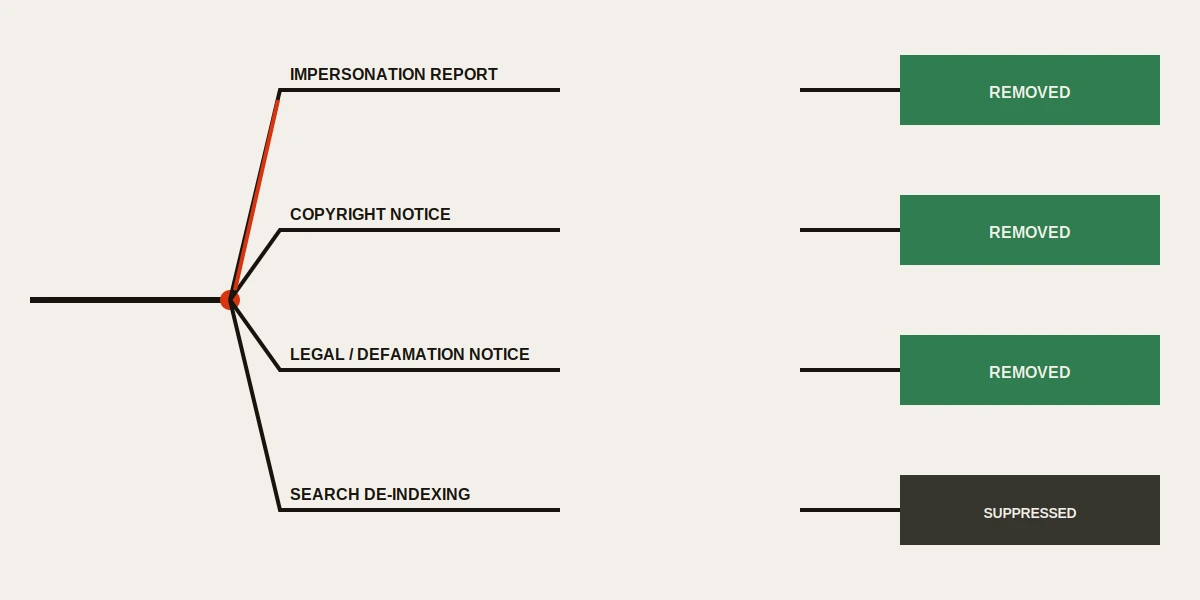
A LinkedIn takedown request is a category of document, not a button. Four channels reach LinkedIn and a fifth reaches Google instead. They carry different evidence bars, and choosing the wrong one is the most common reason a case sits unresolved for months.
| Route | Use it when | Where it goes | What it needs |
|---|---|---|---|
| Impersonation or fake-profile report | A profile is pretending to be you, or is not a real person | In-app More → Report / Block | Both profile URLs, and which is authentic |
| Copyright notice | The profile is using your photographs, writing or design | Form TS-NCI | Ownership proof, sworn statement |
| Trademark notice | A profile or page misuses your brand name or logo | Form TS-NTMI | Registration details, infringing URL |
| Defamation notice | Content states false facts about you | Form ts-ndc | Usually a court order in the US |
| Search de-indexing | The content stays up, but must stop ranking on your name | Search-engine removal request | The URL and a privacy or legal basis |
The three form codes come from LinkedIn's own notice page (LinkedIn Help).
Standing decides your row before wording does. Ask what you are to the content — the impersonated person, the copyright owner, the trademark holder, the person defamed, or a bystander who can simply see the profile is fabricated. The bystander holds the weakest hand, although the "not a real person" report is genuinely open to anyone. That same test governs the five instruments that reach X, and it explains why two people reporting one profile can get opposite outcomes.
Notice what the table has no row for. Not "my competitor is winning". Not "this post is unfair to me". And no row anywhere that a payment can accelerate.
There is a fifth option that people skip because it feels like surrender. LinkedIn's own guidance suggests approaching the poster directly first, calling it "often more productive" than a notice. Between two real professionals with a genuine disagreement, that is not a fob-off — it is frequently the fastest route available, and it costs nothing but a drafted message.
How to report a fake LinkedIn profile so the report sticks
The in-app path is short. Following it precisely matters more than anything you write inside it.
Open the profile, click More, then Report / Block, then Report [member's name] or entire account. Choose either "This person is impersonating someone" or "This account is not a real person", and submit (LinkedIn Help). LinkedIn keeps your identity confidential from the person you report.
Those two options are not interchangeable, and picking between them is the most consequential click in the process.
Remove fake LinkedIn account, or report the profile? They are different asks
People search remove fake LinkedIn account when they mean two quite different things, and the gap between them costs weeks.
A profile that invented a person outright — no real human behind it, a generated face, a fabricated employer — is an authenticity case. Report it as not a real person. Nobody's identity is being stolen, so no identity evidence exists to supply, and the reviewer is judging fabrication signals alone.
A profile that copied you is an impersonation case, and everything changes. Now the reviewer is holding two accounts that claim one identity, and the only question that matters is which came first and which is real. Report it as impersonation, from your own account, and give them the pair: the clone's URL and yours, side by side, with a flat statement of which is which. Not a paragraph of understandable anger. A comparison.
That distinction is the same one that decides whether a Facebook impersonation report converts or stalls, and Meta and LinkedIn both fail the same way when it is fudged.
LinkedIn impersonation removal when the clone is working your contacts
Speed is doing different work here than it does elsewhere. A cloned profile that sits idle is a nuisance. A cloned profile sending connection requests to your client list is an active fraud with your name on it, and the damage compounds every hour it stays up.
Preserve before you file. Full-page screenshots with the URL and timestamp visible, the profile identifier, the date you first saw it, and screenshots of any message the clone has sent to somebody you know. Fake profiles get deleted by their operators mid-case with real regularity, and your screenshots are frequently the only surviving record of what was sent.
Then warn your network in parallel with reporting, not after it. A short post from your real account, saying a clone exists and that you will never ask for payment or credentials through LinkedIn, blunts the fraud while the report is still in a queue. It also creates dated evidence that you acted, which matters if a contact loses money and asks what you did about it.
A practitioner note. In our records, the impersonation reports that resolve fastest are the ones where the reviewer never has to guess. Two URLs, a one-line statement of which is authentic, and a screenshot of the clone messaging a third party will do more than three paragraphs explaining how upsetting it is. We say this bluntly because the emotional version is the natural one to write, and it is the version that gets a templated reply.
Is a LinkedIn ban service a real thing?
No, and the phrase is worth taking apart, because two very different people search it.
The first has been cloned or defamed and wants the offending account gone. That is a legitimate takedown, it runs through the routes above, and the word "ban" is just the wrong label for it.
The second wants a rival, a critic or an ex-colleague removed from the platform. There is no product that does this. LinkedIn has no paid third-party mechanism to terminate an account on request, and nothing sold as a LinkedIn ban service can create one. What such operations actually sell is coordinated reporting, which does not work against a profile that breaks no policy, and which breaches LinkedIn's own terms in a way that puts the reporting accounts at risk rather than the target. We have documented the identical trade on X and on YouTube, where reports do not terminate channels at all.
Say the harder half plainly: we do not take accounts down as a hired attack. If the profile you want removed is impersonating you, defaming you, or infringing your rights, that is our work. If it simply belongs to someone you would rather were not there, we are not the right firm, and pursuing it exposes you to claims of harassment or tortious interference that cost more than the grievance.
What an honest LinkedIn takedown service puts on the invoice
A real LinkedIn takedown service is being paid for routing, evidence and escalation — not for access nobody has. That means identifying which of the five routes actually fits, assembling the evidence pack in the form a reviewer can act on at first read, filing, tracking, and escalating properly when the first response is templated. Where removal is genuinely unavailable, it means saying so before an invoice exists rather than after. Prices in this market vary wildly for the same work, something we broke down with real figures in our teardown of ban-service pricing.
If a clone is already messaging your contacts, or a report has come back templated once, the filing is no longer the whole job. Ask us for a confidential case review — we map the route before you pay anything, we never ask for your password, and we will tell you plainly when reporting is all you actually need.
LinkedIn defamation removal runs into a court order
This is where honest advice separates from marketing, so here is LinkedIn's own position rather than ours.
LinkedIn states that "in some countries, including the United States, we generally require a court order before removing content on defamation grounds", and goes further: "in many cases (including in the United States) we are unable to act on defamation notices" (LinkedIn Help). Form ts-ndc exists, and it is the correct form. It is also, for a US-hosted claim without a judgment behind it, frequently a form that returns a decline.
That reality reshapes LinkedIn defamation removal into a sequencing problem. Before reaching for the defamation label, check whether the post independently breaches a policy you can already enforce. Targeted personal attacks, intimidation and abusive language directed at a member fall under LinkedIn's harassment rule — "We don't allow bullying or harassment", the policy says — and a harassment report needs no court and no solicitor. A great many posts that feel defamatory are removable on that ground alone, and the policy route resolves in days where the legal route resolves in months.
Where the statement is genuinely a false assertion of fact and the harm is commercial, the instrument is a solicitor's letter, and the value of the process is not only removal. Our team's credentials and the way we route these cases are set out on our about page, because on a claim of this kind you are entitled to know who is handling it.
The UK and European lane that does not need a court
If you are in the UK or the EU, you hold something a US claimant does not. Where the material is inaccurate personal data about you, the right to erasure can be exercised against the publisher, and separately against search engines, through Google's dedicated European privacy removal form (Google). Search de-indexing does not delete the LinkedIn page. It removes it from results for your name, which is where almost all of the actual harm lands.
Tomás, who runs this side of our desk, puts it in a way clients find clarifying: removal is about the page, de-indexing is about the search for you, and most people arrive asking for the first when the second is what they actually need. The right to erasure is qualified rather than absolute — it yields to journalism and to public interest — but for a false claim about a private professional it is a genuine lever, and it does not require anybody's permission to try.
What no LinkedIn takedown reaches
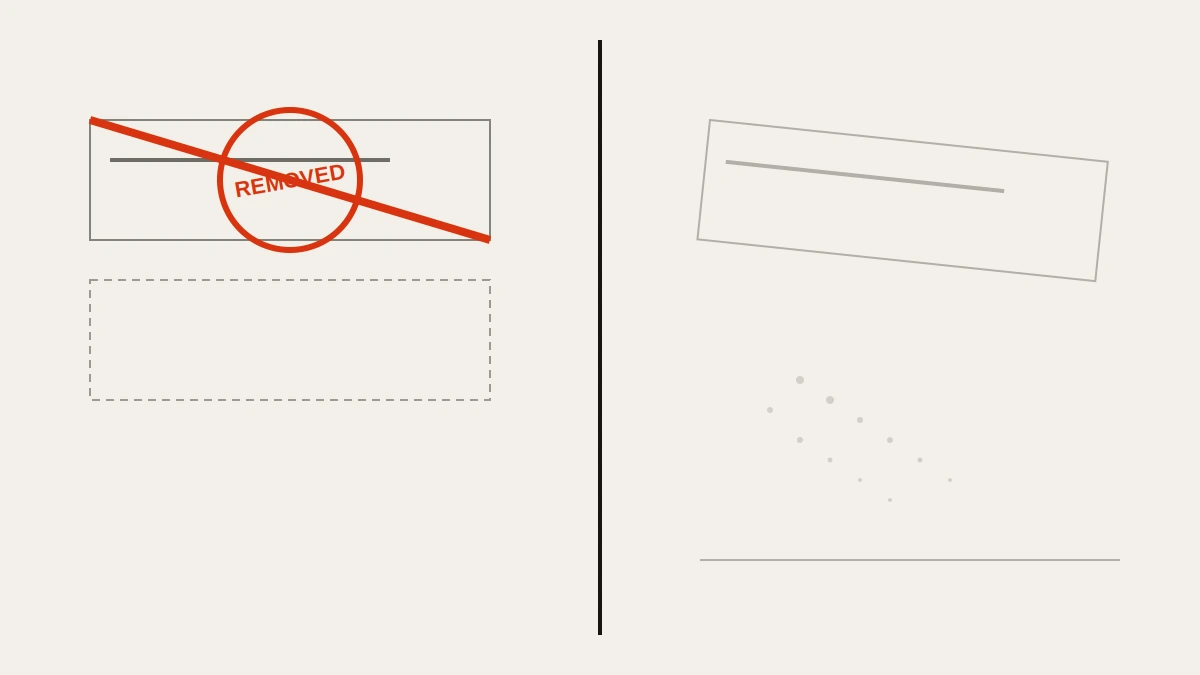
Some things do not come down, and you are owed that answer before you spend anything.
A truthful account of something you did stays up. Genuine public records stay. Protected opinion stays — "I would not work with this firm again" is a view, not a false statement of fact, and no defamation claim survives contact with it. A negative but accurate reference from a former colleague is not removable simply because it is career-damaging. Against any of these, removal is the wrong instrument, and the honest lever is suppression: building authoritative material that outranks the damaging result. It is slower work with no stamp at the end of it, and we set out the same split for Instagram takedowns.
We will not forge a notice, bluff a claim we have no intention of pursuing, or file a copyright complaint over content nobody owns. Each of those gets the material reinstated, exposes the client, and hands the other side a story worth more than the original post. We never ask for your password. Where intimate imagery is involved — rare on LinkedIn, but it reaches us through harassment cases — we never ask you to send the material; hash-matching removes it without a copy leaving your device, and that triage is free and immediate.
Our limits are set out in full in our disclaimer, and the rest of the platform-by-platform work sits in our briefing archive. Across roughly 900 cases we have removed 3,700-plus results (our internal records as of August 2026). LinkedIn publishes no timeframe for reviewing a report and makes no prioritisation promise, so anyone quoting you a guaranteed removal date is quoting you a number they invented. The cases that worked were aimed at the right object, with the right instrument, first time.