
Account or post? The answer changes every step that follows
Most people who ask how do you take down a twitter account do not want the account gone. They want one post gone. The screenshot of a private message, the false accusation with an employer tagged, the photograph nobody agreed to publish — that is usually the real complaint, and it is a different job with different odds.
Post-level removal is the easier ask. X can withhold or delete a single post without touching the profile behind it, and most of its enforcement works at exactly that level: a label, a reach limit, a deletion. Account-level suspension sits much higher. It generally needs a pattern of violations, one severe breach, or a repeat-infringer record built from confirmed strikes. Aim at the profile when your evidence supports only one post and you can lose both.
How to get a tweet taken down without going after the profile
Report the post, not the person. In the app that means the three-dot menu on the post itself; in a legal notice it means quoting the specific status URL rather than the handle. One clean post-level complaint with a timestamp, an archived copy and the exact rule it breaches will outrun a profile-level report that asks a reviewer to infer harm from a whole timeline. If several posts breach the same rule, file them together in one notice. A documented pattern is what moves a case from post-level action to account-level action, and it is the only honest way to get there.
Then the question nobody asks first and everybody should: are you the person harmed, or a bystander? Standing decides which instruments are open to you. Searches phrased as how to get someone's twitter account taken down, or clipped to how to get someone's twitter taken down, almost always come from the second group — and that is the group with the fewest levers. A bystander can file a policy report and little else. The person defamed, the copyright owner, the person in the image — each unlocks a different lever, and the rest of this briefing is organised around that. Worth separating too: none of this is blocking or muting, which change what you see and nothing about their account. We covered that distinction in full because it is where most of these searches actually end.
The five instruments that actually reach X
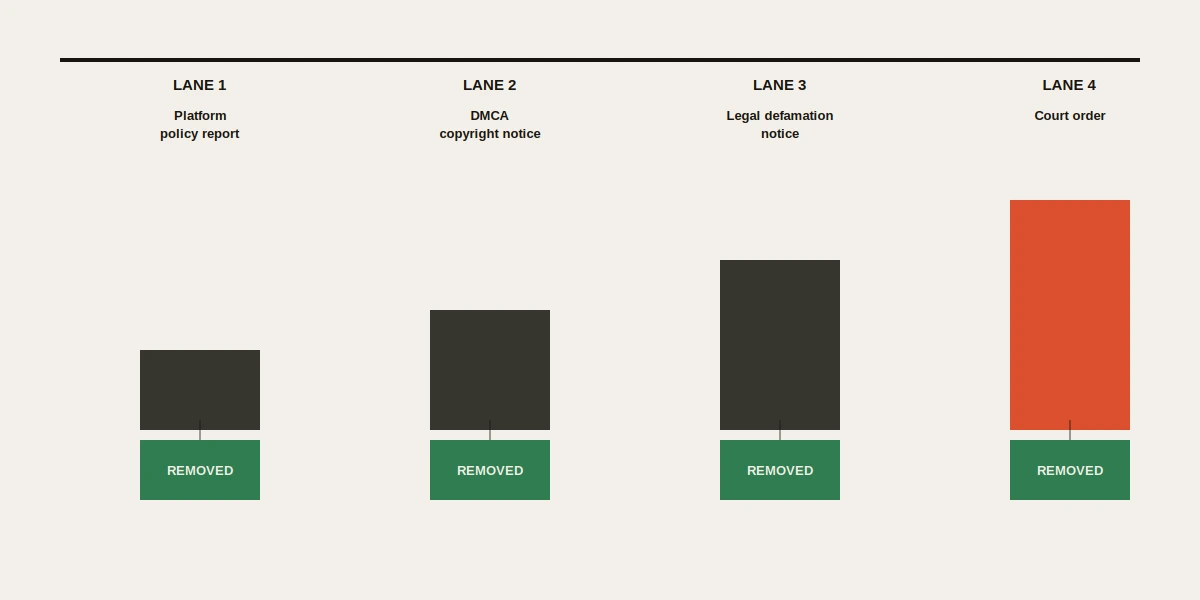
Strip the marketing away and five instruments reach X's enforcement with any reliability. A platform policy report. A DMCA copyright notice. A legal notice for defamation or misuse of private information. A court order. And, for intimate images, hash-matching through a partner service. Everything else is noise dressed as a sixth option.
Each carries its own standing requirement, its own evidence bar and its own queue. A policy report needs no lawyer, but it asks a reviewer to agree with you about a rule; X's impersonation form does not even require an X account, which matters when the impersonator is the reason you left. A DMCA notice needs you to own the copyright — your photograph, your video, your words — and is filed under penalty of perjury through X's copyright process, following the procedure the US Copyright Office sets out. A defamation notice needs a false statement of fact, not an opinion you dislike. A court order needs proceedings. Hash-matching needs only that you are the person in the image.
That list is the whole game. When a case reaches our desk the first hour goes on matching the harm to the instrument, because the wrong instrument does not fail slowly. It fails, and the refusal becomes a record the platform may lean on the next time you write. Typed without the article, as how to take down twitter account, or reversed into how to take down someone's twitter account, the query returns the same five options — the phrasing changes nothing about which one fits you.
How many reports does it take to take down a Twitter account?
There is no number, and the reason there cannot be one is more useful than the myth. A report and a notice do different things to X. A report changes the platform's queue: it routes content to a reviewer who then decides against the rules. A legal notice changes the platform's exposure — once it has been told, in the proper form, that content is unlawful, its own protection starts to depend on what it does next. One is a request. The other is a liability event. Volume can only ever affect the first, which is why a hundred reports and one report land in the same place, and why a single correctly drafted notice outranks both.
Scale settles it. X's transparency reporting for the second half of 2024 logged roughly 181 million user reports alongside about 335 million enforcement actions, the overwhelming majority taken automatically before anyone filed anything (X Global Transparency Report, H2 2024). Against a system that mostly acts on its own signals, report count is a rounding error.
Coordinated volume is worse than useless. Filing in bursts from linked or throwaway accounts breaches X's rules on misuse of the reporting features, and the action can land on the reporters instead. We do not run report brigades, at any price, for anyone. Our teardown of the X mass-report trade works through why the tooling cannot do what it claims, and the YouTube equivalent shows the same ceiling enforced by a hard daily quota.

The DMCA route is the fastest, and the least anonymous
Here is the trade no one selling a twitter account takedown mentions. The copyright route often works better than the route built for the harm, and it costs you your anonymity.
The evidence on the first half is unusually direct. In an audit study published in September 2024, researchers uploaded fifty AI-generated nude images to X and reported half through the non-consensual nudity flow and half as copyright infringement. Every image in the copyright arm came down within 25 hours. Not one in the non-consensual nudity arm came down in over three weeks (Reporting Non-Consensual Intimate Media: An Audit Study of Deepfakes, 2024). Twenty-five items per arm is a small sample, the imagery was synthetic, and the fieldwork predates the TAKE IT DOWN Act's May 2026 enforcement deadline, so read it as a strong signal rather than a law of nature. It still shows which lever the machine respects.
Now the cost. A DMCA notice is not anonymous and was never meant to be. X forwards a copy of the complaint to the user you reported, and that copy carries your name and contact details. Notices are also sent to the Lumen database, a Harvard research archive where takedown requests are published and searchable by anyone. So the fastest way to get a tweet taken down is also the way that tells the person who posted it precisely who objected, and leaves a public record saying so. For a business protecting a brand asset, that is a fair trade. For someone hiding from an ex, it is close to the worst available outcome, and talking clients out of it is the most common thing we do on a first call.
One more condition people miss: you must genuinely own the copyright. A screenshot of someone else's post is their copyright, not yours. Filing anyway is a knowingly false claim, and the exposure that creates is covered in our briefing on buying a ban.
If an account is impersonating you, doxxing you, or sharing intimate images without consent, get a confidential case review. We map the instrument before any fee is named, we never ask for your password, and we never ask you to send us the material.
The UK lane: a section 5 notice and the 48-hour clock
If you are in the UK there is a statutory route the American guides never mention. Section 5 of the Defamation Act 2013, with the Defamation (Operators of Websites) Regulations 2013 underneath it, gives a website operator a defence against a libel claim over something a user posted — provided it follows a set procedure once it receives a valid notice of complaint. That procedure runs on a 48-hour clock, counted with weekends and bank holidays disregarded. Within 48 hours of a valid notice the operator must pass it to the poster; where it cannot contact them and wants to keep the defence, it must remove the material. If your notice is defective it must tell you so in writing inside the same 48 hours, and set out what a valid one requires.
Two honest caveats, because this is where UK guidance oversells. Media lawyers have regarded the section 5 regime as cumbersome and of questionable practical benefit since it came in, and it was drafted with forum and comment-section operators in mind rather than global platforms. And a notice of complaint is not a takedown demand. It starts a process whose most likely outcome is that the poster defends the post, it stays up, and you decide whether to sue. What it reliably produces is a dated, documented record that the operator was told — which is exactly what a claim needs later.
The Online Safety Act is the other thing people expect to help, and case by case it mostly does not. Its illegal content duties came into force on 17 March 2025 and they are real: platforms must assess risk and act quickly on illegal material. But Ofcom regulates systems, not individual grievances. It can open an enforcement programme against a platform whose reporting tools are inadequate. It will not order one post about you taken down. Knowing that before you spend three weeks writing to a regulator is worth something.
When the account is anonymous, unmasking comes first
A defamation claim needs a defendant with a name. Where the account attacking you is anonymous, the step before any claim is a Norwich Pharmacal order: a High Court disclosure order compelling a third party caught up in the wrongdoing to hand over what it knows about the wrongdoer. It is discretionary. The court is not obliged to grant it, and it is not cheap.
There is a jurisdictional wrinkle worth knowing before you instruct anyone. Since 1 April 2025 the controller for UK and EU user data has been X Internet Unlimited Company, an Irish company registered in Dublin, which is why disclosure applications against the platform frequently run through the Irish courts rather than London. That changes both the cost and the timetable. In our casework it is also the point where most individual cases stop — on economics rather than merit, which is a hard thing to tell someone who is right.
So we treat unmasking as the last instrument, not the first. Nearly every case that arrives convinced it needs a court order turns out to have an unfiled copyright claim or an unfiled impersonation report sitting in front of it, and those resolve in days rather than months.
What a "twitter account takedown service" or an "x ban service" is selling
Search twitter account takedown service, or x account takedown, and two different markets answer. Knowing which one you are looking at matters more than the price.
The honest version is administrative. Someone drafts your notice properly, files it against the right policy, tracks it, and escalates when it stalls. That is a real service and it is what we do. It is not a ban button, and any desk quoting a guaranteed suspension or a fixed turnaround is quoting something it does not control. We took the buyer's side of that market apart in what a Twitter ban service can and cannot deliver, with the Instagram version and the TikTok pricing beside it.
The dishonest version is not a service at all. On grey-market forums an x account takedown post is a buyer's advert, and what answers it is often someone offering to compromise the account rather than report it — credential theft sold as enforcement. The Telegram panel trade runs on rented accounts, the WhatsApp version asks buyers to hand over their own session, Facebook's tools and Instagram's GitHub panels resolve to the same thing, and Snapchat's has no endpoint to call at all. Buying one puts you inside the transaction rather than above it.
A note on wording, since the searches split here. An x ban service is usually sold as the same product, but the phrase now returns mostly policy pages and shadowban-checking tools — people asking whether their own reach has been limited, not people shopping for a suspension. If that is why you came, the answer is that visibility filtering and suspension are separate mechanisms and neither is something another user can trigger on demand.
The pattern is not X-specific either. Meta acts on the strike record rather than the headcount, TikTok's honest answer is the same, Instagram rewards precision over volume, and the Instagram spam-report myth collapses for identical reasons. Snapchat adds an evidence problem because the content expires before you can capture it, a WhatsApp block is not a ban, Telegram splits into channel and account routes, and most mass-reported TikTok accounts come back.
What no takedown reaches: removal versus suppression
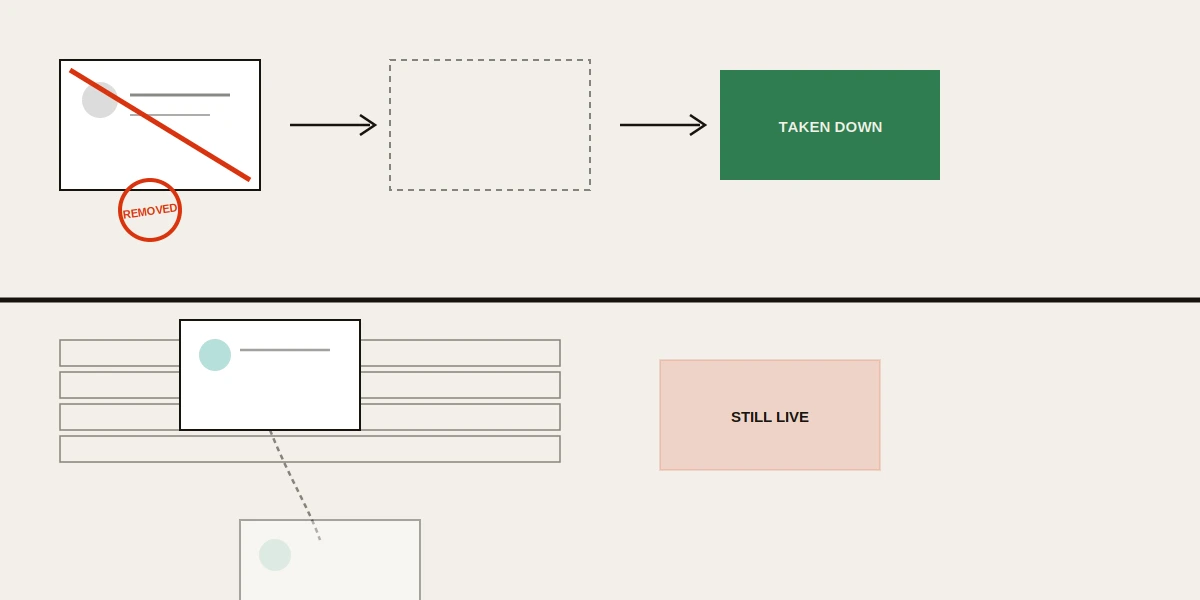
Some accounts will not come down, and saying so early is the difference between a plan and a bill. A true report from a real newsroom, a genuine public record, a critic's protected opinion: X does not remove these, and no instrument on the list above forces it. Forging one to try backfires in a specific way. A bluffed notice gets the content reinstated, exposes the sender, and hands the target a Streisand-effect spotlight brighter than the post you wanted gone. We will not file a notice we do not believe to be true, we never request your password, and we never ask you to send intimate material. Those limits sit in our disclaimer rather than only in the sales copy, and our engagement terms rule out brigading for anyone.
Even a successful takedown has a ceiling. Suspending an account does not reach the screenshots, the quote-reposts that carried the claim onto other timelines, or the copies already in web archives. The account can go dark while the claim keeps circulating three clicks away — the same gap we mapped on the Instagram side.
When removal is genuinely off the table the honest lever is suppression: pushing the result down with authoritative owned content, or de-indexing it. For personal information there is a separate statutory route in the UK and EU under the ICO's right to erasure, and our de-indexing lead will tell you plainly when a true article can only be buried rather than erased. De-indexing hides a result from search; it does not delete the page. How we handle your evidence either way is set out in our privacy notice.
Intimate images are the exception to every queue above. They get urgent, free triage, and we never ask you to send the file. StopNCII.org hash-matches the image and blocks it across participating platforms without a human ever viewing it, which remains the fastest lawful lever available to anyone.
Where to start if the account is aimed at you
Begin by naming the harm rather than the outcome. Whether you arrived searching how to get a twitter account taken down or simply wanted one post gone, the sequence does not change: name the harm, check your standing, then pick the instrument. Impersonation goes to the impersonation form, and needs the side-by-side proof that you are the real party. Your stolen photograph goes to a copyright notice, with the anonymity cost understood before you file. A false statement of fact goes to counsel, and in the UK a section 5 notice starts the clock and the record. An intimate image goes to hash-matching today, not next week. Everything else is either a policy report or a suppression problem wearing a takedown costume.
If you are not sure which of those describes your case, that is the normal place to start rather than a reason to wait. Our takedown briefings work through the same reasoning platform by platform, our team is named and credentialled on the About page, and a confidential case review costs nothing and comes before any fee is quoted.