The account is yours: two clicks, then a ninety-day tail
Most people typing this phrase want out. They own the account, they are done with it, and they want to know where the button lives and what happens after they press it. That version has a clean answer, so take it first.
Deactivation and deletion are different instruments. Deactivating hides your timeline and removes your name from search on Facebook, but Messenger keeps running, friends still see your old messages in their threads, and the whole profile returns the instant you log back in. It is a pause button dressed as an exit.
Deletion is the exit. Settings & privacy, then Settings, then Accounts Centre, then Personal details, then Account ownership and control, then Deactivation and deletion. Choose the profile, choose Delete account, confirm with your password.
Then a clock you should know about starts running. Facebook holds the account for 30 days before deleting anything, and logging in during that window cancels the request outright — which is exactly why people who are certain they deleted their account keep finding it alive months later. Once the grace period expires, Meta states that removing everything from its backup systems can take up to 90 days, during which the content is not accessible to anyone on Facebook (Facebook Help Centre). Download your information before you file, not after. Nothing comes back once the purge runs.
Pages run on a different clock, and the gap catches admins out constantly. A Page you administer deactivates on request and is permanently deleted after 14 days, not thirty (Facebook Help Centre). Half the retention, same assumption. If you inherited a Page from a business you have left, that fortnight is the whole window.
One more case belongs here, because it arrives as the same search. When the account holder has died, a relative can request memorialisation or full removal, and Meta requires proof of death and proof of relationship before it will act on either (Facebook Help Centre). Removal is permanent and there is no appeal from it, so families should agree the decision before one member files.
If none of that describes you — if the account you want gone belongs to somebody else — the rest of this briefing is the part you need. The mechanics change completely, in the same way they do on Snapchat, where only the platform can ever terminate an account.
Whose account is it? That single question decides every step after it
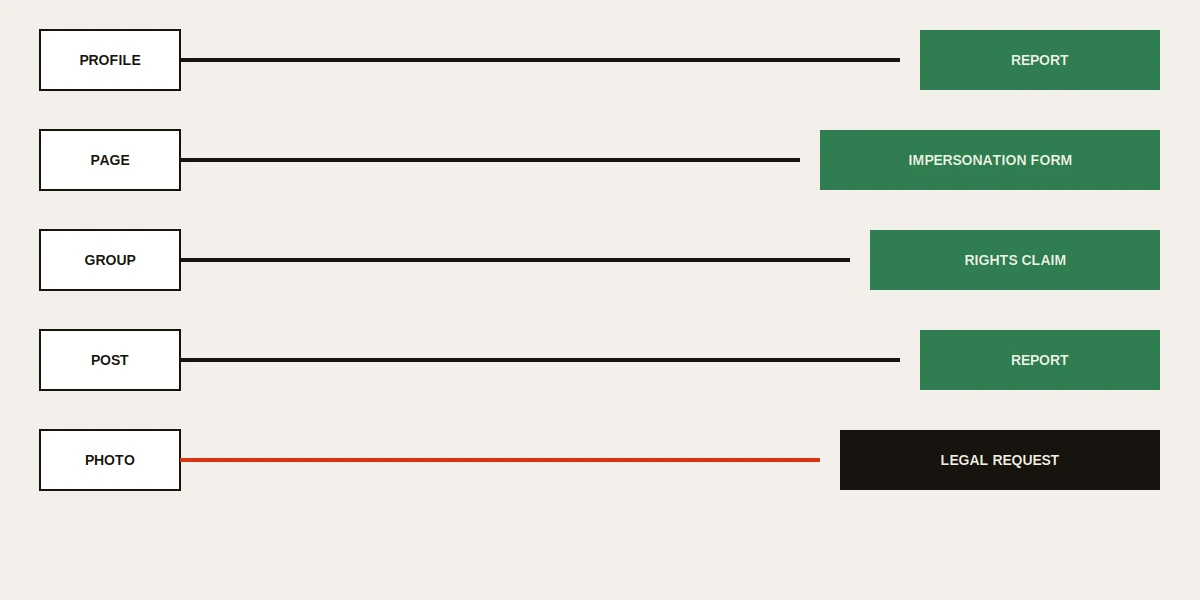
You cannot delete an account you do not control. There is no setting, no form and no service that hands you that power, because deletion belongs to the account holder and termination belongs to Meta. Everyone else is in the business of supplying grounds.
That reframing is not pedantry. It changes what you are actually producing: not an action, but a case. And a case is judged on standing and evidence rather than on effort, which is why the single most common failure we see is a well-intentioned person filing fifteen reports when one correctly categorised report would have done more. Meta reviews the content against its Community Standards; it does not tally complainants. We took that apart in detail in our teardown of what Meta actually acts on, and the panels selling volume are dismantled in our investigation into what runs behind a Facebook mass report tool.
Standing is the second half. Ask what you are to the content. Are you the person depicted, the person defamed, the copyright owner, the trademark holder, the parent of a minor, or a bystander who simply finds it appalling? Each answer opens a different door, and the bystander's door is the narrowest one. The same test governs the five lawful instruments that reach X, and it is why standing beats urgency on TikTok every time.
How to get a Facebook page taken down when you do not administer it
A Page is not a profile, and the confusion costs people weeks. Profiles belong to people and are reported through the profile itself. Pages are business or public objects, reported through the Page, and Meta publishes its own list of why Pages get restricted or removed (Facebook Help Centre).
To get a facebook page taken down, name the violation rather than the grievance. A Page impersonating your business is a trademark or impersonation matter. A Page publishing your photographs is a copyright matter. A Page publishing false statements of fact about you is a defamation matter, and defamation is the one category Meta will not adjudicate on a report form — it wants a legal instrument. Groups follow the Page pattern with one addition worth knowing: admins can remove members and delete content themselves, so where the group is not wholly abusive, the fastest route is often the admin rather than Meta. Channel and group takedowns work much the same way on Telegram.
How to take down a Facebook post, and how to take down a photo on Facebook
The smallest object is usually the fastest to remove, and people routinely aim too big. If one post is the problem, ask for that post — not the account attached to it.
If you posted it, this is trivial: open the post, use the three-dot menu, delete. It moves to your Trash and clears after thirty days. The searches for how to take down a facebook post and how to take down a photo on facebook are, more often than not, this exact task.
If somebody else posted it, you are back to standing. How to get a facebook post taken down turns on which rule the post breaks, and the honest ranking of your options runs like this. A Community Standards violation — harassment, bullying, threats, hate speech, adult nudity — goes through the in-app report, categorised precisely. Your own photograph reposted without permission is a copyright claim through the copyright report form. Your logo or brand misused is a trademark report. A false factual claim about you is a legal matter, not a report.
When you are in the photo but did not take it
This is the case the guides skip. Being depicted in an image does not, on its own, give you copyright over it — the photographer usually holds that. Untagging removes the link to your profile without removing the image. What does give you a route is the content of the picture: privacy violations, harassment, and above all intimate images shared without consent, which sit in their own urgent category and are handled separately below.
Facebook won't take down a fake profile of me. Here is what is going wrong
This is the highest-frustration query in the whole cluster and it usually has a diagnosable cause rather than a conspiratorial one.
Symptom. You reported the clone, got an automated response, and the profile is still there.
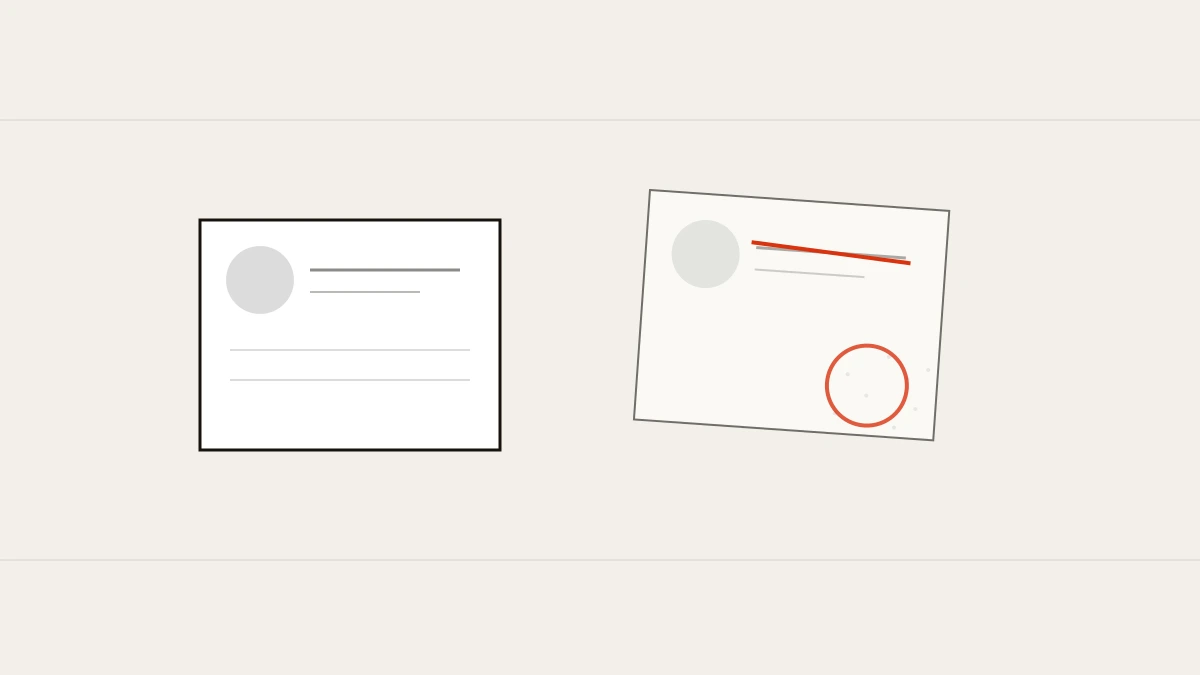
Cause. Almost always one of three things. You used the generic in-app report instead of the dedicated impersonation route. You filed as a concerned friend rather than as the impersonated person. Or you supplied no identity evidence, leaving the reviewer unable to tell which of the two accounts is the real one — a genuine problem from their side of the screen.
Check. Confirm you filed through the report a profile or Page pretending to be you route, and that the report came from the impersonated party or their guardian.
Fix. Use the standalone impostor form, which works while logged out — decisive when the fake account has already got your real profile restricted (Facebook impostor form). Attach government identification. Impersonation is, in our records, the highest-converting category we file and simultaneously the one where most effort is wasted, and the difference between those two outcomes is almost entirely whether identity documentation was attached at the first attempt rather than the third. Meta's approach to fake accounts across its properties is set out in our briefing on the Instagram spam-report bot myth, and the parallel route for a cloned Instagram profile sits in our Instagram account takedown guide.
One structural change explains why this got harder. In January 2025 Meta ended third-party fact-checking in favour of Community Notes and raised the confidence threshold required before removing content, shifting more of the burden onto user reports (NBC News). Fewer wrongful removals, fewer proactive ones. A vague report now does less than it did two years ago.
What a Facebook take down request actually contains
A facebook take down request is a category of document, not a button, and the single most useful thing you can do is work out which document you are writing before you start.
Four instruments reach Facebook, and they are not interchangeable. A policy report cites a Community Standard and asks Meta to enforce its own rules; it is free, anonymous to the reported party, and weak on anything contested. A copyright notice invokes the DMCA and carries real statutory force, but it is not anonymous — your name and claim go to the person you reported, and a counter-notice puts the content back within roughly ten to fourteen business days unless you file suit (U.S. Copyright Office). A trademark complaint works similarly for brand misuse. A legal notice from a solicitor is the instrument for defamation, and it is the only one that meaningfully moves false factual claims.
Choose wrongly and you lose more than time. Filing a copyright claim over a post that merely insults you is a false statement made under penalty of perjury, and it is the fastest way we know to convert a removable problem into a lawsuit against yourself.
Preserve before you file, always. Full-page screenshots with visible URLs and timestamps, the profile or Page ID, the date you first saw it, and any prior reports. Accounts get deleted mid-case with striking regularity, and the client's screenshots are frequently the only surviving copy.
If reporting has already failed once, or the post has spread beyond Facebook, the filing is no longer the whole job. Ask us for a confidential case review — we map the route before you pay anything, we never ask for your password, and we will tell you plainly when reporting is all you actually need.
The European lane almost every guide skips
If you are in the UK or the EU, you have an instrument that in-app reporting does not give you, and it is badly underused.
Article 16 of the Digital Services Act obliges platforms to run a notice-and-action mechanism for illegal content and to give you a reasoned decision. Article 20 obliges them to operate an internal complaints system you can escalate into. A DSA notice is a different object from a report: it creates a duty to respond, and it is logged.
That distinction acquired teeth in October 2025, when the European Commission preliminarily found that Meta's notice-and-action and appeals mechanisms on Facebook and Instagram breach those very articles — describing the reporting design as obstructive and noting that users could not properly submit evidence in appeals (European Commission). For anyone whose report vanished into an automated reply, that is not vindication, but it is leverage. Cite the articles, keep every reference number, and the burden of justifying the outcome moves. Who we are and what we actually file is published for the same reason.
Facebook took down your content. The appeal runs the other way
A large share of people searching this cluster want the opposite of a takedown. Your facebook post taken down without explanation, your facebook group taken down overnight, your Page restricted with no warning. Say plainly what we are: Obscura removes content, we do not restore removed accounts. Nobody should pay us for this. But the route is short enough to give away.
Start inside the notice itself. Meta's own path for a disputed removal is documented at I don't think Facebook should have taken down my post, and a facebook page taken down appeal starts in the same place — Page status, then request review. Speed matters more than eloquence here; appeal windows close, and a reviewed decision left unchallenged hardens.
Above Meta sit two further doors. The Oversight Board takes appeals once you have exhausted Meta's internal review, you have 15 days from the decision to file, and it aims to resolve within 90 (Oversight Board). Since 2021 it also hears the reverse complaint — content Meta left up that you believe should have come down (Meta). That dual jurisdiction is exactly what people mean when they search for a content taken down facebook appeal, and it is why the phrase covers two opposite audiences.
For EU users, Article 21 of the DSA adds a certified out-of-court body. Appeals Centre Europe overturned platform decisions in 59 per cent of the cases where it got a substantive look, and unlike some Meta properties, Facebook sits squarely within its certified scope. The same sequence — appeal fast, preserve everything, escalate — is set out for WhatsApp enforcement, and if the removals landed in a suspicious cluster, what actually happens to a mass-reported account and why counting reports fails are both worth reading before you assume a glitch.
What no Facebook takedown reaches
Some things do not come down, and you are owed that answer before you spend anything.
Truthful journalism stays. Genuine public records stay. Protected opinion — "this company was useless" — stays, because it is not a statement of fact and no defamation claim survives contact with it. Against any of those, removal is not the instrument. Suppression is: building authoritative content that outranks the damaging result, which is a slower, quieter job with no stamp at the end of it.
We will not forge a notice, bluff a lawsuit we have no intention of filing, or send a copyright claim over content nobody owns. Those tactics get the page reinstated, expose the client, and hand the other side a Streisand-effect story worth more than the original post. We do not take accounts down as a hired attack either — that is a different trade entirely, and what a paid ban service is really selling explains why the outcome is rarely what was purchased. Nor do we ask for your password, ever, or for intimate material to be sent to us; where images are involved, hash-matching through StopNCII or the FTC's Take It Down portal removes the content without a copy ever leaving your device.
Our limits are set out in full in our disclaimer, and the rest of the platform-by-platform work — including the Instagram version of this question and what actually gets a YouTube video removed — sits in our briefing archive. Across roughly 900 cases we have removed 3,700-plus results, and the ones that worked were the ones aimed at the right object with the right instrument, first time.