The myth that flooding reports bans an X account
Mass reporting is the practice of getting a crowd of accounts to file the same complaint against one X (formerly Twitter) profile, post or comment, in the belief that the sheer number of reports will trigger a suspension. Working out why that belief is wrong is the whole game. On X, a report is not a ballot dropped in a box to be counted. It is a flag that pushes content into a review queue, and what happens next turns on whether a moderator or a classifier decides a rule was broken. The tally of reports barely enters that decision. So "mass reporting a Twitter account", or "twitter mass reporting" sold as a service, is a widely shared tactic built on a misreading of the machine. You are buying a stack of flags. X was never designed to read a stack of flags as a verdict.
Two very different people arrive here. One wants to point reports at somebody else and is hunting for a tool or a paid service. The other has just watched their own account get locked and needs to know whether the attack was real and whether it can be undone. I meet both, though usually the second: I handle search and suppression at our desk, so these cases tend to reach me after the reporting is over, when someone asks why an account is still standing, or why theirs is not. We run an editorial takedown practice rather than a report farm, and that difference shapes everything below.
The commercial cousin of this question, whether paying a stranger can get an account banned, is a separate market we dismantled in our teardown of the X ban-for-hire trade. Here I am after the reporting mechanic itself, and the "bot" that supposedly drives it.
Does mass reporting work on X (Twitter)?
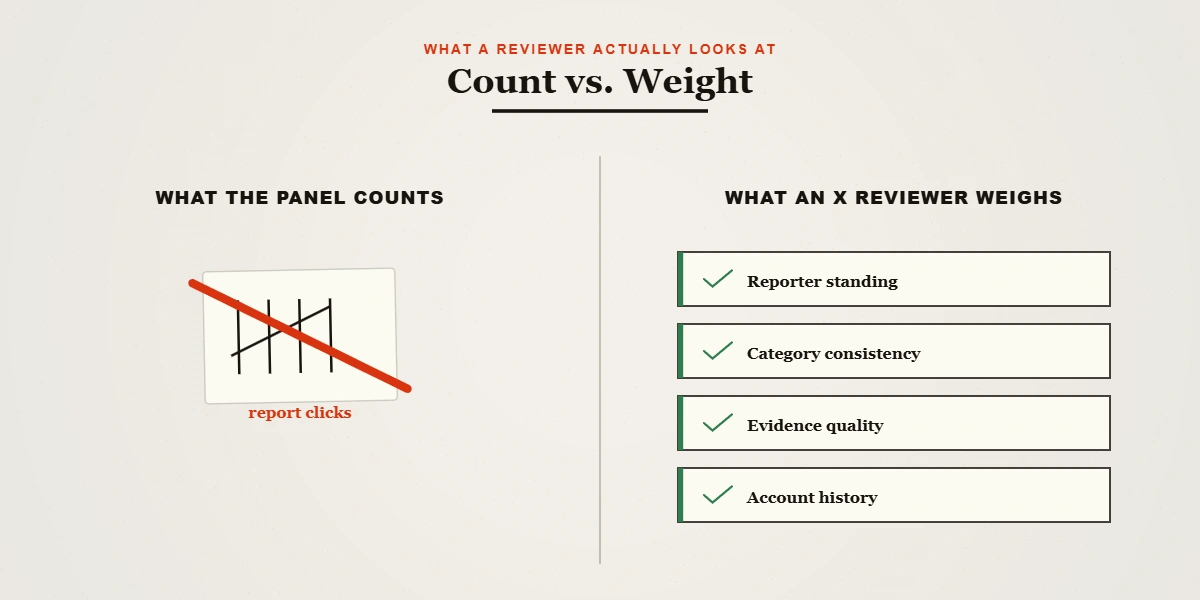
Short version: no, not the way the panels sell it. No report count trips an automatic suspension, and X publishes none because none exists. The lever is whether the content breaks a rule, judged on the content and weighted by who filed it and how well they evidenced it. One precise report from a credible account, naming the policy and quoting the post, counts for more than fifty identical flags from accounts registered last week. Volume is the part the market charges for, and the part that matters least.
The scale settles it. In its transparency report for the second half of 2024, X said it received over 181 million user reports, actioned around 10.1 million posts, and suspended roughly 4.19 million accounts for breaking its rules (X transparency reporting). Those actioned posts were a sliver of everything reviewed. A separate tier of enforcement, about 335 million accounts suspended for spam and platform manipulation, ran mostly on automation before a single human report was filed, and X said that figure fell roughly 28% against the first half of the year. Read together, the numbers describe a system that largely polices itself, with user reports a thin stream feeding it. That is the reverse of the "flood it and they vanish" story the tools tell.
I keep hammering this because the wrong belief costs people. When a client turns up certain that a rival "mass reported them off the platform", the account is usually still live, and the real wound is a defamatory post ranking under their name that no report was ever going to move.
Mass reporting a Twitter account is loud. It is seldom what does the work.
Is there a real "X mass report bot"? What the API allows
Here is the technical fact that empties the whole category, and that no vendor page prints. X's public API, in its current v2 form, has no reporting endpoint. You cannot file a report through the official developer interface at all, in bulk or one at a time, because the capability was never built into it (X developer documentation). The only reporting call that ever shipped is a legacy v1.1 method, POST users/report_spam. It handles a single account, for spam only, one target per call, with no bulk parameter, and it is reachable now only through X's paid API tiers as part of a deprecated surface the free tier does not expose. Nothing an app can call will "mass report" anyone.
So what is a "twitter mass report bot" or an "x mass report bot", if not an integration? It is browser automation. A script drives the same reporting screen a person uses, through a headless browser, signing into one account after another and clicking the identical flow at a few seconds per login. The "bot", whether it is sold as that or as a "mass report twitter bot", is therefore only as strong as the pile of logins behind it, and that pile is the real product: a farm of aged or stolen accounts, or your own credentials handed to an operator so you can be added to the swarm. Some listings ask outright for your session cookies, the auth_token and ct0 pair, which is account theft dressed as a service. "Bot" implies clever code. What you get is a rack of sock puppets and a Selenium loop.
The "twitter mass report tool" and "buy mass report twitter" market
Search for a twitter mass report tool, a twitter mass report service, or how to buy mass report twitter, and you drop into a small, loud market that is easy to read once you know its layers. There are three, and none is the panel the copy promises. Tier one is free scripts on GitHub and GitLab: DIY automation that wants your login, snaps whenever X changes its front end, and still reports one account at a time however many logins you feed it. Tier two is the SMM panels, selling "Twitter reports" by the thousand at a few cents each, which are account farms clicking the live interface per target, priced beside followers and likes. Tier three is the "full service" seller quoting a suspiciously round "92% success rate" and a 24-to-72-hour turnaround, a line that recurs word for word across a ring of mirror domains, which marks it as syndicated copy rather than a measured result.
What unites the three is that the money flows one way and the risk flows the other. You pay for flags X weighs lightly, cast by accounts its manipulation detection is built to catch, with nothing back when the target stays up. To mass report a Twitter account this way is to bankroll the exact footprint the platform hunts for. This is not a product we sell, to any client, at any figure, and the boundary is written into what we will and will not take on. The economics of the paid "ban", its pricing and the ban-then-restore trap, sit in our X ban-for-hire teardown, and the same "what you are actually buying" pattern on Meta is laid out in our breakdown of the Instagram ban market. Most of the time the honest description is plainer than the sales copy makes it sound: the buyer pays, the target stays, and the failure rate priced in kills the deal.
Being impersonated, doxxed, or hit with intimate images on X is a takedown case, not a reporting one. Ask for a confidential review: we scope the legal route first and name a fee second, we never touch your login, and non-consensual intimate images we treat as urgent and triage first, at no charge, without ever needing the file.
How to mass report a Twitter account the honest way
If the content genuinely breaks X's rules, there is a correct way to report it, and it involves no bot. This is what people typing how to mass report a Twitter account, how to mass report someone on Twitter, or just how to mass report on Twitter actually need, because the honest method beats the swarm.
- Open the post, tap the three-dot menu, and choose Report. Pick the category that fits: impersonation, targeted harassment, private information, non-consensual nudity, threats, or spam. Getting the category right routes the report to the correct queue, which matters more than anything else you do.
- At the description step, quote the exact words or spell out the exact image, and name the rule you think it breaks. A specific, evidenced report is weighted far above a vague one.
- Report the whole account as well as the post where the profile itself is the problem, a clean impersonation or a dedicated harassment account, through X's own reporting flow.
- Where several genuinely separate people were harmed, each can file their own honest report. That is not a brigade; it is real, unconnected complaints, and it is the only legitimate shape "mass" reporting ever takes.
There is no step five where a bulk button appears. "How to mass report a Twitter account" has no satisfying tool because the satisfying answer is qualitative: one accurate, well-evidenced report that a reviewer agrees breaks a rule. The logic is platform-agnostic, and the teardowns for the Instagram categories Meta enforces and how TikTok's own queue handles the same request reach the identical end. When the pitch is a bot that skips all of it, you are looking at the same myth we traced on Instagram in a bluer coat.
What happens if you mass report someone: the reporter's risk
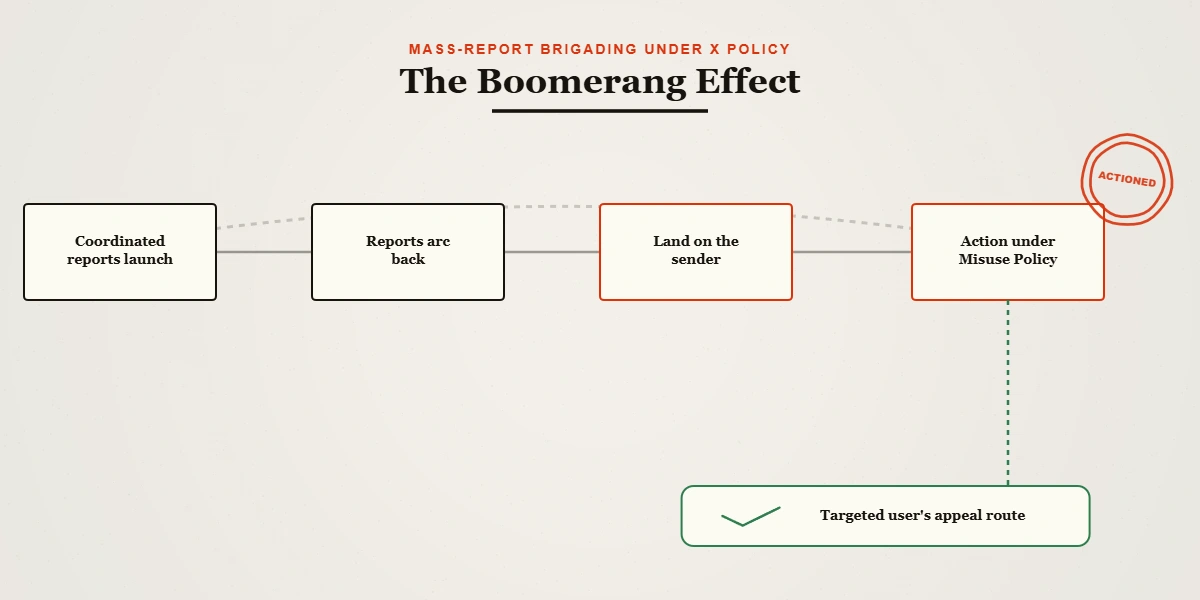
The line the sellers never print is that coordinated reporting is itself against X's rules, and the penalty can fall on the people doing the reporting. X's Misuse of Reporting Features Policy, introduced in 2023, treats organised or bad-faith reporting as its own violation, and its enforcement options run from a label to a lock to a suspension aimed at the reporters. Fire in a burst from linked or purchased accounts and you have drawn the exact signature the system flags. The clicks you paid for turn into evidence against the accounts that made them.
Under the platform layer sits a legal one, and it shifts with where everyone lives, so read this as general information rather than advice. Copyright is the sharpest edge: a DMCA notice you know to be false is a misrepresentation under 17 U.S.C. § 512(f), and US courts have let wrongly-targeted users recover their fees under it. A sustained false-report campaign against a named person can tip into harassment, and where it carries false claims of fact, into defamation. Buying the attack does not shift any of that off you; in the platform-manipulation case it drags your own account into range. Those risks are exactly why our scope of engagement rules the work out.
If you are the one being mass-reported
Half the people searching these terms are not attackers. They are account holders who have just been locked or limited by a brigade and want to know what landed on them. If that is you, move fast and in order.
First, appeal at once through X's account-access appeal form. The window is real, and the odds of reinstatement drop the longer an action goes unchallenged; say directly that the reports look coordinated and false, and point at whatever shows it. Second, save the evidence before it evaporates: screenshots of the reporting where you can see it, timestamps, and any advert, chat or post where the campaign was arranged or sold. If you are in the EU, the Digital Services Act adds a route, a right to a reasoned decision on the action and an out-of-court dispute mechanism, so keep the notice X sent. Third, split the two problems apart. A wrongful suspension is a platform matter you appeal. A smear that rode in with it, a defamatory post, a leaked image, an impersonation, is the case we actually work, and how we hold that evidence is set out in our privacy notice. Being brigaded is frightening. It is also, far more often than the panic allows, reversible.
The ceiling: what removal can't reach
Now the honest ceiling, the part I handle most as the suppression lead. Say the reporting works, or you win a takedown the right way. It still may not fix the thing that frightened you, because removal and suppression are different remedies and only one is on the table for any given post. Removal deletes the content at its source. Suppression leaves it up but stops it surfacing, de-indexed from a search on your name, pushed under stronger results. A dead account is not a deleted claim. The suspension does nothing to the screenshots people already grabbed, the reposts that ferried the line across other feeds, or the archived copy sitting in the Wayback Machine, and X hands you no button to wipe another user's repost. The profile goes dark; the allegation keeps circulating.
Some posts will not come down at all, and no service, honest or not, changes that. Accurate journalism, a matter of public record, an opinion the law protects: X leaves these up, and faking a notice to dislodge one rebounds. The post is reinstated, the sender is unmasked, and the coverage the target dreaded gets a second, louder life. Two lines we will not cross: we do not lodge a report we believe to be false, and we do not ask for your password. In intimate-image cases we also never need the file, because StopNCII.org matches on a hash of the image, so participating platforms can block it without anyone, on our side or theirs, opening it. When removal is genuinely gone, suppression is the lawful lever, and it is honest about its limit: it buries the link, but the page behind it is still there. The search-side mechanics are the same ones in our briefing on removal versus suppression.
If you cannot tell which side of that line your case sits on, that is the usual starting point, not a reason to wait. The account attacking you is often removable. The true-but-painful article next to it usually is not, and separating them is the first thing we do, at no cost to ask. More of these teardowns live in the briefings archive; if an account is doing real damage right now, open a case. We do not brigade, we do not run bots, and nothing is billed until we have mapped a route.