Four supply routes, and what each one wants from you
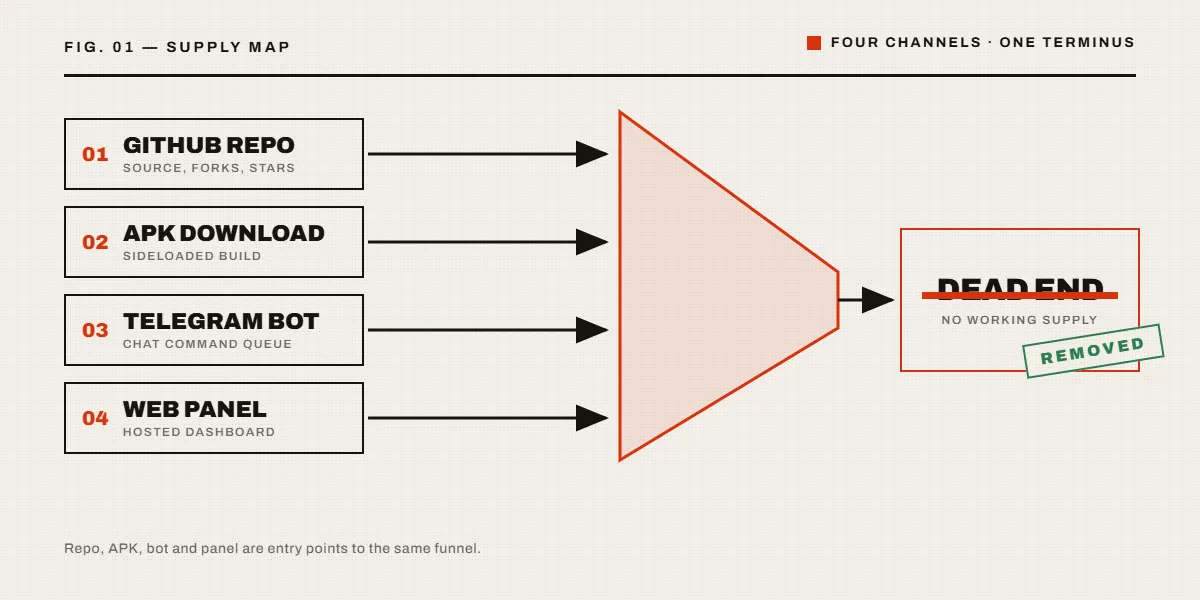
Search for a way to mass report an Instagram account and the results sort themselves into four channels inside a minute. Public code on GitHub. Android packages to sideload. Telegram bots that answer in seconds. Hosted dashboards billing by the thousand.
They present as four products at four price points. They are one product. Instagram has a single door for a report, the one on your own screen, and none of these four has found another.
Ask instead what each wants from you first.
| Where it comes from | What it asks for first | What it can actually reach |
|---|---|---|
| A public GitHub repository | A text file of account logins | The ordinary Report screen, one session at a time |
| An APK you sideload | Install permissions on the phone holding your logins | The same screen, if the build still runs |
| A Telegram bot | Payment up front, sometimes your own credentials | Nothing you can verify |
| A hosted "online" panel | Your Instagram login, or a per-report fee | Nothing you can verify |
Vocabulary rotates. Mechanism does not. Listings surface identically for instagram mass report bot, mass report bot instagram, mass reporting instagram bot, instagram mass reporting bot, mass reporting bot instagram, mass instagram report bot, mass report instagram bot and mass report instagram account bot, and equally for instagram mass reporter, mass reporter instagram and instagram mass reporter bot. Swap the noun and nothing underneath changes: instagram mass report tool, mass report tool instagram, mass report instagram tool, mass reporting tool instagram, instagram mass reporting tool, instagram mass reporter tool, mass instagram report tool and mass report instagram account tool all name a loop driving borrowed sessions.
We ran this same teardown on X and the anatomy was identical, so I will not repeat it here — the claim tested against Twitter's reporting stack covers the shared parts. What follows is the Instagram-specific half.
Read the repository before you run it
GitHub has one honest advantage over the other three routes: you can read what you are about to run. Almost nobody does.
Searches for github instagram mass report, github mass report instagram, instagram mass report github, mass report instagram github, instagram mass report bot github, instagram mass report tool github and instagram mass reporter github land on the same small pool of repositories, and their shape is remarkably consistent. Take Khanejo's Instagram-mass-reporter, representative rather than unusual, which I checked again on 27 July 2026. Nine commits, an MIT licence, and a README asking for a list of account credentials, alongside a disclaimer that the author is not responsible for malicious use.
That credential requirement is the entire story, and it is sitting in the open.
None of it holds privileged access to Instagram; it cannot file anything as itself. It needs accounts. Accounts mean logins, which means the asset in the project was never the code — it is whatever pile of credentials the person running it manages to assemble. Plenty of these repositories also call internal endpoints Meta rotated years ago, so they fail before ever reaching a login screen. Open code is not working code, and a star count measures curiosity rather than function.
GitHub's own Acceptable Use Policies prohibit automated excessive bulk activity and coordinated inauthentic activity such as spamming. Hosting dual-use code is broadly tolerated there; running a brigade with it is not. That gap is why so many of these projects sit archived and forked rather than maintained.
Instagram's platform API has no reporting endpoint
Here is the structural fact the entire market depends on you not checking.
Meta's Instagram Platform documentation sets out what a developer may do with an Instagram account: publish content, read insights, manage comments and direct messages, build Login-based integrations, run and measure advertising. No endpoint anywhere in it covers filing a Community Guidelines report. As of July 2026 no sanctioned path exists from outside code into Meta's moderation queue.
So a bot, in the sense the word implies, cannot exist here — an authorised program talking to a platform is not what any of this is. Device and browser automation is what exists: a script signing into an ordinary account, tapping the same three-dot menu you have, waiting, repeating. That is why every listing eventually asks for accounts, and why this market rests on a supply of logins rather than on any piece of engineering.
Which reframes the question people are actually typing. Can you mass report an Instagram account? You can certainly arrange for many accounts to file reports about one profile. Whether that arrangement changes an outcome is a separate question entirely, and it is the one no seller answers directly.
Does mass reporting work on Instagram?
No, and the reason explains every other failure in this market.
A report is not a vote. It is a routing instruction: it places one specific post, comment, message or profile in front of a classifier or a reviewer with a policy attached, and the decision comes from comparing that content against that rule. Filing it forty times asks the same question forty times. The answer does not improve with repetition.
Meta's own reporting structure shows where the leverage sits. Its Community Standards Enforcement Report publishes a proactive rate for each policy area — the share of content actioned before any user reported it — and across most categories that share is the overwhelming majority of everything removed. User reports feed a supplementary stream into a pipeline that mostly finds violations without being told. Volume was never the lever there, which is why buying more of it buys nothing.
One corollary is worth holding onto if you are on the receiving end. Because reports do not accumulate into a ban, a wave of them is not the emergency it feels like at three in the morning. What a wave does reliably produce is a coordinated pattern, and coordinated patterns are exactly what Meta's integrity systems are built to find. Our Instagram spam-report briefing sets out how that rebounds onto the accounts doing the filing.
What the download costs, and what the panel costs
Three of the four routes take something real from you before delivering nothing.
An instagram mass report apk is a request to sideload an unsigned Android package, from an anonymous source, onto the device holding your logins, your messages and your two-factor codes. McAfee Labs documented an Instagram credential stealer distributed as a "mod app", a category that persists precisely because people keep installing social-media utilities from outside the store. Scale is not hypothetical here: in May 2025 the researcher Jeremiah Fowler found an exposed infostealer database of roughly 184 million records, Instagram logins among them in plain text.
Hosted versions skip the file and go straight for the account. An instagram mass report bot online, a mass report instagram account online service and an instagram mass report online dashboard all describe the same page, which asks you to sign in so it can add capacity. Read that plainly. Your account becomes one of the sessions used against somebody else, and the password you typed now sits in a stranger's database next to a few thousand others.
An instagram mass report telegram bot, an instagram mass report bot telegram listing and an instagram mass report telegram channel are the same trade conducted in a chat window, with payment collected first and no mechanism for getting it back.
Searches for buy mass report instagram and instagram mass report service open a market layered like any other SMM panel: reports priced by the thousand beside followers and likes, a quoted turnaround, and a success rate that recurs word for word across a ring of mirror sites, which marks it as copied sales text rather than measurement. We set out what an Instagram ban service is really selling separately.
Easily the most useful pages in these results are the ones nobody monetises. Threads found through instagram mass report bot reddit, mass report instagram account reddit and how to mass report an instagram account reddit describe outcomes instead of promising them, and those outcomes are consistent: no evidence of a ban delivered, payments sent to sellers who stopped replying, accounts lost after a login was handed over. The identical pattern on TikTok's panels is documented in our briefing there.
One test separates a desk from a reseller and it costs nothing to apply. A firm filing genuine notices commits to a route and a process; it cannot commit to the outcome, because that decision belongs to a platform or a court. What we will and will not file is published before anyone pays us a penny, and the limits of any removal claim, including ours, are written down in the same spirit.
Different problem, different desk. If a post is defaming you, exposing your address, or circulating intimate images you never consented to, report volume is not what you need — a correctly chosen notice is. Bring it to us for a confidential review. We name the route before we name a fee, we never ask for your password, and non-consensual intimate imagery goes to the front of the queue at no charge, without us ever needing to see the file.
If a report wave has landed on your account
Roughly half the people searching mass reporting instagram account, mass reporting instagram, instagram mass reporting, mass report instagram, mass instagram report, instagram account mass report, mass report account instagram, mass report an instagram account and mass report on instagram are not shopping for anything. Something has already happened to them.
Telling a brigade from ordinary enforcement
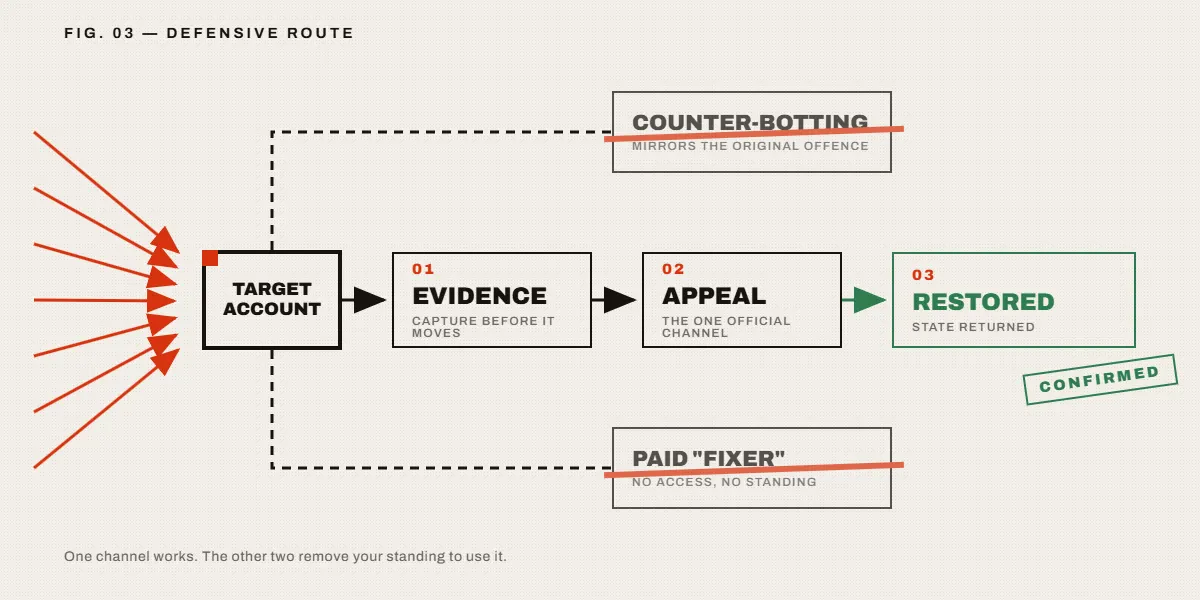
Coordinated attacks tend to arrive as several actions inside a short window, often against older posts that had sat untouched for months, and often within days of a public argument. Routine enforcement looks different. One recent post, one policy, one notice. Account Status inside the app holds the record of what was actioned and under which standard, and reading it before forming a theory saves wasted effort (Instagram Help Centre).
Whether the reports came from a purchased panel is not something you can tell from inside your own account, and it makes almost no difference to the appeal. Only one thing matters: whether the content actually broke the rule Meta says it broke.
The appeal, and what to send with it
Appeal once, inside the notice itself, and quickly. State that the actions appear coordinated and give the timing: the dates, the gaps between them, the public dispute they followed. Then stop. Second and third appeals add nothing and can close a route while it is still open.
Preserve first, tidy later. Across the Meta work that reaches my desk, the commonest way people damage their own case is deleting the disputed post before anybody has captured it — the screenshots, the timestamps and the comment thread go with it, and from that point the appeal is an argument from memory. How we handle material a client sends us is set out in our privacy notice, because that bundle is frequently the only surviving copy of the thing in dispute.
Where the underlying content is defamatory rather than merely against guidelines, reporting is the wrong lever altogether, and the escalation layer behind an Instagram takedown is the better starting point.
Where removal stops and suppression starts
The honest answer to how to mass report an instagram account — and to how to mass report instagram, how to mass report instagram account, how to mass report on instagram and how to mass report someone on instagram — is that you file one accurate report rather than forty noisy ones. Open the post or the profile, tap the three dots, choose Report, then select the standard the content actually breaks instead of the one closest to how you feel about it. Quote the words in the description and name the rule. To mass report instagram post content by pointing ten accounts at one photo adds ten identical rows to a queue and not one new fact.
Some things stay up regardless. Accurate reporting, a genuine matter of public record, an opinion the law protects: Instagram leaves these, every platform leaves these, and a notice built on a false claim to dislodge one tends to rebound. Instead the post is restored, the sender is identified, and the material you wanted buried gets a second and much louder circulation. In the United States a copyright complaint you know to be untrue is a misrepresentation under 17 U.S.C. § 512(f), and courts there have made senders pay the other side's costs. Two lines we do not cross: we file no report or notice we believe to be false, and we never ask for your password.
Even a successful removal has a ceiling. A deleted post is not a deleted allegation. Screenshots already saved, reposts sitting on other platforms, the version somebody remembers — none of that comes down with the original. Where content cannot lawfully be removed, the remaining work is suppression: leaving it where it sits while making sure it is not what surfaces when someone searches your name. Suppression is honest about its own limit too. It buries the link. Behind that link the page still exists.
Working out which of those two your case supports is the first hour of the job rather than the hard part. Report routes Meta genuinely acts on are set out in our Instagram enforcement guide, and the team that files these notices will tell you plainly when the answer is that nothing can be filed at all.