
What a "TikTok mass report bot" actually is
A TikTok mass report bot is software sold on the promise that it will file hundreds of complaints against one account, video or livestream until the platform gives way. Listings for it are real. The mechanism is not. TikTok's developer platform publishes Login Kit, the Content Posting API, the Research API and its commercial advertising interfaces, and none of them exposes any way to file a Community Guidelines report; the word "reporting" appears there only in the sense of advertising dashboards. As of July 2026 there is no sanctioned path from outside code into TikTok's moderation queue, which means a mass report bot tiktok listing cannot be an integration with TikTok at all. What sits behind the dashboard is a script signing into ordinary accounts and tapping the same Report button you have, one session at a time, until the front end changes and it stops working.
Vocabulary shifts, product does not. A tiktok mass report tool, a mass report tiktok tool, a mass report tiktok bot, a mass tiktok report bot, a tiktok mass reporter: each names the same arrangement of borrowed logins and a loop. The free tier is public code, which is what people find when they search tiktok mass report github, and those repositories largely call scraped internal endpoints TikTok retired years ago. An installable version, the thing behind tiktok mass report bot apk, asks you to sideload an unsigned Android package from a stranger onto the phone holding your own logins. The hosted version, tiktok mass report bot online, wants your credentials so it can add your account to somebody else's swarm.
I am not going to spend this briefing dismantling the automation, because we already did that on X and the anatomy is identical: the same teardown, run on Twitter's reporting stack. Only the platform-specific part matters here. TikTok decides removals differently, and that difference is why the flood fails.
Does mass reporting work on TikTok? Read TikTok's own arithmetic
TikTok answered this in writing years ago and has never walked it back. Its safety team stated that "mass reporting content or accounts does not lead to an automatic removal or to a greater likelihood of removal by our Safety team" (TikTok Newsroom, July 2021). A report is a routing instruction. It puts one specific piece of content in front of a classifier or a reviewer with a policy attached, and the answer comes from comparing that content to that policy. Twenty submissions and one submission ask the same question. That is the whole of what tiktok mass reporting achieves: repeating a question does not change the answer.
Enforcement figures show why volume was never the lever. In the fourth quarter of 2025 TikTok removed 175,302,085 videos, roughly half a percent of everything uploaded. Around 87% of those were caught by automated systems rather than by a human decision, 99.1% came down before any user reported them, and 93.4% were actioned inside a day (TikTok Community Guidelines Enforcement Report, Q4 2025, published via TikTok's transparency centre). Read that middle number slowly. Ninety-nine removals in a hundred happen with no report involved at all. User reports are a thin supplementary stream feeding a system that mostly polices itself, which is a poor place to apply pressure by weight.
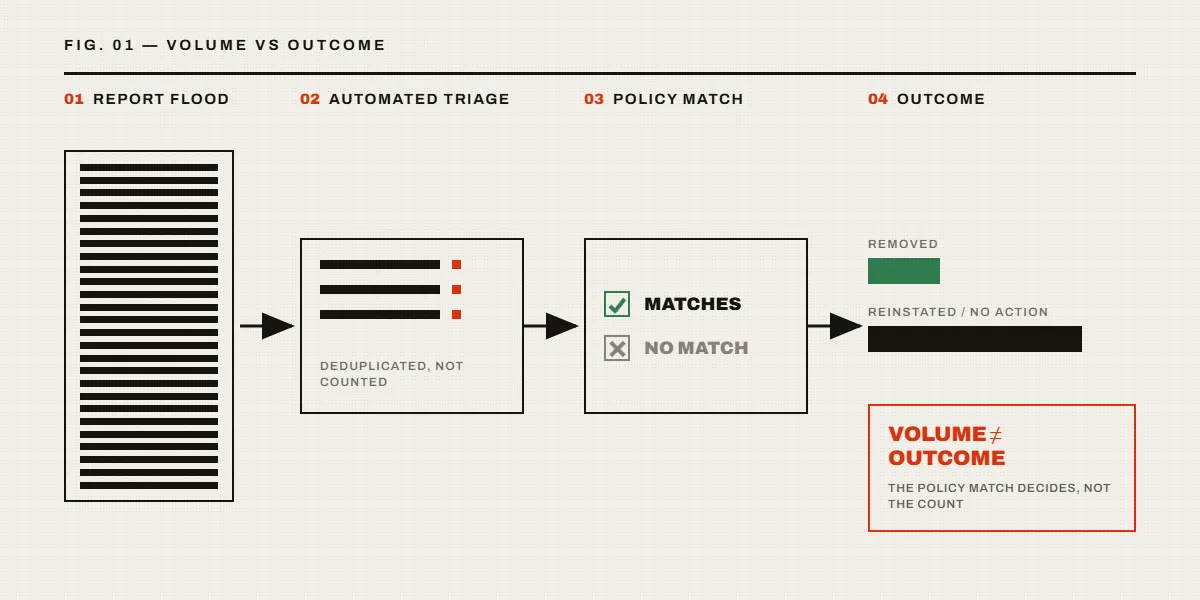
One figure in the same report is quoted almost nowhere, and it is the one I would put on the wall: 8,360,780 videos were reinstated after further review in that quarter. Wrongly-removed content comes back at roughly one restoration for every twenty-one removals. Our editorial and legal desk treats that as the operative fact for anyone on the receiving end of a campaign, and it is also why we set out plainly what any removal claim can and cannot promise. The strike ladder sitting behind an account ban is covered in our TikTok ban briefing, and I will not repeat it here.
Mass report a TikTok account, a video or a live: three different requests
People type mass report tiktok and mean at least three separate things, and the surface decides almost everything about what follows. Getting this wrong is the commonest reason a tiktok mass report goes nowhere.
Mass report a TikTok video
A single video is the easiest object to action, and the one TikTok's automation is tuned for. Open it, tap the share arrow, choose Report, then pick the guideline the clip breaks rather than the one closest to how you feel about it. The free-text box is where the work happens: quote the words and name the policy, with a timestamp. To mass report tiktok video content by pointing ten accounts at the same clip adds ten identical entries to one queue and no new information.
Mass report a TikTok account
Searches for how to mass report a tiktok account, how to mass report tiktok account, how to mass report on tiktok and mass report a tiktok account all want the profile gone rather than the clip. Report the account from the profile: three dots, Report, Report account. An account-level review looks for a pattern across the profile, so a report listing three specific videos with dates outperforms one saying the person is a bully. Where the profile itself is the violation, a clean impersonation of you or a page built to target you, say so first, because it changes which team reads it. Blocking, by contrast, is the only lever you hold directly, and it changes nothing for anyone else.
Mass report TikTok Live
Livestreams are time-limited, which makes this the one surface where speed genuinely matters. Report during the broadcast through the share menu; once it ends there may be nothing left to review unless somebody captured it. Hosts and nominated moderators can remove a viewer from the room, which is what most people searching mass report tiktok live actually want, and it is not a ban. That one evidenced report beats a hundred hollow ones holds here exactly as it does on Meta's surfaces.

The buy side: panels, sellers and what the Reddit threads show
Search tiktok mass report buy or tiktok mass report service and a small market opens up, sorted into layers that are easy to read once you know them. SMM panels list "TikTok reports" beside followers and likes, priced by the thousand, because to a panel a report is one more unit of clicking. Telegram and Discord sellers quote a turnaround and a success rate, and that rate is usually a suspiciously round number recurring word for word across a ring of mirror sites, which marks it as sales copy rather than measurement.
Those tiktok mass report bot reddit threads are the useful part of this search results page, and worth reading before any purchase. Consistently, they contain no evidence of bans delivered. Instead you find people asking whether anyone has ever seen it work, people describing cryptocurrency sent to a seller who stopped replying, and people who handed over a login and lost the account. Same pattern we documented in what an Instagram ban service actually sells and in the ban-then-restore con on X.
One tell separates a real desk from a reseller, and applying it costs nothing. A firm filing genuine notices commits to a route and a process; it cannot commit to the outcome, because that decision belongs to a platform or a court. Anyone promising the ban itself is either reselling clicks or misrepresenting what they control. What we will and will not take on is written down before anyone pays us a penny.
If content on TikTok is defaming you, exposing your private information, or sharing intimate images without your consent, that is a takedown case rather than a reporting one. Ask for a confidential review: we scope the lawful route first and quote a fee second, we never ask for your password, and non-consensual intimate imagery is triaged urgently and free, without us ever needing the file.
What ordering a brigade costs the person who ordered it
Sellers describe the risk as yours only in the sense that you might waste money. Larger exposure sits elsewhere. Coordinated reporting is itself a violation, and TikTok's integrity and authenticity rules treat organised inauthentic behaviour as actionable against the accounts doing it. The platform says it disrupted more than fifty covert influence operations worldwide during 2024, and the detection built for that work reads a report brigade easily: linked accounts submitting the same thing at the same moment. Groups mass reporting tiktok accounts in coordination leave that signature whether they meant to or not. Buying the campaign puts no distance between you and it either. If your own account is one of the logins in the swarm, you are inside it.
Underneath the platform layer sits a legal one that moves with jurisdiction, so treat this as general information rather than advice. A copyright complaint you know to be untrue is a misrepresentation under 17 U.S.C. § 512(f), and courts in the United States have made senders pay the other side's costs. A sustained false-report campaign against a named person can meet the threshold for harassment in England and Wales, and where it carries false statements of fact it can reach defamation. None of that transfers to a vendor because you paid them. The same rebound is visible on Instagram, where the reporting accounts rather than the target end up limited.
If a mass report campaign has landed on your account
Half the people searching these terms are not shopping. They have just lost a video or a livestream and want to know whether they were brigaded. Work through it in order.
Start by separating a brigade from an ordinary strike. Coordinated attacks usually arrive as several removals inside a short window, often on old content that had sat untouched for months, and often just after a public disagreement. Routine enforcement lands on one recent post, under one policy. Check Settings and Privacy, then Safety Centre, then Account status, where TikTok keeps your record of reports and actions (TikTok Safety Centre).
Then appeal inside the notice itself, quickly and once. Those 8.36 million reinstatements in a single quarter are not a rounding error; the review layer works, and it works on evidence, so state that the reports appear coordinated and give the timing.
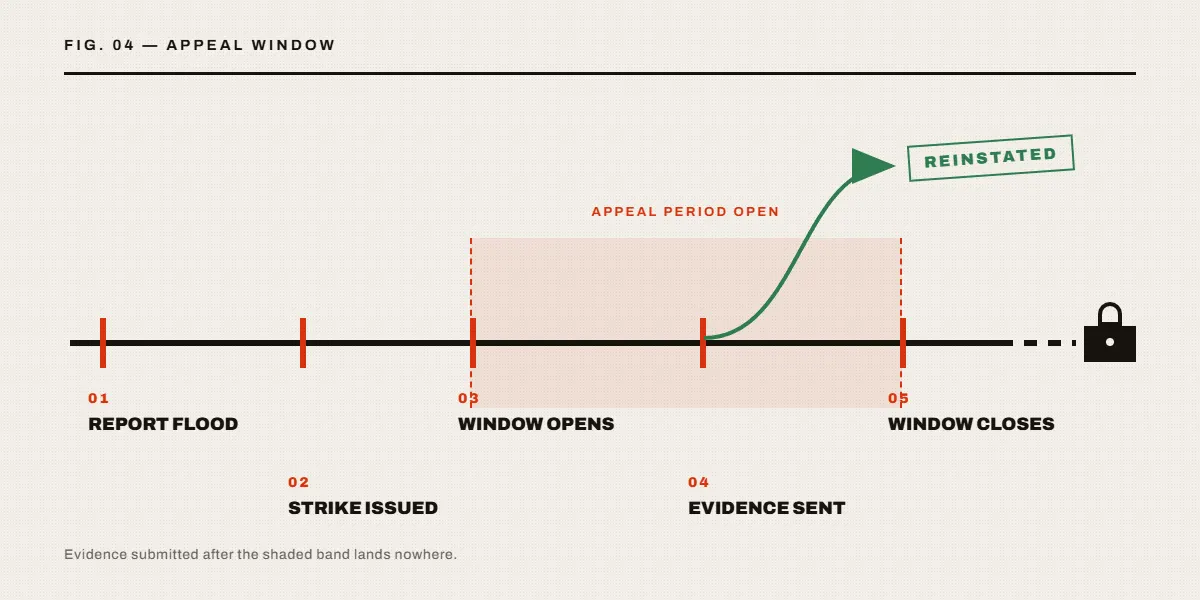
Preserve everything before you tidy anything. This is where people lose. Of the TikTok cases we opened in the first half of 2026, roughly a third arrived after the account holder had already deleted the disputed video, taking the timestamps and the comment thread with it (our case records, June 2026). One related piece of folklore circulates widely, and I want to be precise about its status: many creators warn that deleting or privating a video during an appeal forfeits the restoration. Nothing TikTok has published confirms it, and community accounts conflict, so treat it as an unverified precaution rather than a rule, and leave the video alone regardless, because you need the evidence either way.
Strikes expire from an account's record after ninety days, and they accrue per policy and per feature, so a comment strike and a LIVE strike sit in separate columns (TikTok Newsroom). If you are in the EU, the Digital Services Act gives you a right to a reasoned decision and an out-of-court route, so keep the notice. How we handle evidence a client sends us is set out in our privacy notice, because that bundle is often the only surviving copy.
The routes that actually move TikTok content
When the goal is a specific piece of content gone rather than a person punished, four levers exist, and they run at different speeds.
A Community Guidelines report under the correct category is the fastest lawful step for harassment, hate and minor-safety content, and it is anonymous: TikTok does not disclose who filed it. A DMCA notice, filed under the procedure the US Copyright Office sets out, is the route when a video uses something you own, typically your photograph or your footage, and unlike a report it carries your name. Where a video states something false as fact about a named person or business, a defamation notice through counsel is the route, and it reaches content no guideline covers. For intimate images shared without consent, StopNCII.org matches on a hash of the file so participating platforms can block it without anyone opening the image, and in the United States the Take It Down Act has been enforceable by the FTC since 19 May 2026.
Choosing between those four is most of the job. We run an editorial takedown desk rather than a report farm, and the first thing we do on any case is work out which one the facts actually support, because filing under the wrong lever wastes the strongest shot you get. The same routing logic, applied to Meta, is laid out in our briefing on Instagram takedowns and what removal really means.
What no report, and no removal, can reach
Some content stays up, and any service telling you otherwise is not being straight with you. Accurate reporting, a genuine matter of public record, an opinion the law protects: TikTok leaves these, every other platform leaves these, and a notice built on a false claim to dislodge one tends to rebound. The video is restored, the sender is identified, and the thing you wanted buried gets a second and much louder circulation. Two lines we do not cross: we file no report or notice we believe to be false, and we never ask for your password.
Then comes the part removal cannot fix even when it works. A deleted video is not a deleted allegation. Duets and stitches that carried it, screen recordings already saved, reposts sitting on other platforms: none of those come down with the original, and TikTok hands you no button that reaches them. This is where removal ends and suppression begins, leaving content where it sits while making sure it is not what surfaces when somebody searches your name. Suppression is honest about its ceiling too. It buries the link; the page behind it still exists.
Working out which side of that line your case falls on is the first hour of the work rather than the hard part, and asking costs nothing. More of these teardowns sit in the briefings archive. If something on TikTok is doing real damage right now, open a case with us and we will map the route before anyone talks about a fee.