
Instagram removal is four separate jobs, not one
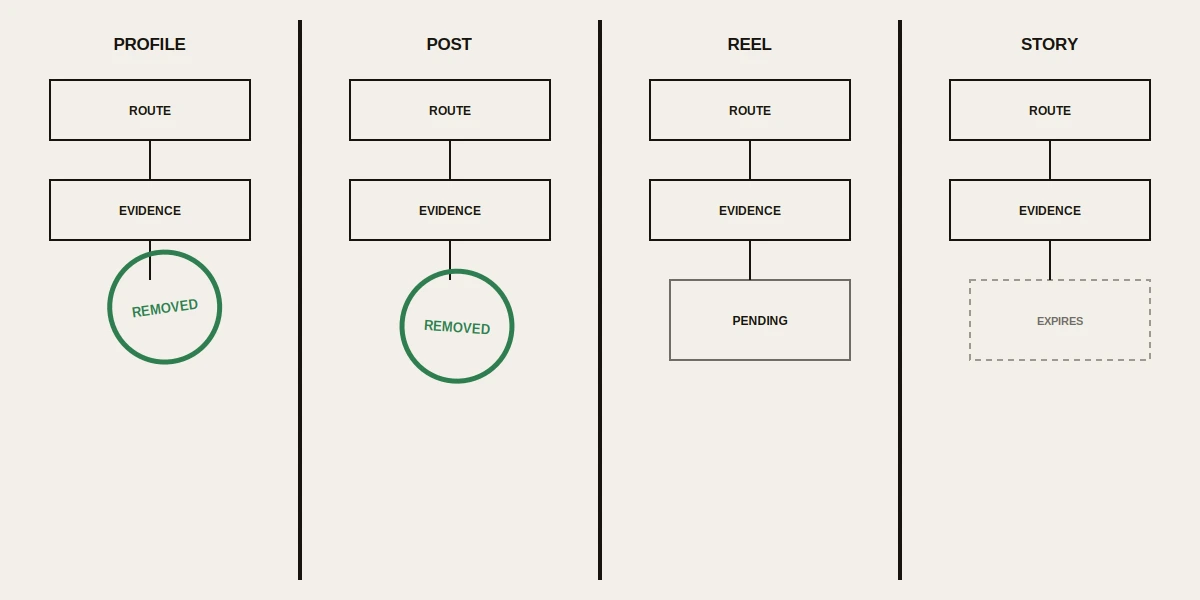
Almost everyone who contacts a removal desk about Instagram describes the problem as a single thing: something is up, and it needs to come down. The platform does not see it that way. Instagram treats a profile, a feed post, a Reel and a Story as four distinct objects, each attached to a different form, a different evidence threshold and a different clock. A request that names the wrong object gets refused on procedure long before anybody assesses whether the content was actually wrongful. That is the most common reason a well-founded complaint fails, and it costs nothing to avoid.
Before any of that matters, one question decides everything: is the content yours, or somebody else's? Deleting your own material is a settings task you can finish in a minute. Getting somebody else's material removed is a filing that has to persuade a stranger. The two share a vocabulary and nothing else. We have split this briefing along that line, and the own-content answer comes first so that readers who need only that can leave satisfied.
| Object | Where the request goes | What decides it | Realistic ceiling |
|---|---|---|---|
| Profile | Impersonation, trademark, defamation or UK unlawful-content form | A verifiable identity or legal claim | Whole account disabled |
| Post | Community Guidelines report, IP form, or privacy form | Guideline breach, ownership, or privacy | Single post removed |
| Reel | The same three routes as a post | Identical to a post, plus audio and remix claims | Single Reel removed |
| Story | Same routes, but the clock beats you | Evidence captured before expiry | Usually expires first |
Why insist on the distinction so early? Because the object determines the ceiling, and the ceiling determines whether hiring anybody is rational. One defamatory sentence in one caption almost never costs somebody their account, however much it deserves to. A profile built entirely around impersonating you frequently does. Clients who understand that before they instruct us make better decisions about what to spend, and they stop chasing the outcome that was never available. An honest Instagram takedown service works this fork before it quotes a price. The same discipline applies on every platform that runs a single-item route alongside an account-level one, which is why getting one clip taken down is a genuinely different filing from removing the account that posted it, and why the five instruments that reach an X account do not reach a single post.
Deleting your own post, Reel or profile
Most people searching for instagram post removal, instagram reels removal or a way to remove instagram profile want to delete their own material. No service is needed and none should be sold. Here is the whole mechanism, current as of August 2026.
Deleted content does not vanish on contact. It moves to Your activity → Recently deleted, where posts and Reels sit for 30 days before Instagram destroys them, and Stories that were never saved to your stories archive go after roughly 24 hours. Because the archive is switched on by default for most accounts, that short window applies to far fewer Stories than the guidance implies. Meta adds that once permanent deletion begins it may take up to 90 days to complete. Anything you delete during a live dispute should be screenshotted first, since Recently deleted is a holding pen rather than a vault, and a deletion you regret on day 31 is simply gone.
Three refinements are worth knowing, and one of them contradicts most guides still circulating.
- Archiving is not deleting. An archived post disappears from your grid but keeps every like and comment, and you can restore it whenever you want. Nothing is destroyed and no clock runs.
- You can now edit a carousel. Since 2026 the three-dot menu on a published carousel offers Edit, which lets you pull out one photo or video and leave the rest standing, on iPhone, Android, iPad and web. Older help text saying this is impossible is stale, and a great many listicles still repeat it.
- Deactivation and deletion are different buttons. Deactivating hides the profile and can be done roughly once a week. Deleting starts a 30-day countdown that logging back in cancels, though Meta notes the length of that cancellation window varies by region.
Remove instagram profile: deactivate, delete, or wait it out
Choosing between the two buttons is easier than it looks, because they answer different questions. Deactivation answers "I need this to stop being visible today." The profile, its posts, its comments and its likes disappear from public view, your handle is held rather than released, and everything returns intact the moment you log back in. Deletion answers "I want this gone permanently." It begins a countdown, it releases nothing until the countdown expires, and it cannot be undone afterwards. People in the middle of a harassment episode almost always want the first and reach for the second, then spend the following week logging in to check on the situation and quietly cancelling their own deletion request without realising it. If you are deleting to escape something rather than to tidy up, deactivate instead, preserve your evidence, and decide when the episode has passed.
Two exceptions change the advice entirely. If you cannot reach your own account, this stops being a deletion problem and becomes a recovery problem, which runs through a different queue. And if somebody is pressuring you over intimate images, skip the settings menu completely and go to the final section of this briefing, where the route is faster, free, and does not require you to send anyone the material.
Removing an Instagram profile that isn't yours
This is where an instagram account removal service earns its fee, and where the largest share of wasted effort happens. Instagram will disable an entire profile, but it does so on narrow grounds, and the grounds you choose dictate the evidence you need. Three routes account for nearly every successful profile takedown, and they are not interchangeable. Picking the wrong one does not merely fail; it produces a refusal that reads like indifference and discourages people from filing the claim that would have worked.
How to remove a fake instagram account pretending to me
Impersonation is the most common trigger for a full account removal and carries the most exacting form. Reports go to help.instagram.com/contact/636276399721841, which works without an Instagram account of your own but requires photo identification, and Meta will only act on a filing from the impersonated person or an authorised representative such as a parent or legal guardian. A friend reporting on your behalf receives a polite refusal, which surprises people who assumed a chorus of reports would help. The evidence question underneath any attempt to delete fake instagram account clones is not "is this account fake" but "which of these two accounts is the real one", and answering it is a discipline of its own. We set out that argument in full in the two filings an impersonation case actually needs, and readers who want the mechanics of instagram impersonation removal should start there rather than here.
Scale suggests the route works when it is used correctly. Meta says it removed more than 20 million accounts impersonating large content creators in 2025, with impersonation reports from that group falling 33% (Meta Newsroom, 13 March 2026). Those are creator-account figures rather than a general impersonation statistic, and they should not be read as a promise about an ordinary case. What they do describe is a filter that moves at considerable volume once it is handed a verifiable identity claim, and one that stays still when it is handed indignation instead.
Report and remove defamatory instagram profile content
Defamation is the route people assume is easiest and is in fact the hardest. Instagram's own defamation form at help.instagram.com/contact/653100351788502 states the position without softening it: "Without a court order establishing the unlawfulness of the content you wish to report, Instagram is not able to act on that content." Read that sentence twice before paying anybody to report and remove defamatory instagram profile material on your behalf. Absent a court order, the platform is not weighing your account against theirs. It is declining to adjudicate at all, and no amount of persuasive drafting changes a jurisdictional refusal into a substantive one.
Two doors remain open. The first is to stop arguing defamation and identify a Community Guidelines breach sitting inside the same profile, because harassment, credible threats and privacy violations are assessed against policy rather than against legal findings, and policy is something Instagram will actually apply. The second, for readers in the United Kingdom, is the unlawful-content form at help.instagram.com/contact/474053802368648, which accepts filings under UK law, can be submitted by a parent, guardian or representative of the person affected, and is anonymous. Neither door delivers a defamation ruling. Both are faster than issuing a claim, and the second is the one most British complainants never find, largely because it does not appear in the in-app reporting flow at all.
Fake instagram account detection and removal services
Searches for fake instagram account detection and removal services return monitoring products, and it is worth being precise about what those do. Detection is surveillance: a tool sweeps for profiles reusing your name, your handle pattern or your photographs, and it alerts you. Removal is a filing made afterwards by a person. No detection product removes anything by itself, and vendors that blur the two are selling a subscription while describing an outcome. Monitoring genuinely helps where clones reappear in waves, because the sooner a duplicate is caught the less it has cost you and the fewer of your followers it has reached. For a single clone already sitting in front of you, detection adds nothing a search bar cannot, and the budget is better spent on the filing itself.
The commercial logic here is identical to the one governing services that charge for a report and bill it as an outcome, and the enforcement machinery is shared with Facebook, so what moves a Meta enforcement decision applies to both apps and a Facebook profile's fate turns on the same Community Standards.
Instagram post removal when the post belongs to somebody else
A single post rarely justifies removing a whole account, and asking for the account when you want the post is a reliable way to get neither. Three routes reach one post, and choosing between them changes who learns your name.
The Community Guidelines report is the in-app three-dot menu. It is anonymous, it is free, and it is assessed against policy, which means it succeeds only where the post breaches a written rule. The intellectual-property form at help.instagram.com/contact/552695131608132 is the fastest lane when you own the photograph or video, and it carries a cost most people do not anticipate: Meta states it will pass the rights owner's name, email address and the nature of the report to the person who posted the content. A copyright claim tells your opponent precisely who complained. The privacy form at help.instagram.com/contact/512241091300432 covers images and video that violate your privacy, works while logged out, and cannot be processed without the exact URL of the offending item. Check that your country appears in its dropdown before relying on it, because Meta serves region-specific variants and the one you land on may not be yours.
Choosing between anonymity and speed is the real decision. Someone being harassed by a former partner usually cannot afford to have their name handed over, so the copyright lane is closed to them even when they own the photograph. A business defending a product image usually does not care, and takes the faster route. There is no correct answer in the abstract, only a correct answer for your situation, and any adviser who reaches for the copyright form without asking about the disclosure has not understood the case.
How to force remove an instagram post
Nothing forces a removal except a court order, and any instagram post removal service claiming otherwise is describing a report while calling it leverage. What genuinely resembles force is a correctly categorised filing with the exact URL, unambiguous evidence, and a named legal basis where one exists. Volume is not force. Meta states plainly that the number of times something is reported doesn't determine whether or not it's removed, and the mechanics behind that sentence, including why no automated tool can alter it, are documented in why there is no reporting endpoint to automate. Learning which report categories Meta actually acts on will do more for a case than any quantity of additional reports.
Some perspective on the odds is useful here. Meta measured its Instagram enforcement precision at more than 87% in Q3 2025, and reported that less than 1% of all content produced across Facebook and Instagram was removed for violating its policies (Meta Integrity Reports, Q3 2025, 11 December 2025). Removal is rare, and it is reasonably accurate when it happens. A complaint that does not clear the policy bar is not being ignored. It is being correctly declined, which is exactly why the categorisation work at the front of a case matters more than persistence at the back, and why a desk that files four weak grounds instead of one strong one is working against you.
What an instagram post removal service actually adds
Given that the forms are public and free, it is fair to ask what anybody is charging for. Three things, honestly stated. The first is categorisation, which is the difference between a privacy filing that succeeds and a defamation filing that was never going to be read. The second is evidence assembly: exact URLs, preserved copies, timestamps, and a written chronology that a reviewer can follow without doing any work of their own. The third is knowing what a refusal means and whether refiling is worth anything, which is knowledge accumulated from refusals rather than from successes. What nobody is charging for, because nobody has it, is a private line into Meta. When we file these, the queue we join is the same queue you would have joined; the difference is that our filing tends not to come back on procedure, and that is where the time is actually saved.
Instagram Reels removal and the takedown route that does not exist
Here is the finding that reshapes most Reels cases, and one almost nobody states plainly: there is no separate reporting form for Reels. Reels have their own help documentation, their own creation tools and their own tab in the app, but a report against one funnels into exactly the same Community Guidelines, intellectual-property and privacy flows that handle an ordinary feed post. Anyone selling a dedicated instagram reels takedown as a distinct product is selling you the post route under a different name, usually at a premium justified by the format's apparent novelty.
That has a practical consequence worth acting on. Because the routes are shared, the evidence you assemble for a Reel is the evidence you would assemble for a post, with two additions specific to the format. The first is audio. A Reel using a commercial track is not a copyright matter you can raise unless you hold rights in that recording, and Instagram's licensed music library sits outside your complaint entirely, which disposes of a surprising number of otherwise hopeful claims before they are written. The second is reuse, and it is where the strongest Reels cases live. Neither addition changes the form you file, which is the point worth holding on to: a Reel is a post that moves, and Instagram's reporting architecture has never treated it as anything more exotic than that.
Instagram reels takedown when your own footage is reused
Remixes, straightforward re-uploads and stitched excerpts of your video are the most winnable Reels claims, because they are ownership claims rather than interpretation claims. Ownership is the one thing an Instagram reviewer can verify without adjudicating a dispute between two strangers, and reviewers move fastest on questions that have an answer. Where a Reel has been re-uploaded across several accounts, treat each upload as its own filing with its own URL. Bundling them into a single report invites one decision on the clearest example and silence on the rest, which then reads as a rejection of the whole complaint when it was nothing of the sort.
This is the same failure pattern that makes a single-item video takedown succeed while an account-level complaint stalls, and the same reason reporting the accounts amplifying a piece of content does nothing whatever about the content itself.
Stories expire before most takedowns finish
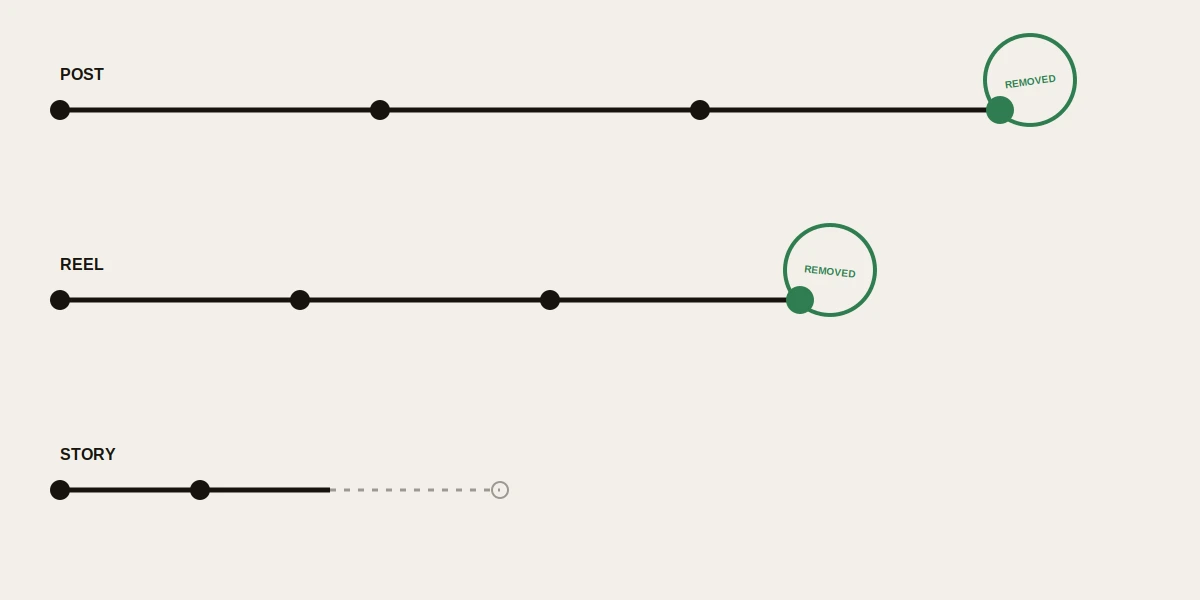
A Story lasts 24 hours. Almost no removal decision does. That mismatch makes the Story the one object where filing first is usually the wrong instinct, and capturing first is always the right one.
Preserve before you report. Screen-record the Story with the handle, the timestamp and any surrounding context visible, note the account's numeric identifier if you can reach it, and write down the exact time you observed it. That record is what survives into an appeal, a police report or a claim, and it is the first thing a solicitor will ask for. The Story itself will be gone by then, and a description of something nobody else saw is worth very little. If the same account repeats the behaviour across several days, the archive you have built becomes a pattern, and a pattern is materially stronger than any single Story, because harassment and coordinated abuse are assessed on repetition rather than on one incident.
Two Story-specific traps catch people out. Reposting the offending Story to your own account so that others can see what happened destroys the anonymity of any later report and hands the other side a grievance of their own, and we have seen it turn a straightforward harassment case into a mutual complaint that Instagram then declines to unpick. Sharing it into a group chat has the same effect more slowly. Keep the evidence private, share it with your adviser rather than your audience, and resist the urge to make the case publicly, however satisfying that would be. Whether an expired Story can still be reported is genuinely unclear, and nobody at Meta has published an answer, so treat the 24-hour window as the outer edge of what you can rely on rather than as a deadline somebody will extend for you.
Report it anyway, immediately, even knowing the clock will win. A report filed against a live Story leaves a record attached to that account, and accumulated records inform later decisions about the account as a whole. This is the least intuitive advice in the briefing: you are filing a report you expect to be overtaken by the expiry, because its value is cumulative rather than immediate. The same reasoning governs ephemeral content on Snapchat, where a disappearing format has never been a defence against enforcement, only an obstacle to proving what happened.
Instagram account removal service for businesses
Company cases run on different instruments from personal ones, and the difference usually favours the company. Where an individual has to establish an identity, a business can often establish a registered right, and a registered right is the cleanest claim Instagram accepts.
The trademark route at help.instagram.com/contact/230197320740525 handles profiles trading on your brand name or username, and it spares you any argument about intent. Where a fake profile is taking payments or soliciting your customers, the case usually contains a second and faster claim, because use of your logo or product photography is a copyright matter, and copyright turns on ownership rather than on interpretation. Meta has been building specifically against commercial impersonation: it reported in March 2026 that it removed 159 million scam advertisements and 10.9 million scam-centre accounts during 2025, alongside new detection aimed at accounts imitating public figures and brands (Meta Newsroom, 11 March 2026). For a company case that means the platform is already looking for the pattern you are about to describe, and a filing that names the commercial mechanism plainly, the payments solicited, the customers contacted, the logo reproduced, lands in a queue that has been tuned to recognise it.
Two cautions apply to anyone buying this as a service. Instagram keeps Community Guidelines reports anonymous but not intellectual-property ones, so a trademark or copyright filing puts your company's name in front of the person you are reporting, which changes the calculation for a brand that would rather not escalate visibly. And a takedown does not stop a determined operator from registering again the following week. Sustained brand protection is a monitoring commitment rather than a single filing, which is the honest reason detection subscriptions exist even though they remove nothing on their own. The professional-network version of this problem, where employment claims and company pages complicate the same trademark logic, runs through clones, libel and limits on LinkedIn.
What an instagram content removal service can do, and how to vet one
An instagram removal service is selling you three things: correct categorisation, a properly assembled evidence pack, and somebody who has read the refusal letters before. None of those is a private channel into Meta, and any firm implying it holds one is describing a relationship that does not exist for commercial clients at any price.
What a competent desk does on the first day is unglamorous. It establishes which of the four objects is actually in play. It confirms whether the content is unlawful or merely unpleasant, which are not the same category and attract completely different routes. It captures evidence before that evidence moves. It identifies the single strongest ground rather than filing four weak ones and hoping. And it tells you plainly when the honest answer is that nothing is coming down, which is the conversation that separates a removal desk from a storefront and the reason we run a confidential review before anybody is charged a penny. None of that is glamorous and none of it is secret, which is rather the point: you are paying for the discipline to do it in order rather than for access nobody has. The equivalent discipline on X, where the same evidence-first logic decides cases, is set out in how a removal desk is judged on evidence rather than promises.
Five questions to ask any instagram takedown service
Ask these before you pay, and the answers will sort the field quickly. Which specific form will you file, and why that one rather than the others? What happens if it is refused, and is a refiling included? Will my name or my company's name be disclosed to the other party as a result of the route you have chosen? What is your success rate on cases resembling mine, and what does the word success mean inside that number? And finally, what will you refuse to do? A desk that cannot answer the last question has not thought about the boundary, and a desk that answers "nothing" is telling you it will forge a notice if you pay enough.
If a profile, post or Reel is trading on your name, targeting your customers, or publishing something about you that is untrue, send us the URL and a short account of what happened. We will tell you which route fits and whether it is worth filing, before any money changes hands. Start with a confidential case review, or read about the people who handle these filings.
Our own boundary, stated plainly: we never ask for your Instagram password, we do not send notices we know to be unfounded, and we do not take payment up front on a case we have not assessed. Forged or bluffed notices are worse than useless. They fail, they are retained, and they convert a removal problem into a legal exposure that sits with the person who commissioned them, a risk explored at length in who actually carries the liability when a takedown is bought. A desk offering to mass-report a target is offering something that does not work and can get the reporting accounts actioned instead, which is the mechanism behind ban services that sell reports rather than outcomes.
How long it takes, and what to do when Instagram says no
Straightforward cases move in days. Community Guidelines reports on clear breaches are frequently decided within 24 to 72 hours. Intellectual-property claims carrying clean ownership evidence commonly resolve inside a week. Impersonation filings that include acceptable identification tend to land in the same range, and they slip when the identification is rejected rather than when the underlying claim is weak, which is why the document you upload deserves more attention than the paragraph you write. Defamation without a court order has no timeline at all, because it has no route. Any firm quoting you a guaranteed number of days for a defamation removal is quoting a number it does not control.
Refusals are not the end, and they are not all alike. A procedural refusal means the form, the URL or the identification was wrong, and refiling correctly is the entire fix. A substantive refusal means Instagram assessed the content and found no breach, and refiling the same claim on the same grounds changes nothing except your patience. Work out which one you received before deciding what to do next, because the two arrive in nearly identical language and call for opposite responses. Most people treat every refusal as substantive, give up, and abandon a case that needed a corrected URL.
One reason timelines vary so widely is that the queue you enter is chosen by the form, not by the severity of what happened to you. A privacy report with a clean URL is a short, factual assessment. An impersonation filing requires a human to compare identity documents against a profile. A trademark claim is routed to people who read registrations. Nothing about your distress alters which of those desks receives the file, and a case that feels urgent can sit behind a queue that was never built for urgency. That is worth knowing in advance, because the most common reason clients lose confidence in a live filing is not refusal but silence, and silence at day four usually means the file is exactly where it should be.
Beyond the appeal, escalation depends on where you live. Users in the European Union can take a Meta moderation decision to a certified out-of-court dispute settlement body under Article 21 of the Digital Services Act, such as Appeals Centre Europe or User Rights, at no cost to themselves. Manage the expectation carefully: those decisions are non-binding, and Meta implemented only 23% of the Instagram dispute decisions covered in its most recent transparency reporting. The mechanism is still worth using, because a documented external decision retains value later even when the platform declines to act on it. Readers in the United Kingdom cannot use Article 21 at all, which is precisely why the UK unlawful-content form matters so much for British complainants. Meta's own governance is moving here as well, with the Oversight Board taking its first case on permanent account disabling in January 2026 and criticising the company's inconsistent approach in a decision that June.

What cannot be removed, and what we do instead
Some content stays up. A firm that will not tell you so before invoicing is not shielding you from bad news; it is selling you a bill.
Truthful reporting does not come down. Neither do genuine public records, nor opinion that is recognisably opinion rather than a false statement of fact dressed as one. A post that is accurate and humiliating remains accurate, and Instagram will not remove it because it hurt. Filing a fabricated copyright claim or an invented legal threat against material of that kind is the worst move available: it fails, it is retained by the other side, and it hands them a story about you considerably more damaging than the original post. Cases like these also attract wider attention precisely because somebody tried to suppress them, which is the outcome nobody is paying for. Our full position on outcomes and limits sits in the disclaimer, and it is worth reading before you instruct anybody, ourselves included.
Where removal is unavailable, suppression sometimes is, and that distinction is not a consolation prize but a different instrument entirely. De-indexing removes the route to the content rather than the content itself. Google's tools are explicit that they take a page out of Google Search results only and never touch the site hosting it, which for an Instagram profile means the post survives while becoming markedly harder to find by name. UK and EU readers should use the Right to be Forgotten form rather than the Results about you dashboard, which is not available in every market. A UK GDPR erasure request carries its own arithmetic: an organisation must respond within one calendar month, extendable by two where the case is genuinely complex, and the right is expressly not absolute, with freedom of expression sitting among the recognised grounds for refusal (Information Commissioner's Office).
Suppression is slower than removal, and it is never total. For a great many clients it is nonetheless the only thing that changes what a stranger sees when they search your name, which is usually the outcome they actually wanted when they said the word removal.
Intimate images are the exception to every timeline on this page. If someone has shared, or is threatening to share, intimate images of you, do not send the material to us or to anyone else. Use StopNCII if you were 18 or over when the image was taken, or NCMEC's Take It Down if you were under 18. Both generate a digital fingerprint on your own device, so the image never leaves your phone, and Facebook, Instagram and Threads participate in both schemes. Cases of that kind receive urgent triage from us at no charge, and we say so before anybody thinks to ask. For everything else, the honest starting point is a look at the URL and a straight answer about which of the four objects you are actually dealing with, which you can find across the rest of our takedown briefings.