Four different actions hide behind one question
Ask how to ban someone on Twitter and you are really asking one of four questions, depending on what you meant by the word. Sorting them apart takes a minute and saves weeks.
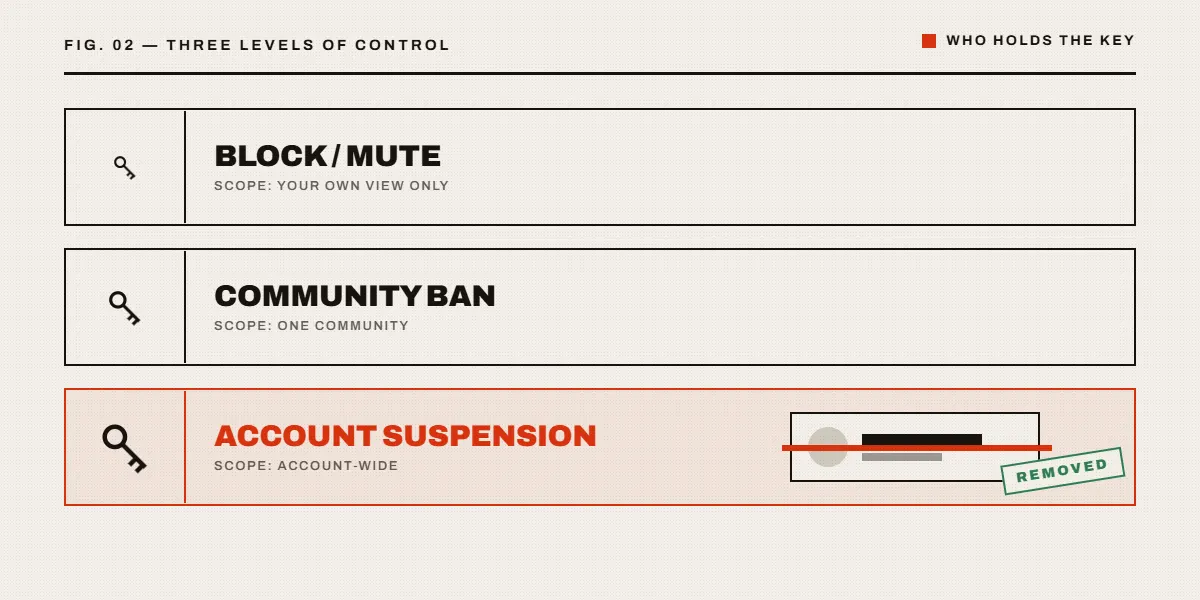
Blocking is the first, and it is entirely yours. You press the button, the other account loses access to your profile and posts, and nothing whatsoever happens to their account.
Second was the Community ban — a moderator removing a member from a topic group. That option no longer exists. X announced on 23 April 2026 that it was closing Communities, then moved the final date to 30 May 2026 after moderators pushed back, saying the feature reached under 0.4% of users while generating roughly 80% of the platform's spam, scam and malware reports (TechCrunch's report). Group chats in XChat took over, capped at 350 people. If you came here wanting to remove someone from your Community, there is no Community left to remove them from.
Third is narrow but live: a Space host or co-host can pull a speaker out of a live conversation and block them from rejoining.
Fourth is what nearly everybody actually means. Account suspension — profile locked, handle dead. You cannot do that. Neither can we, and neither can anyone selling it, because only X suspends X accounts and it does so against its own rules on its own schedule. We run a takedown desk, which means our days go on routing a harm to the mechanism capable of acting on it, and the honest first move is telling you which of those four things your problem needs.
What blocking actually does, and what it doesn't
Blocking is the whole of your unilateral power here, so its edges are worth knowing. Block an account and it can no longer follow you, message you, or see your posts while signed in, and any existing follow breaks in both directions. Your replies in public conversations stay public, which is where most people are caught out: a blocked account can sign out, open a browser tab, and read every word you have written.
Muting is quieter still. The other side never finds out, and their posts simply stop arriving in your timeline and notifications.
Neither action touches their standing on the platform. Neither registers with X's enforcement systems as a complaint of any kind. That is the practical answer to how to ban someone from twitter in the sense you control — it ends your exposure to them, and it ends nothing else. Their account continues. Their posts about you continue. Their reach to everyone who is not you is untouched. Where the problem is a smear or an impersonation, blocking is close to the worst available move, because you surrender sight of what is being published under your name while it carries on circulating.
How to get someone banned on Twitter: the routes X acts on
Everything below starts from one fact. X acts on rule breaches, not on grievances, so the work in how to get someone banned on twitter is not persuasion — it is matching what the account did to the policy it broke, then handing a reviewer proof they do not have to hunt for.
Weight sits in narrower categories than most people expect. Impersonation of you or your business, judged under X's authenticity rules, which since April 2025 require parody, commentary and fan accounts to carry a label. Private information: a home address, a phone number, a workplace posted to expose you. Credible violent threats. Targeted harassment aimed at one person rather than a crowd. Non-consensual intimate imagery, which X treats as an emergency. Copyright infringement, which is not a rules complaint at all but a DMCA notice under the US Copyright Office procedure.
Notice the absence. "This is a lie about me" is not a report category — X retired its standalone misinformation option back in 2023. A false statement of fact that damages your reputation is defamation, and defamation is a legal instrument, not a button in a menu.
Most outcomes are decided by the filing itself. Quote the exact words. Name the rule. Attach timestamps and permalinks. One report written like a case file outperforms a dozen written like complaints, and our founder came into this work through media and defamation law precisely because that gap is a legal habit rather than a technical one. Identical discipline governs the categories Meta will act on for Instagram: the platform changes, the evidentiary standard does not. Which is also why how to get someone banned from twitter has no shortcut worth the name. The evidence is the shortcut.
How to report someone on Twitter for ban evasion
Suspension is not always the end of it. A determined harasser opens a new account, sometimes inside the hour, and the person they were targeting starts over. X calls this ban evasion and treats it as a violation in its own right, separate from whatever removed the first account.
Its policy is unusually blunt for a platform document. Where an account has been suspended for breaking the rules, X reserves the right to suspend any other account it believes the same person operates, regardless of when that other account was created — so a dormant old profile spun back up counts too. Circumventing an enforcement action, X states, results in permanent suspension at first detection. No warning tier applies.
Detection leans on signals an evader usually cannot change. Device fingerprints survive a fresh email address and a VPN. Reused phone numbers and recovery addresses link accounts silently. So do behavioural patterns: the same posting rhythm, the same tics of phrasing, the same small cluster of followers migrating across.
Then comes the awkward part, because no item in the report menu says ban evasion. In practice the filing runs through the impersonation and authenticity flow — open the new profile, the three-dot menu, Report, then the option covering someone pretending to be you or another person, giving the original suspended handle in the description along with whatever makes the link obvious. Screenshots comparing bio text, profile images, follower overlap and posting times do the work no checkbox can.
Keep your own record while you go. We log every filing, its date and its outcome, because a pattern of evasion reads far more persuasively on the fourth report than the first — and because how we hold case evidence is a question clients ask before they send us anything at all.
If the account that came back is republishing a smear, an intimate image, or a fake profile in your name, you have a takedown case rather than a reporting exercise. Ask us for a case review: we scope the route before naming a fee, intimate-image work jumps the queue at no charge, and we handle it without ever touching the image itself.
How long does Twitter take to ban someone?
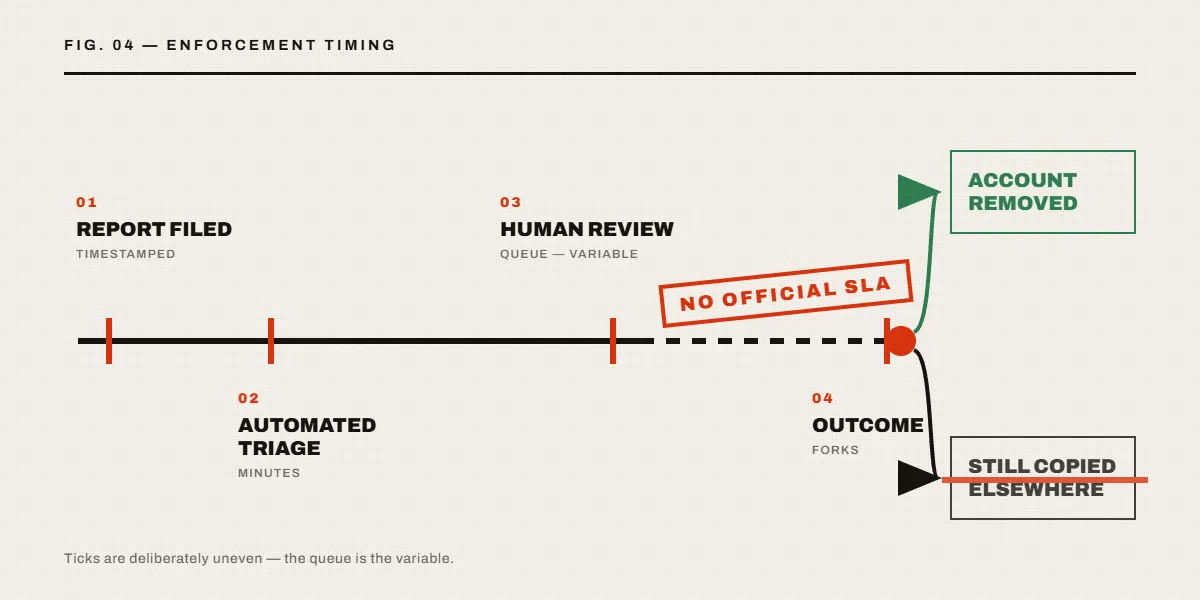
No published answer exists, and anyone quoting you a figure invented it. X sets no service level for report review — not 24 hours, not 48, not seven days. Numbers circulating in guides and forum threads are individual anecdotes that got promoted to rules.
What X does publish is the shape of enforcement rather than its speed. Its enforcement options run as a ladder: a label or a reach limit, then read-only mode, then a temporary lock requiring deletion of the offending post, then permanent suspension, with severe categories skipping straight to the last rung. Where your report enters that ladder depends on category and evidence, never on how long you have been waiting.
Two things genuinely move the clock. Automated classifiers act within seconds on content matching a known signature, which is why an obvious spam report can resolve before you close the tab. Human review of a contested harassment or impersonation claim joins a queue, and queues answer to volume rather than to your urgency.
In our own casework, a well-evidenced impersonation report honestly runs in days rather than hours, and a meaningful share need a second filing before anything moves. Read that as an observation from our files, not a promise. We do not sell turnarounds.
The related question people usually mean — how long a suspension lasts — has firmer edges: temporary locks are commonly reported at twelve hours to a week depending on the breach, while permanent means permanent, subject to appeal. Volume, incidentally, accelerates none of this, a myth Tomás took apart in his teardown of X mass-report bots and one that plays out identically inside TikTok's review queue.
Can you pay to get an account suspended?
Search how to get someone's twitter account banned and the paid market surfaces within two results. It resolves into resold free reports, brigades run from farmed accounts, and a restoration con. We took the economics of that market apart separately, and the Instagram version sells the identical product in a different coat, so this section stays short. Two points belong here, though, because they change what you do next.
Money buys nothing you lack. Every category above is free to file, filing quality is the only variable, and paying hands the one part you should control to someone with no stake in getting it right.
Commissioning it also drags your own account into range. Coordinated reporting breaches X's rules on their own terms, and enforcement in that scenario runs toward the reporters. Someone searching how to get someone's twitter banned rarely pictures themselves as the account that ends up limited. It happens often enough that we mention it first.
What we will and will not take on is written into our scope of engagement rather than left to a sales conversation. We file no report we believe to be false, we run no report campaigns, and we ask nobody for a password.
What a suspension still won't reach
Suppose the report lands and the account goes. The thing you actually came here about may be sitting exactly where it was.
Enforcement operates on the account, not on the record it left behind. Reposts belong to other users, and X hands you no mechanism to reach them. Screenshot threads, third-party mirrors and archive snapshots sit outside the platform's authority altogether. Where the damage has already migrated to a blog post or a forum, an X suspension does not touch a word of it.
Then there is the category nobody sells honestly. Accurate reporting by a news outlet, a genuine court or company record, an opinion the law protects: X will not remove these, and we will not pretend otherwise. Filing something we believe untrue is a line we hold for practical reasons as much as ethical ones, since a bluffed notice gets reversed, identifies whoever sent it, and hands the other side a better story than they started with. Those boundaries live in the disclaimer rather than buried in small print.
Where content cannot lawfully be removed, the remaining lever is suppression — de-indexing where the law allows it, outranking it where it does not. Tomás handles that side, and the mechanics are the ones we set out for Instagram takedowns. It is a weaker instrument than deletion. For a true-but-damaging article, it is also the only one there is.
If the account is aimed at you
Most people typing these queries are not attacking anybody. They are being impersonated, followed, exposed, or quietly dismantled under their own name, and "get them banned" is simply the first idea to hand.
Split the problem in two before doing anything else. The account is a platform matter: report it under the correct category, evidence it properly, and report the returning version as evasion the moment it appears. The content is a separate matter, and usually the one doing the actual harm — a defamatory claim, a leaked image, a fake profile surfacing when somebody searches your name. That second half is our work.
Intimate-image cases are the exception to every process on this page. They are triaged first, free, and they require you to send us nothing: StopNCII.org matches on a hash of the image, so participating platforms can block it without anyone opening the file.
None of this is platform-specific — the same reporting myth runs on Instagram, and it collapses for the same reasons. Further practice notes are collected in our briefings.
What we do first is work out which of the four bans at the top of this page your situation actually needs, then say plainly if the answer is none of them. That review costs nothing and commits you to nothing. Talk to the desk when you are ready.