A WhatsApp account is a phone number
On most platforms the account and the identifier come apart. Someone picks a handle, the handle changes, the account survives. This service is built the other way round: the account is the number. Which is why searches for how to ban someone whatsapp number and how to ban someone whatsapp account arrive in the same place. On this service they describe one object.
That has a consequence people find deflating for about a minute, and useful afterwards.
You cannot ban a number. Only WhatsApp can, and it acts on evidence its reviewers can see rather than on the force of a request. What sits inside your control is narrower than the search suggests and considerably more effective: blocking, reporting the right object in the right way, and preserving proof before it erases itself. We drew the same line for X in what you actually control when you want someone banned, and it falls in the same position here — with one complication no other platform carries. Every chat is end-to-end encrypted by default, which means WhatsApp cannot read a word of it.
The real question is therefore not how to ban a number. It is what WhatsApp can see, and how you make certain the part it sees is the part that matters.
Policy described here is current as of July 2026. It is briefing material rather than legal advice.
Being harassed, impersonated or blackmailed on WhatsApp? Ask us for a confidential review. You will hear which route fits your case before anyone pays anything, and you will hear it plainly if the honest answer is not a ban.
What WhatsApp actually receives when you report
A report is not a message to a human. Think of it as a packet whose contents are fixed before you tap anything.
WhatsApp's Help Centre states that when you report a contact it receives "up to five of the last messages they've sent to you", along with the reported user or group ID and information about when each message was sent and what type it was — image, video or text. Where calls are involved it also gets basic information about the last five, including who placed them and how long they lasted (WhatsApp Help Centre). Note the direction of travel. Five messages they sent to you, not the last five in the thread, and nothing you wrote. Everything outside that window stays encrypted, and WhatsApp holds no copy it can go back and consult. A reviewer therefore judges your case on a five-message extract chosen by nothing more sophisticated than recency. That single mechanical fact governs almost every practical decision below: report while the abusive messages are the most recent ones, and do not let a fortnight of ordinary conversation push them out of the frame.
Two further details change how people act once they know them.
The reported person is never told. Nothing reaches them at any stage, and the Help Centre says so in as many words: the user or group won't be notified. Fear of retaliation suppresses a great many reports that should have been filed, and that fear is misplaced.
Reporting also does not block. The two are separate actions sharing one screen — a tickbox on Android and Web, a choice between "Report" and "Report and block" on iPhone. Filing a report and assuming contact has stopped is among the commonest errors we see.
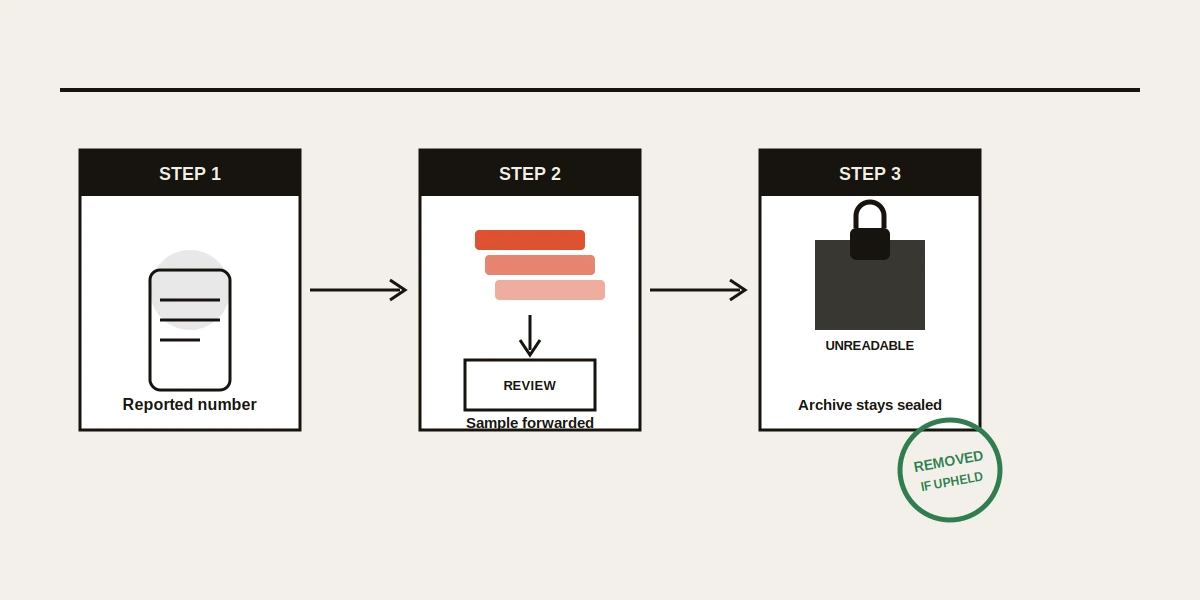
How to ban someone from WhatsApp: the sequence that reaches a reviewer
Order matters more than effort here, because the evidence lives on your handset and the report window only looks backwards five messages.
- Screenshot before anything else. Your chat history sits on your device, not on WhatsApp's servers. Capture the abusive messages with the sender's number visible, plus timestamps, and store them somewhere outside the app.
- Do not delete the chat, and do not clear it. Deleting destroys the five messages the report is going to carry.
- Report the object that actually breached the rules — the contact for a stream of abuse from one number, the group for a group, the specific message where that is what the interface offers.
- Tick the block option in the same flow, so contact stops while the review runs.
- Stop replying. Your own messages are not transmitted, so nothing you write improves the case, and engagement is what most harassment and sextortion scripts are waiting for.
Evidence that deletes itself is a problem we have written about before in a different setting, and the discipline transfers unchanged: see how to capture proof before it disappears. The category you choose matters too, in the same way it does across Meta's other report routes.
"How to ban someone WhatsApp account" — what that search usually means
Three different jobs hide inside that phrasing, and only one of them belongs to WhatsApp.
Getting someone out of your WhatsApp is entirely yours and takes under a minute: block the number, and in Settings restrict who can add you to groups and who can see your photo, status and last seen. Getting someone off WhatsApp altogether belongs to WhatsApp and to nobody else. And getting somebody removed from a group you run belongs to you as admin, with a wrinkle worth knowing.
Groups: removing is not banning
An admin can remove a member instantly, and the removed person is not sent a notification. What WhatsApp does not maintain is a per-group ban list. Removal does not prevent a return through a live invite link, so resetting that link is the step people forget. Reporting a group behaves differently again: on Android and Web, reporting a group removes you from it, and rejoining requires a fresh invitation from an admin. On iPhone you are offered "Report group" and "Report and exit" as separate choices.
Does report volume matter on WhatsApp? Unusually, yes — but not as a vote
Across every other platform we work, the honest answer to this is a flat no. WhatsApp is the exception, and the exception is narrower than the people selling ban panels would like you to think.
WhatsApp's own Help Centre says it "uses both machine learning technology and reports from users to detect and ban accounts", and elsewhere states directly that it bans accounts that are reported multiple times. So reports do feed enforcement here in a way they do not on YouTube or Facebook. What WhatsApp does not run is a threshold. Its published anti-abuse material explains the reasoning: if its systems looked only at report rates and banned anything crossing a line, coordinated attacks could knock legitimate users off the platform, so it weighs the relationship between reporter and reported instead. Strangers filing in concert against someone they have never messaged is precisely the pattern that machinery is built to discount. A report from a person the account actually messaged carries weight. Fifty from accounts it has never contacted look like the attack they are.
Which leaves the brigading buyer in the worst position available. The technique is discounted by design, and the attempt is itself a breach.
WhatsApp's Terms of Service prohibit misusing any reporting channel, "such as by submitting fraudulent or groundless reports or appeals", and its Messaging Guidelines bar "adversarial behavior", defined to include efforts to "abuse reporting tools". The panels advertising WhatsApp number bans are the same rented-account trade we took apart in the Telegram panel market, sold with the same promises we examined in the spam-report bot myth. The seller carries none of the exposure. The buyer carries all of it.
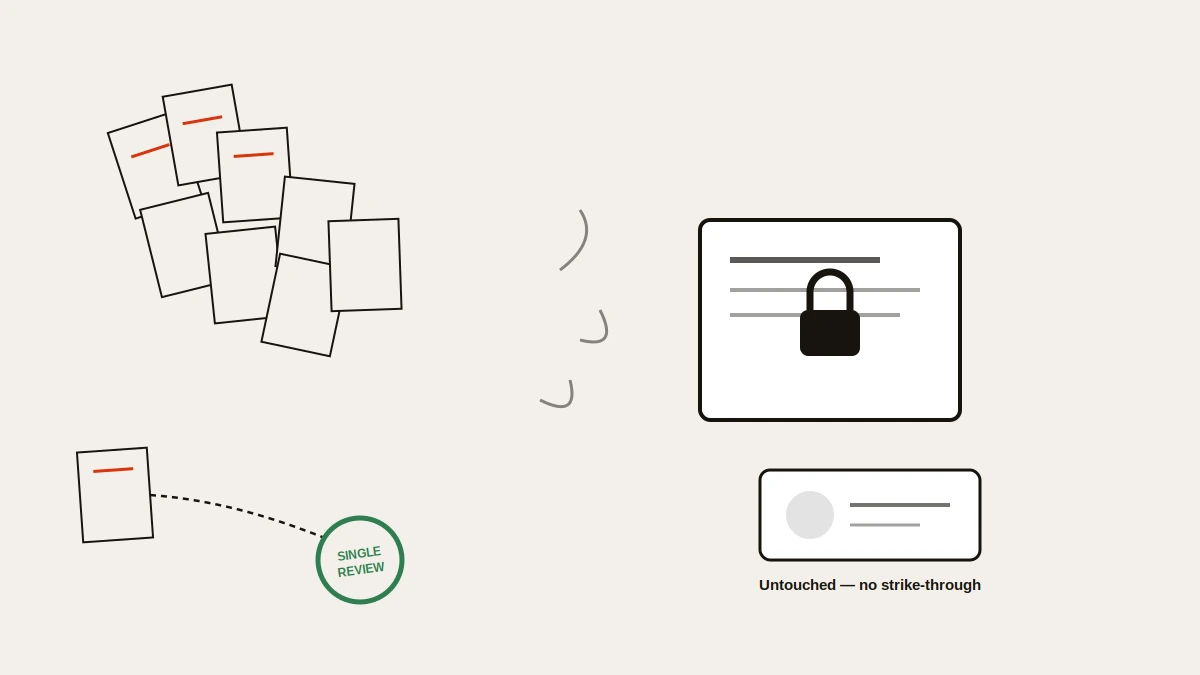
What WhatsApp bans accounts for
The enforceable list is short and mostly not about how badly somebody behaved in your chat.
Bulk messaging, auto-messaging and auto-dialling are barred outright by the Terms of Service, as is any non-personal use that has not been authorised. Modified clients — GB WhatsApp, WhatsApp Plus and the rest — are a separate, reliable trigger, as is creating accounts or groups by automated means. Harassment, threats, impersonation and sexual exploitation are actioned through the report route described above.
The scale is easier to read from WhatsApp's Indian compliance filings than from anything it publishes elsewhere. Between 1 and 31 May 2026 it banned 7,214,702 Indian accounts, of which 1,379,438 were removed proactively, before any user had reported them (WhatsApp India Monthly Report, published 1 July 2026). Turn that around and close to six million enforcement actions in a single month began with a signal from somewhere else, reports among them. The same filing logs 19,859 grievances received that month, of which 10,590 were appeals from people who had themselves been banned — the largest single category by a wide margin, and a useful corrective to the assumption that these bans are rare or hard to trigger. WhatsApp recorded 399 accounts actioned across all those grievances, a figure that counts restorations as well as bans.
Meta's enforcement grammar is consistent across its apps, and we mapped the parent version of it in how Meta counts violations rather than complaints.
The ban screen, and the only appeal that works
Worth knowing from either side of the case, because the wording tells you exactly which state an account is in.
There are three. A restricted account carries the notice "Your account is restricted right now"; there is nothing to appeal, and it lifts on its own. A temporarily banned account is the warning issued for unofficial clients or data scraping, and it converts to permanent if the behaviour continues. A banned account shows "This phone number can't use WhatsApp", with a Request review button and the line "Most reviews are completed within 24 hours" (WhatsApp Help Centre).
That button is the entire appeal process. There is no second channel.
Here is the part worth carrying away, because it wastes weeks of people's time. Support requests by email are no longer accepted at all. Messages to [email protected] and every other @whatsapp.com address go unread, and WhatsApp's support page now warns specifically that any support email address you have seen recommended on a blog or by an AI assistant is outdated (WhatsApp Help Centre). If the app will not open, the substitute is the web form at whatsapp.com/contact. When we handle these, the first thing we check is whether a client has spent a fortnight emailing a decommissioned mailbox. Often enough, they have.
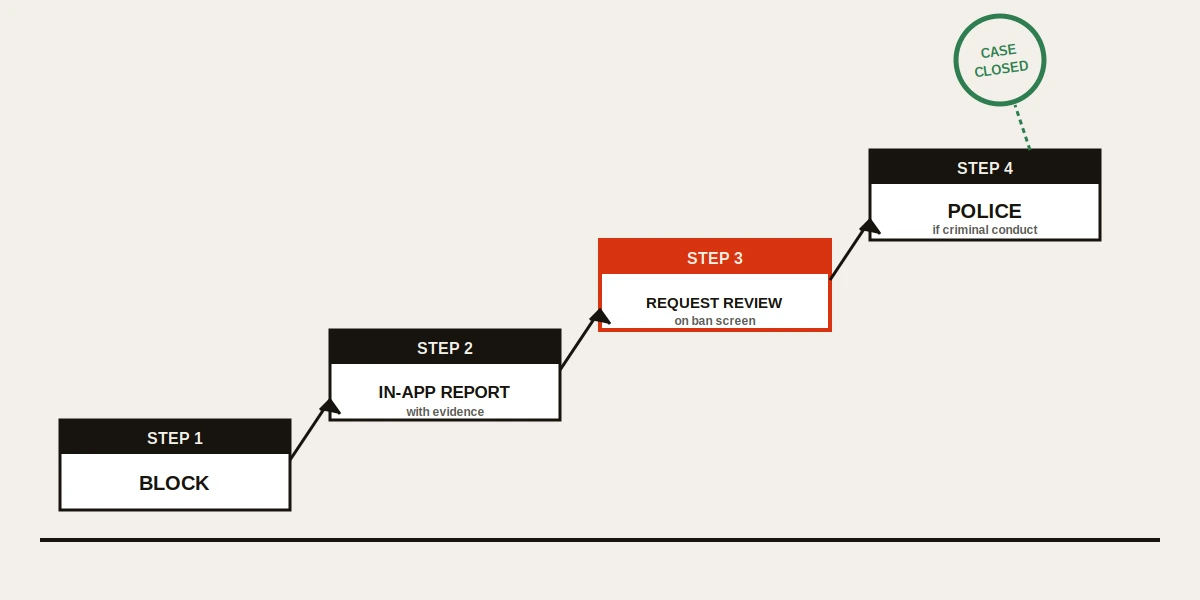
The bodies above WhatsApp, and the one door that is shut
Two escalation routes exist above the platform, and which one you have depends entirely on where you are.
In India, the Grievance Appellate Committee hears appeals against a platform's handling of a complaint. You have 30 days from the Grievance Officer's response to file at gac.gov.in, the process runs online, and Rule 3A(4) of the IT Rules 2021 requires the Committee to endeavour to resolve within thirty calendar days. Rule 3A(7) makes its orders binding on the platform, and the mechanism is not decorative: WhatsApp's May 2026 filing records 15 GAC orders received and 15 complied with.
In the EU, the equivalent door is shut, and almost nobody says so.
Article 21 of the Digital Services Act lets users escalate account decisions to a certified out-of-court dispute body, and the best known, Appeals Centre Europe, overturned platform decisions in 59 per cent of the cases where it got a substantive look. It does not take WhatsApp cases. Its certified scope covers Facebook, Instagram, Pinterest, Threads, TikTok and YouTube. Designation as a Very Large Online Platform arrived in January 2026, but it attaches to the public Channels feature, and private messaging sits outside the definition (European Commission, 26 January 2026). A European reader appealing a WhatsApp account decision has the in-app review and, where the conduct is criminal, the police. Anyone promising a DSA appeal on a WhatsApp ban is selling something that does not exist. Our team and what we actually file is published for the same reason.
If the abuse involves intimate images
Read this part before you act, because the tool most people are pointed to does not work here.
StopNCII lets an adult create a hash of an intimate image on their own device, so the picture itself never leaves the phone, and it has protected more than two million images. None of that reaches WhatsApp. Its FAQ is explicit that it works only on public-facing platforms, because "most messaging platforms use encryption which means hashing technologies do not apply" (StopNCII.org). There is nothing inside an encrypted chat for a hash to match against.
So the sequence inverts. Report and block inside WhatsApp first, since that is what reaches a reviewer, and screenshot for your own record before you do. Then file the StopNCII case anyway — not to police the chat, but to pre-emptively block the same image if the sender tries to post it to Facebook, Instagram, Threads, X, Reddit, TikTok, Snap or Bluesky, which is where lasting damage is actually done. If the person depicted was under 18, use NCMEC's Take It Down instead, which works the same way and is built for minors. In the United States the TAKE IT DOWN Act has required covered platforms to remove reported material within 48 hours since 19 May 2026, though how that duty applies to encrypted messages has not been tested — a platform cannot delete what it cannot see. Treat in-app reporting, not the statute, as your practical lever inside WhatsApp itself.
We never ask you to send us the material. Not to assess a case, not to prove one. That has no exceptions.
What a ban never reaches
A ban ends an account. It does not retrieve anything.
By the time somebody searches for a way to ban a number, the screenshots have usually travelled — into other chats, onto a forum, sometimes onto a page that Google has indexed. WhatsApp's decision reaches none of that. Removing content from a platform and clearing a search result answer to different authorities on different timetables, a divide we mapped in removal versus suppression. A banned number returns on a new SIM within the hour, too. And there is a newer gap worth knowing: under the EU's interoperability rules, WhatsApp's Help Centre warns that someone you blocked "might be able to message you through third-party apps", which requires a fresh block inside that chat. A block you believe is permanent may not be.
Where we stop is fixed and stated before money changes hands. We do not sell, build or recommend a WhatsApp ban bot or panel, because the technique is discounted by design and the buyer carries the consequence. We do not forge legal notices or threaten litigation nobody intends to file. We will not ask for your password. True accounts of events, genuine records and honestly held opinion do not come down whatever anyone charges to try, and cases like those are won by outranking rather than deleting — you will hear which of the two you have in the first conversation rather than after three invoices. Our limits are published in full, and the rest of the briefings are worth reading before anyone takes your money for a ban.