
Telegram mass report panels are sold on Telegram, not built into it
Search the phrase and the results fall into two piles: code repositories, and shopfronts. Both sell the same thing under different labels, and neither is a Telegram product. That distinction decides what a seller can actually deliver, and, if you are the one being targeted, what you are defending against. We work both sides of it at Obscura. The supply routes behind these tools look almost identical whichever platform they point at.
What you are actually renting when you buy a telegram mass report tool
A telegram mass report tool is a pool of logged-in Telegram accounts plus a script that walks each one through the report flow. That is the whole product. The accounts are burner registrations bought in bulk, or real accounts whose session files were stolen by infostealer malware. Cyfirma's write-up of PupkinStealer and Flare's research into session-stealer markets both document the desktop tdata folder being lifted straight off a victim's machine. A session string is the account. A password and two-factor authentication do not stop it, because the thief inherits an already-authenticated session.
Pricing sits where you would expect for something with almost no marginal cost. Panels advertise around 0.90 US dollars per thousand reports (panel listings, checked July 2026), while hijacked accounts with real posting history resell for roughly 20 to 200 dollars each, according to AlgorithmWatch's reporting on the trade. You are renting other people's stolen credentials by the thousand. That is the transaction, stripped of the dashboard.
Why a telegram mass report bot is not a bot at all
Telegram's documentation settles this in one line. The MTProto methods that file a report, messages.report and account.reportPeer, both carry the same note: only users can use this method. The Bot API, which is what everybody means by a Telegram bot, has no verb for reporting content to Telegram. A bot can restrict or remove someone inside a chat it already administers. It cannot tell Telegram that a stranger's channel is abusive.
So the product is a userbot: a script driving an ordinary user account through the normal client protocol, usually with Telethon or Pyrogram. The branding is marketing. We ran the same test on X and found no bulk-report endpoint there either, which is not a coincidence. Report volume is a moderation signal, and no platform hands out programmatic control of its own moderation signals.
Instagram mass report telegram channels: the cross-platform trade
The bigger business is not reporting Telegram. It is selling access to other platforms from inside Telegram. Instagram mass report telegram channels operate as open storefronts: a pinned price list, a bot that takes orders, a payment handle, and a customer base that never learns whose accounts are doing the work. AlgorithmWatch traced this trade across roughly 400 targets in 40 countries, and quoted Meta describing coordinated or automated reporting as abuse of its reporting systems, which it says it has invested significantly in detecting.
Telegram, in that model, is the market square rather than the merchandise. It also explains why the search demand looks so strange. People query the platform where the stall sits, not the platform being attacked. We have written separately on why a flood of reports tends to boomerang onto the senders. The sellers know this, and they price accordingly.
Telegram mass report volume does not decide anything
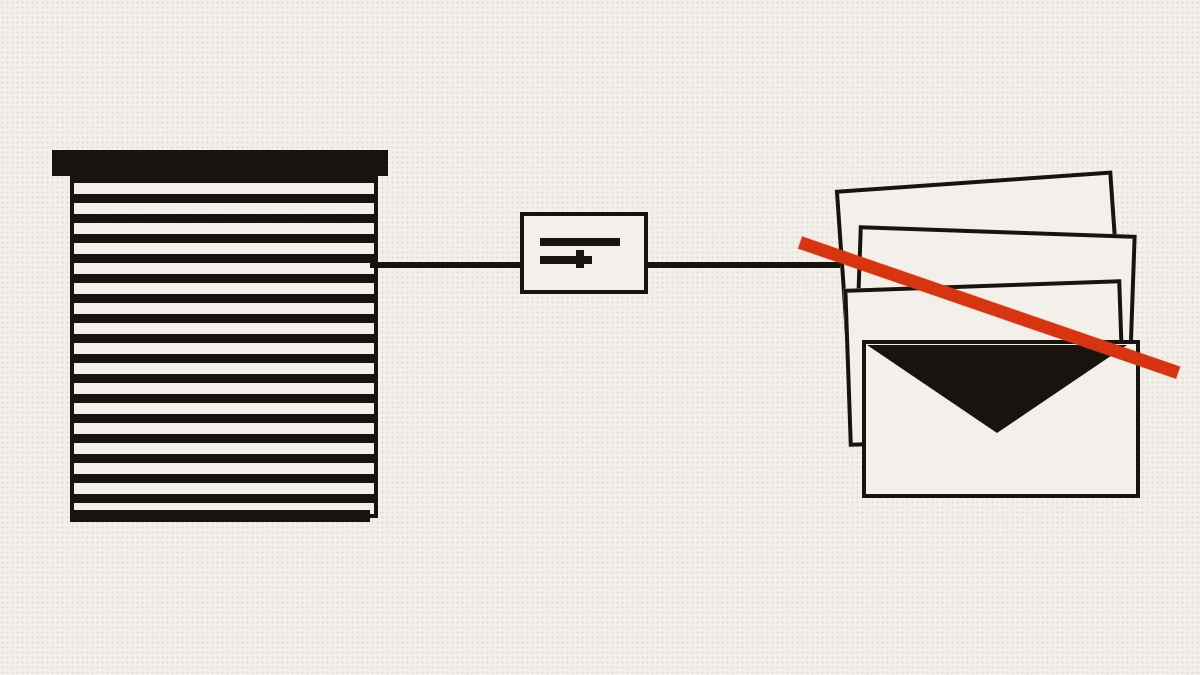
Every panel implies the same arithmetic: enough reports, and the channel dies. Telegram's own published material describes a different process, and so does every enforcement pattern we have watched. The counter is not a threshold. Meta works the same way, which is why we keep repeating that violations are counted, not reports.
Telegram mass reporting: how it works, detection and abuse policy
Here is the mechanism end to end. A report is filed from a client, tagged with a category, and forwarded into a moderation queue. Telegram's spam and abuse FAQ states that reports are passed to its team of moderators for review, and that an account is limited only if the moderators decide it should be. The decision point is a person reading a case, not a tally crossing a line.
Detection cuts the other way too. Telegram's API terms warn that accounts used for flooding, spamming or faking will be banned forever, and that logins from unofficial clients are automatically placed under observation, which is exactly what a userbot pool looks like from the inside. Telegram's public moderation counter showed roughly 19.7 million groups and channels banned during 2026 to date when we checked in July 2026. Almost none of that volume comes from user reporting.
What happens when strangers mass report Telegram account and channel pages
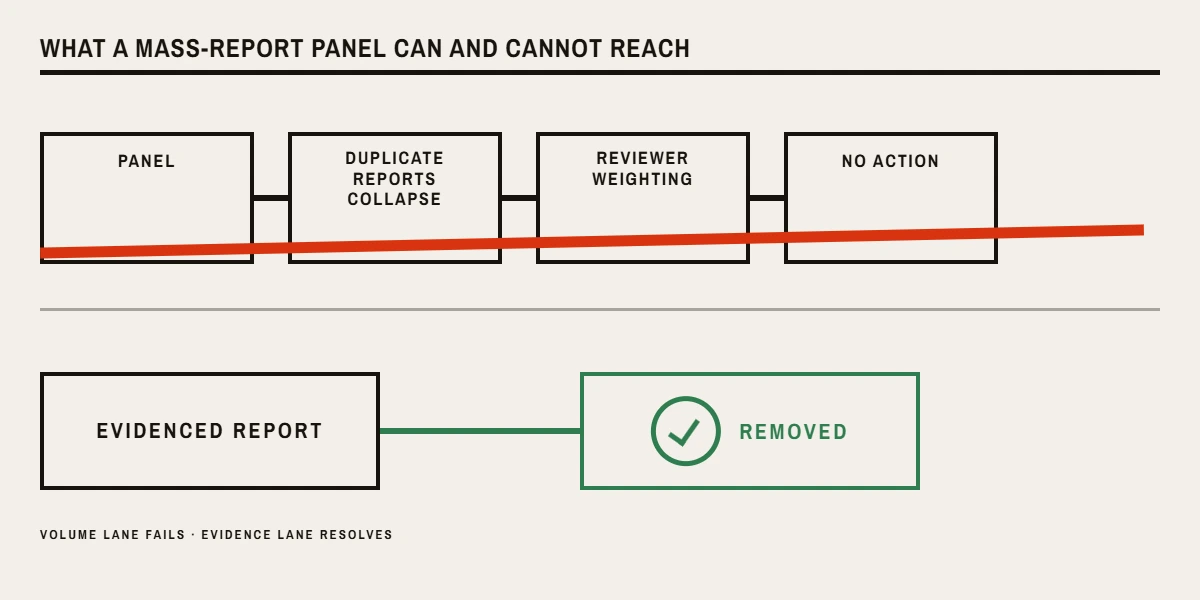
Duplicate reports against the same object collapse into one case. That is ordinary queue design rather than a Telegram secret, and it is why a thousand identical submissions reach a moderator's desk looking like a single complaint with an unusually long sender list. If the underlying content breaks a rule, one honest report was already enough. If it does not, ten thousand will not manufacture a violation.
What the volume does change is context. A moderator who can see that a complaint arrived from hundreds of accounts registered in the same week, sharing an IP range, is now looking at a brigading pattern rather than a content problem. We described the same dynamic on TikTok, where enforcement is algorithmic rather than crowd-triggered. A report is evidence. Evidence does not get stronger by being photocopied.
The telegram mass reporter usually gets actioned first
The exposure runs in an order most buyers never consider. The burner pool goes first, because that is what the flooding clause exists for. The customer's own account goes next, if the order was placed from it or from the same device. Telegram's bot developer terms separately prohibit operating by proxy on somebody else's credentials to dodge moderation. The target is last, and only if a moderator independently agrees that the content breaks a rule.
Then there is the money. Paying a panel buys a position in a queue nobody controls, with no refund mechanism and no service you could complain about to anyone. We took the same look at the paid ban market on X and found the buyer carrying the legal exposure while the seller carried none of it.
| What the panel advertises | What actually happens |
|---|---|
| Ten thousand reports, guaranteed ban | Duplicates collapse into a single moderator case |
| Automated Telegram report bot | Userbot scripts running on stolen or burner user accounts |
| Works on any channel or account | Only works where a real rule was genuinely broken |
| Fast delivery, tracked in a dashboard | The dashboard tracks submissions, never decisions |
| Anonymous and risk-free | Reporting pool and buyer account both exposed to permanent bans |
Telegram channel mass report routes that actually reach a human
Everything a panel sells is already free, already available to you, and already more likely to work. Telegram publishes several routes, each pointed at a different kind of harm, and picking the wrong one is the most common reason a legitimate complaint goes nowhere. As of July 2026, these are the ones we use.
| Route | Use it for | How to file | Realistic expectation |
|---|---|---|---|
| In-app Report | Anything visible to you in a chat, channel or profile | Long-press or three-dot menu, pick the precise category, add detail | Fastest route; category accuracy matters more than length |
| [email protected] | Harassment, threats, impersonation, coordinated abuse | Email with t.me links, screenshots and timestamps | Days rather than hours; a clean evidence pack moves it |
| [email protected] | Your copyrighted work reposted without a licence | Formal notice identifying the work and the infringing links | Strongest lever wherever copyright genuinely applies |
| @NoToScam | Financial scams, fraudulent sellers, investment fraud | Report the account in-bot with evidence attached | Purpose-built queue, better than generic abuse mail |
| [email protected] | Child sexual abuse material | Email immediately, and report to national authorities too | Highest priority; documented on Telegram's own X account |
When the in-app report beats every telegram mass report script
For most complaints the in-app report is not the weaker option, it is the correct one. It attaches your account, the exact object and a category that routes the case to reviewers who handle that category. A script cannot do any of that better. It can only do it repeatedly.
Two details change the outcome more than volume ever will. Pick the narrowest accurate category, impersonation rather than spam if the account is pretending to be you, because a miscategorised report lands in the wrong queue and dies there. Then write the description as though the reviewer has thirty seconds and no context, because roughly speaking they do. Quote the message, name the rule, link the profile. That is the same discipline we apply when routing an Instagram complaint, and it is why single reports from our desk tend to outperform campaigns.
The four addresses that reach a moderator
Telegram's email routes are badly underused, mostly because people do not know they exist. [email protected] handles harassment, threats and impersonation. [email protected] handles copyright, and it is the strongest lever available to anyone whose own photographs, video or written work has been reposted, because copyright is a legal right rather than a policy preference. @NoToScam is a dedicated bot for financial fraud. [email protected] is the child-safety route, documented on Telegram's own X account rather than in the FAQ.
Two corrections to what circulates online are worth making. Private chats have been reportable since September 2024; only secret chats sit outside Telegram's reach, because Telegram cannot read them. And sticker packs have their own removal path through the delpack command rather than the general abuse queue.
What a telegram mass reporting service charges you for something free
Strip a telegram mass reporting service down and the product is a form-filling gig with a markup. The routes above cost nothing. The evidence pack costs an afternoon. What the buyer is really paying for is the feeling that something automated and large is happening on their behalf.
Where paid help earns its fee is the part panels never touch: deciding which route fits the harm, assembling evidence that survives a sceptical reviewer, escalating when the first answer is no, and handling the search-result problem that outlives the platform decision entirely. We wrote the equivalent breakdown of what an Instagram ban service is really selling, and the shape is identical here. Our scope and fees are published before anybody pays us anything, which is not a standard the panel market has ever been asked to meet.
Being targeted, or trying to get something genuinely harmful taken down? Send us the links for a confidential first review. We will tell you which route fits, what it is likely to achieve, and where it stops, before you pay anything.
If people mass report Telegram channel pages you own
Now the other side of the transaction. A restriction lands, the channel stops working, and the obvious explanation is that somebody bought a campaign. Sometimes that is true. Often it is not, and acting on the wrong theory burns the window in which an appeal still works. We covered the same moment from the target's seat on TikTok.
How to tell a coordinated wave from a genuine violation
Read the notice before you read the theories. Telegram's restriction messages usually name a category, and the category tells you which queue made the decision. A spam limit behaves differently from a copyright removal, which behaves differently again from a channel pulled on scam reports. If the notice cites a specific post, a moderator looked at a specific post.
The signal for an actual brigade is timing plus breadth. A wave arrives compressed: a spike in joins from accounts with no history, a burst of hostile comments seeded to justify the reports, an off-platform thread organising it. Genuine enforcement tends to be narrow and to name the thing it objects to. The block-versus-suspension confusion we untangled for X has an exact Telegram equivalent. Users can restrict what they see. Only Telegram can restrict what exists.
What to capture before it disappears
Evidence has a shelf life, and on Telegram it is short. Messages delete for everyone, channels get renamed, and the accounts driving a campaign are usually discarded once the order completes. Capture first and analyse later, which is the same rule we set out for Snapchat's disappearing evidence.
- Full-window screenshots showing the message, the sender handle and the timestamp together
- The t.me link for every offending post and profile, copied rather than retyped
- The restriction notice itself, including its exact wording and date
- Member-join graphs or admin logs covering the spike
- Any off-platform post organising the campaign, archived somewhere that timestamps it
We hold client evidence under the handling described in our privacy notice, and we never ask anyone to send us intimate material. For that, hash-matching through StopNCII does the job without the file ever leaving your device.
Appealing without making the restriction worse
Appeal once, properly. Repeat submissions from several accounts on your own side look like precisely the behaviour you are complaining about, and they reset your position in the queue rather than improving it.
State what the channel is, what the notice said, and why the cited content does not break the rule it was matched against. Attach the evidence pack. If the restriction followed a coordinated wave, say so plainly and show the timing data instead of asserting a conspiracy. Where the underlying content genuinely did cross a line, remove it before you appeal and say that you have, because moderators handle a fixed problem far more readily than a disputed one.
Expect days rather than hours, and expect silence between submission and outcome. Silence is not refusal. A second angry email inside twenty-four hours is, however, a reliable way to lose the thread.

The t.me page Google indexed is a separate problem
This is the part the panel market has no answer for, and the reason most people end up finding us. Public Telegram channels and posts have web addresses. Those addresses get crawled. So a defamatory message can be removed from Telegram and still be sitting on page one for your name, held in a search index that never got the memo.
Why a Telegram removal does not clear the search result
Search engines and platforms keep separate records. When Telegram deletes a post, the t.me URL usually stops returning anything useful, but the indexed snippet, title and cached copy can persist for weeks. Third-party mirrors, aggregators and screenshot threads frequently outlive the original entirely. We have watched a successful takedown change nothing about what a client's name returned in Google for a month afterwards.
That is why we treat platform removal and search removal as two jobs running on two clocks. The first is a policy question decided by a moderator. The second is an indexing question decided by a search engine under a completely different set of rules. The same split runs through our briefing on Instagram takedowns and the removal-versus-suppression line, and it is the single thing people most often misjudge when they estimate how long any of this takes.
The de-indexing routes that apply to a t.me result
Four routes cover most cases. Google's removal request tools handle outdated content, where the page no longer shows what the snippet claims, which is exactly the state a deleted Telegram post leaves behind. Its personal-information policies cover doxxing material such as home addresses, phone numbers and identity or financial documents, and they cover non-consensual intimate imagery, which is removed on request rather than argued over.
For UK and EU subjects there is the right to erasure, the mechanism most people call the right to be forgotten. The ICO's guidance sets out when it applies and when a public-interest argument defeats it. Where none of those fit, the honest answer is suppression: building and strengthening results that legitimately outrank the one you cannot remove. Slower, far less satisfying, and frequently the only thing that works.
What we will not do at any price
We do not sell, build, rent or recommend mass-reporting panels, bots, scripts or software, for Telegram or for anything else. Not on ethical grounds alone. They do not work, and the buyer absorbs every part of the risk.
We will not file a forged DMCA notice over content we do not own, or send a legal threat we could not stand behind. Both get the page reinstated and hand the other side a story worth telling, which is how a small problem becomes a permanently searchable one. We will not ask for your password or a session string. We will not ask you to send intimate images so that somebody here can look at them.
And we will not promise removal of true reporting, genuine public records, or somebody's honestly held opinion, because none of those come down. They can be pushed down. Where a case is suppression rather than removal, we say so at the first review. Our full limits are published.

Telegram is not the hard part of this. The hard part is the record that outlasts it, the indexed page, the mirror, the screenshot sitting in somebody else's thread. That is the work Obscura does, and the rest of our platform-by-platform briefings are worth reading before you spend money on anything with a dashboard.