Who is actually asking this question
Nine phrasings land on this page and they do not represent nine situations. They represent four.
Someone is being harassed and wants it to stop. Someone has found a profile wearing their photographs and their name. A shop owner is watching an anonymous account invent claims about their business. And a group smaller than the wording suggests simply wants an argument to end with the other person gone.
Only the last group is looking for a weapon.
This is not the page that hands one over. What follows describes how Meta's enforcement machinery behaves: what triggers it, what has never triggered it, and the point where the process runs out and something else has to take over. That description serves all four readers equally, which is the reason to write it instead of a five-step listicle.
One correction first, because it saves people weeks. Getting somebody out of your Facebook is a different job from getting them off Facebook. The first is entirely yours — block, restrict, remove and ban from a group you admin, tighten who can find you by phone number or email — and it takes about a minute. The second belongs to Meta and to nobody else, and no amount of effort on your side converts one into the other. We drew the same boundary for X in what you actually control when you want someone banned, and it sits in the same place on every platform we work.
Policy described here is current as of July 2026. It is briefing material rather than legal advice, and our limits are set out plainly.
How does someone get banned from Facebook?
An account is actioned when its conduct matches a defined line in the Community Standards and a review confirms the match. That is the entire mechanism. Everything else is detail hanging off it.
The categories are specific: harassment and bullying, credible threats of violence, hate speech, adult sexual exploitation, impersonation, fraud and scams, coordinated inauthentic behaviour, sale of restricted goods, child safety violations. Each carries its own evidentiary shape. A complaint that does not land squarely inside one of them has nowhere to be routed, and it dies at triage rather than being rejected in any way you would notice.
Three factors then decide what happens. Severity of the violation. The account's live strike record. And whether the reviewer, automated or human, can see the violation in what you actually submitted — which is a narrower question than whether the violation happened.
What plays no part is the number of complaints. Meta states this directly: reporting content does not guarantee removal, and the volume of reports is not what the review turns on (Facebook Help Centre). It is the most expensive misunderstanding in this entire subject. It is also why organised pushes so reliably produce nothing except a tired group chat and, occasionally, consequences for the people in it.
Strike systems behave much the same across the industry, which matters if the same person is troubling you on more than one service. We took the equivalent apart in our TikTok briefing, and the conclusion transferred without modification. Category, evidence, standing. Never volume.
The strike clock nobody reads
Here is the part almost no guide on this subject covers, and it changes what is realistic.
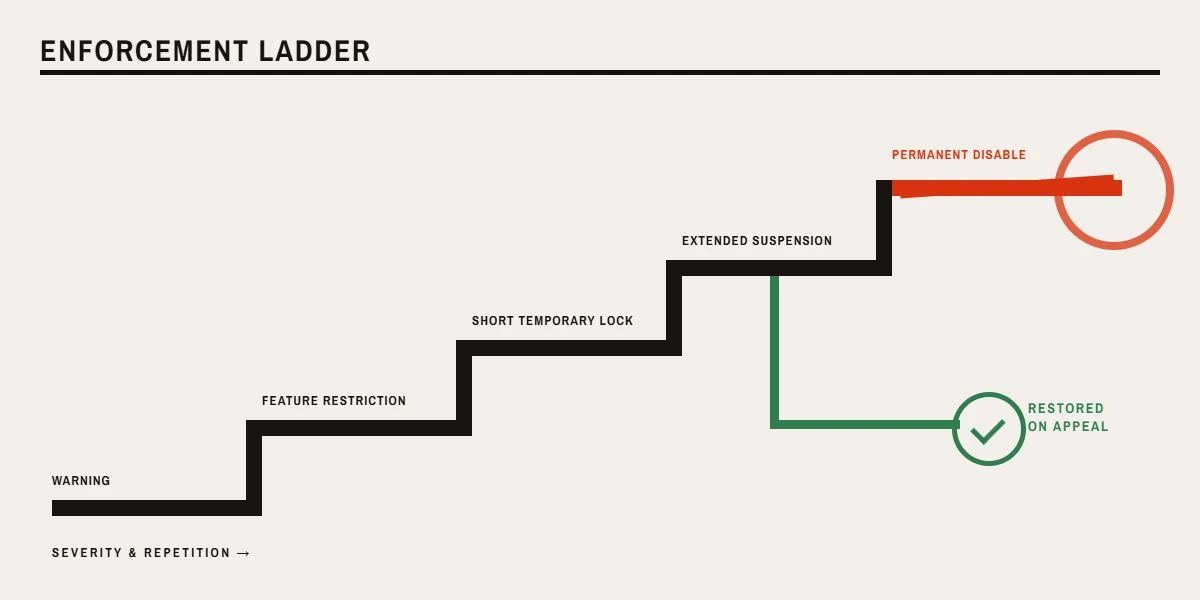
Strikes are not permanent. Under Meta's published enforcement framework they expire one year after they are applied. Beyond that, violations older than 90 days generally stop counting toward new restrictions at all, and for the most severe categories the lookback window runs to four years (Meta Transparency Center, updated 23 April 2025).
Read that again with a campaign in mind.
A patient effort to accumulate strikes against somebody is racing a clock that resets underneath it. Two strikes land in March, a third the following February, and the first has already fallen off the ladder. The escalation described in Meta's account restrictions documentation — a warning, then progressively longer limits on creating content — only bites when strikes land close enough together to stack. Spread them out and the ladder never assembles.
How to get someone permanently banned from Facebook
The honest answer has two halves and neither is a method.
You cannot construct a permanent ban out of minor infractions, for the clock reason above. And you do not need to construct one, because permanent removal is reserved for conduct severe enough to skip the ladder entirely. Meta's framework confirms that certain violations — child sexual exploitation is the clearest example — disable an account on a single confirmed occurrence, with no accumulation required.
So the question inverts. Permanent bans are not earned by reporters. They are triggered by the account holder doing something the platform treats as disqualifying on its face. If what you are looking at genuinely sits in that band, one accurate report through the correct channel is the whole job, and speed matters far more than volume. If it does not, no quantity of reporting will promote it there.
Which route matches which violation
Facebook does not have one report button. It has a switchboard, and choosing the wrong socket is the commonest reason a legitimate complaint never reaches a decision.
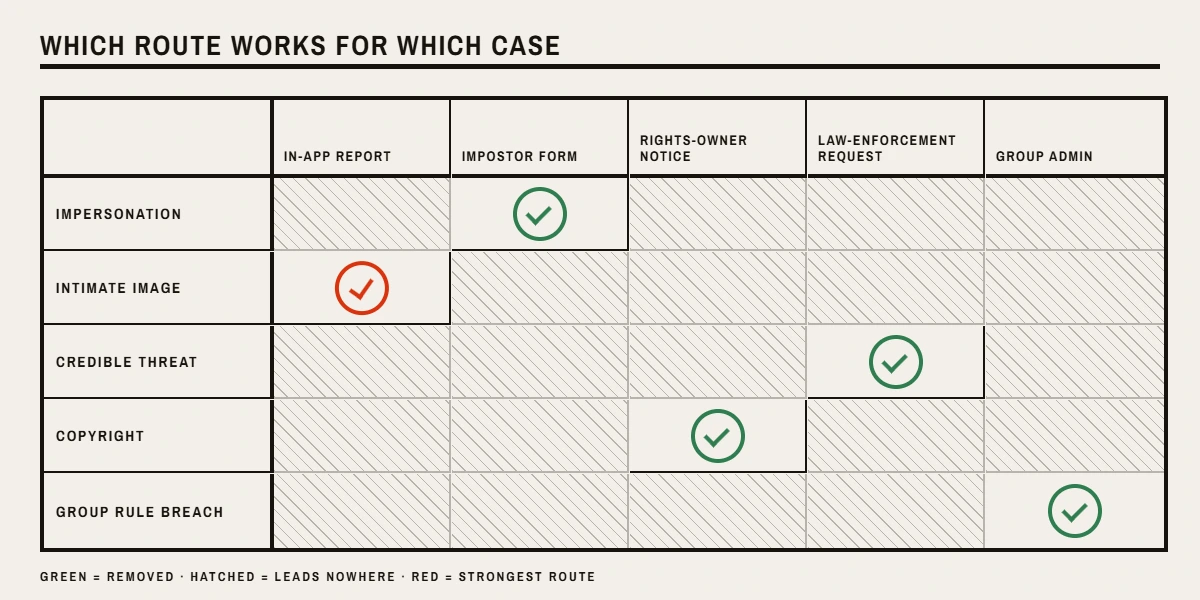
| What you are reporting | Where it actually goes | Who has standing to file |
|---|---|---|
| Harassment, threats, hate speech | In-app report on the post or profile | Anyone who can see it |
| Impersonation of you | Standalone impostor form, works logged out | The impersonated person or a guardian |
| Your photographs or video reused | Copyright notice under 17 U.S.C. § 512 | The rights holder only |
| Intimate images shared without consent | StopNCII or Take It Down hash-matching | The person depicted |
| Someone breaking your group's rules | Group admin tools: remove, mute, ban | Admins and moderators |
| Immediate danger to a person | Emergency services first, platform second | Anyone |
Two of those rows deserve expansion, because they are the ones people get wrong.
How to get someone's account banned on Facebook for impersonation
Impersonation produces both the highest conversion rate we see and the most wasted effort, frequently inside the same case. The route is a dedicated form rather than the in-app flow, and it works while logged out — which matters enormously when the impostor has already got your real account locked or reported.
The constraint is standing. That form is built around the impersonated person proving identity. A friend filing on your behalf is filing into a process that was not designed for them, and it usually goes nowhere at all. If you are helping somebody, help them file it themselves.
The same architecture governs Instagram, since both sit on Meta's review infrastructure, and our Instagram briefing covers those forms in more detail. Where the evidence expires — Stories, disappearing messages, anything on a timer — the capture discipline in our Snapchat briefing applies unchanged: secure it first, report it second. Anything you send us during a review is handled under our data policy, and we do not retain material we have no reason to keep.
How can you get someone banned from Facebook faster? You can't
There is no accelerator. There is a decelerator, and most people reach for it by accident.
Organising a group to report the same target is not a neutral act on Meta's systems. Concerted misuse of reporting tools falls under the Inauthentic Behavior policy (Meta Community Standards). Detection here needs no sophistication. Forty accounts filing near-identical complaints against one profile inside an hour is a conspicuous signal, and the usual outcome is that the reports are discounted as a set while the reporting accounts get a closer look than the target does.
Search phrasing carries the assumption buried in the question. How to get someone banned on facebook, how to get someone facebook banned, how to get someone's facebook banned — each presumes a lever that scales with effort. There is no such lever, and the tooling sold on the promise of one is a separate problem entirely.
Facebook has no public reporting API. Nothing calling itself a mass report bot is talking to Meta. It is driving a browser against farmed accounts, or harvesting your credentials, or doing nothing whatsoever behind a progress bar. We have documented all three variants: the spam report bot myth explains why Meta has no bulk endpoint by design, the GitHub and APK panels investigation sets out what those downloads actually collect, and the X teardown shows the identical architecture on another platform.
Copyright warrants its own warning. A DMCA notice is a sworn statement, and filing one in bad faith carries liability under 17 U.S.C. § 512(f) for damages and legal costs. It is the fastest removal route on the internet when you genuinely hold the rights. It is the fastest route to a lawsuit when you do not.
What a "Facebook ban service" is actually selling
The market is old and the pitch has not changed in a decade. A handle, a fee somewhere between twenty and three hundred pounds, removal promised inside twenty-four to forty-eight hours.
Three things sit behind it. A brigade of throwaway accounts, which Meta screens for and which the section above just explained is counter-productive. An invoice for filing the free report you could have submitted yourself in ninety seconds. Or a phish, dressed as a verification step, that wants your login or your six-digit code.
The sales page is portable. We have taken the same operation apart as an Instagram ban service and as a Twitter ban-for-hire, and the copy is close to interchangeable. The platform name swaps. Nothing else does.
The tell is always the guarantee. Enforcement is Meta's decision, made against Meta's standards, by Meta's reviewers and classifiers. Anyone promising you the outcome of a decision they do not make is either misinformed or lying, and your money goes the same way in both cases.
For the avoidance of doubt: Obscura does not accept ban-for-hire instructions. We do not report accounts that have broken no rule, we do not forge notices, and we do not bluff litigation nobody intends to bring. Our engagement terms say so in less friendly language.
When the honest answer is suppression, not removal
Some of what damages people cannot be taken down, and pretending otherwise is how firms in this industry lose both cases and clients.
A truthful news report about a real event stays up. A negative opinion, however unfair it feels, is protected expression on most platforms and in most jurisdictions. A public record remains a public record. None of those breaches the Community Standards, so a report against them is not a near miss — it is a category error that produces nothing. Escalate it into a forged notice or an invented legal claim and it produces considerably worse than nothing. Filing a false takedown against a publisher is the most reliable method yet devised for converting a page nobody was reading into a story about you.
Where removal is unavailable, the remaining lever is visibility. De-indexing where a legal basis exists, right-to-be-forgotten filings for eligible European cases, and building authoritative material that outranks what cannot be deleted. Slower than a ban, less satisfying, and frequently the only thing that genuinely works. Our removal-versus-suppression briefing sets out how we decide which of the two applies to a given case.
If the reports have gone in and nothing has moved, or the content has already spread beyond Facebook, the report button has done everything it can. Ask us for a confidential case review. We map the route before you pay anything, and we will tell you plainly when reporting is all you need.
If someone is trying to get your Facebook banned
Traffic on this subject runs both directions, and the defensive answer is shorter than the offensive one.
A brigade aimed at you rarely succeeds on its own merits, for the reasons already covered. What it can do is trigger an automated restriction while a review runs, which feels identical to a ban and is not one. Appeals matter enormously here and the window is finite, so do not wait. Do not open a replacement account while an appeal is live either — evasion is a separate violation, and it forecloses the recovery you were otherwise entitled to.
The appeal path has grown teeth worth knowing about. The Oversight Board published its five-year assessment in December 2025, reporting more than 200 binding decisions and over 320 policy recommendations since October 2020, with Meta implementing every binding decision and roughly three-quarters of the recommendations (Oversight Board). Through 2026 the Board has been piloting review of account-level restrictions rather than only individual pieces of content, which is precisely the decision type a wrongful suspension turns on.
We wrote the target-side version of this in full for another platform: what a mass-reporting campaign actually does to the person receiving it. The mechanics of the defence carry over to Facebook almost unchanged.
What we do when the report button runs out
A practitioner note, since this is the question we field most.
When a case reaches us, the first thing we establish is not how bad the content is. It is which lawful route the content is actually eligible for, because that determines everything afterwards. Most cases that stall before they reach us stall for one reason: a genuine grievance filed through a channel never built to hear it. An impersonation complaint sent as a harassment report. A copyright claim argued as defamation. A defamation matter reported as a Community Standards breach, where it was never going to be assessed as one.
We fix the routing, assemble the evidence in the form a reviewer needs, and escalate through the channels open to us. Where nothing lawful will remove the material, we say so and move to suppression rather than sell hope. Obscura exists for the cases where the free routes have been exhausted, the people who run it do this work full time, and our briefings on the other major platforms follow the same method.