The evidence is already deleting itself
Most guides on this open with a list of rules. On Snapchat that is the wrong first move, because the thing you want to report may be gone before you finish reading the list.
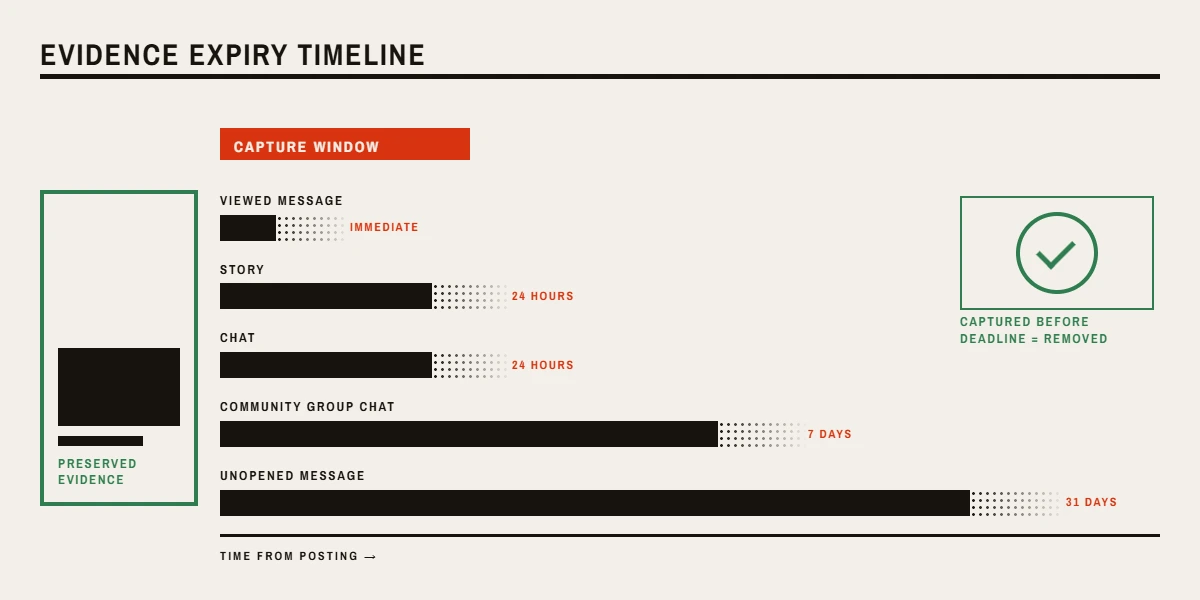
Snap deletes on a clock. Viewed one-to-one and group Snaps come off Snap's servers almost immediately once everyone in the conversation has opened them. Unopened Snaps last 31 days. Stories run about 24 hours. Chats clear 24 hours after viewing, or 31 days if nobody opens them, and Community Group Chats hold for seven. Snap publishes the full schedule.
| What you saw | How long it survives | Still reportable after that? |
|---|---|---|
| Viewed 1:1 or group Snap | Deleted almost immediately | No |
| Unopened Snap | 31 days | Only inside the window |
| Story | About 24 hours | No |
| Chat message | 24h after viewing, 31 days unopened | Only inside the window |
| Community Group Chat | 7 days | Only inside the window |
| Username, display name, bio | Persists | Yes |
Capture comes first, then. And capture on Snapchat has a trap in it.
Screenshotting a Snap notifies the sender instantly. Screenshotting a Story leaves a marker beside your name in the viewer list. Profile screenshots do not notify at all, which is why handles, display names and bios are the easiest evidence to secure.
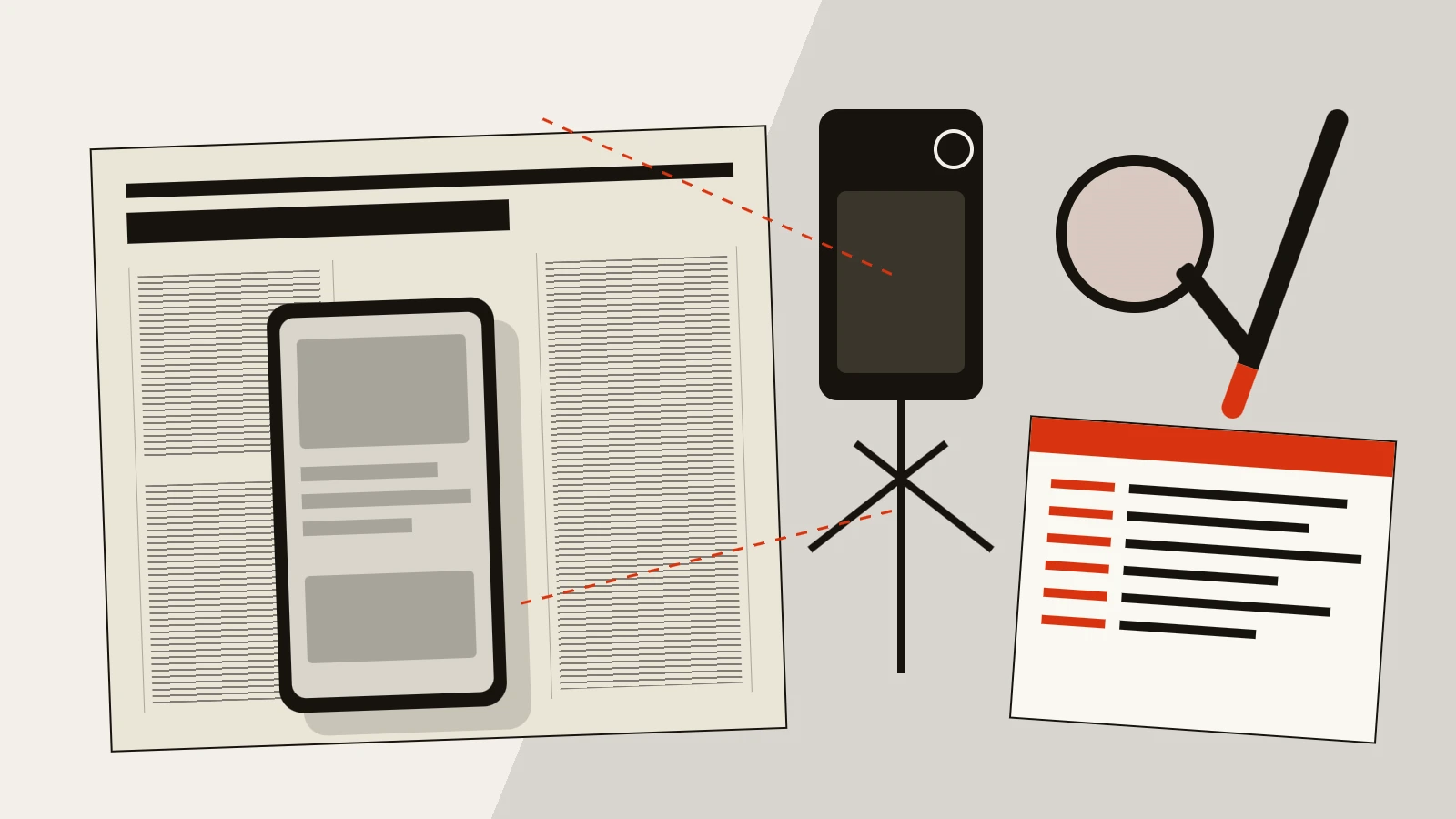
That old workaround — airplane mode, screenshot, clear the cache — no longer holds. Capture events queue while the device is offline and fire on reconnection. As of July 2026 the method we rely on in casework is the dull one: photograph or film the screen using a second phone. Nothing to notify, nothing to queue, and you keep the surrounding context in a single frame, including the handle above the message and the timestamp beside it.
Photograph the profile as well as the message. A good share of the cases that stall in our queue stall for the same reason: a flawless picture of an abusive line, and nothing proving who sent it. Anything you do send us is handled under our data policy, and we do not retain material we have no reason to keep.
How does someone get banned from Snapchat?
Snap enforces against conduct, not against complaint volume. An account gets actioned when its behaviour matches something in the Community Guidelines: harassment and bullying, threats of violence, sexual content involving a minor, non-consensual intimate imagery, impersonation, scams and phishing, drug sales, hate speech, spam. Severity then decides the response. A first minor breach usually draws a warning or a temporary lock. Repeat or severe breaches escalate to permanent termination, and Snap can act at device level rather than only on the account, which is what defeats the make-a-new-one reflex.
Scale is worth holding in mind before you decide how many friends to rope in. Across the first half of 2025 Snap received 19,766,324 in-app reports, took 6,278,446 enforcement actions and actioned 4,104,624 unique accounts, at a median turnaround of roughly two minutes (Snap Transparency Report, H1 2025). Two minutes is not a queue you can flood. It is a system reading one report against one policy line.
People ask this a dozen ways — how to get someone snapchat banned, how to get someones account banned on snapchat, how to get someones snapchat banned, how to get someones snapchat account banned — and the mechanism never changes with the phrasing. One accurate report against a real violation does more than forty vague ones, because those forty carry a pattern Snap already screens for.
Our briefings on the other major platforms reach the same conclusion, and the people who write them do removals for a living rather than reviewing apps.
The report routes that actually reach a decision
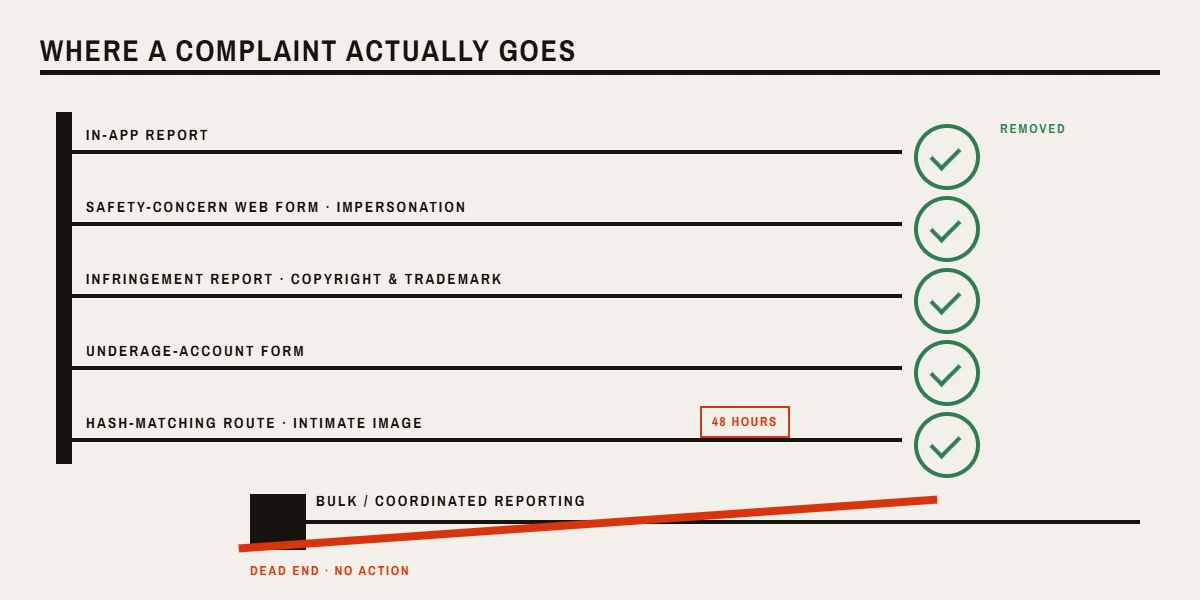
Five routes exist. They are not equal, and picking the wrong one is the most common reason a legitimate complaint dies quietly.
- In-app report. Press and hold the name or the Snap, then Manage Friendship, then Report. It is confidential, Snap does not disclose the reporter to the reported account, and it cannot be withdrawn once filed. Snapchat's support article covers the abuse and illegal-content flow. Use it for harassment, threats, sexual content, drugs and scams.
- Report a Safety Concern, for impersonation. The web form carries a "they're pretending to be me" option, and it is built around the impersonated person, or their guardian, proving who they are. Here is the detail almost every guide misses: if you are a bystander reporting impersonation of a friend, that form was not designed for you and the report usually goes nowhere. Get the person being impersonated to file it themselves. The form is here.
- Report Infringement, for copyright and trademark. If the account is reposting your photographs, video or brand assets, this is a DMCA route under 17 U.S.C. § 512 rather than a conduct complaint. It is not anonymous, the account can file a counter-notice, and repeat confirmed infringement is one of the cleaner paths to permanent termination.
- Underage account. Snapchat's minimum age is 13. Anyone can report a suspected under-13 account, and confirmed cases are terminated with the data deleted. Where the profile gives the age away, this converts at a higher rate than most people expect.
- Intimate images. Do not report this one with a screenshot attached. Adults use StopNCII.org, which hashes the image on your own device so the file itself never leaves it. Under-18s use NCMEC's Take It Down. Snap participates in both.
If you have been searching how to get someone banned from Snapchat and none of those five describes your situation, that is your answer. The instinct at that point is to reach for volume, and it is the wrong instinct. The two nearest platforms behave identically: how to get someone banned on TikTok and getting someone banned on Instagram both come down to category, evidence and standing.
Can you get someone banned on Snapchat immediately?
Whether you searched how do you get someone banned from snapchat or something blunter, the timing answer is the same: sometimes, and it has nothing to do with how fast you file.
The phrasing we see most is how to get someone banned on snapchat immediately, and the honest response splits by severity. Content that threatens a child, shows sexual abuse of a minor, or carries a credible threat of violence gets triaged ahead of everything else, and against a median action time of about two minutes, something in that category can be gone within the hour. A harassment complaint about an ongoing argument may sit for days, attract a warning, and never produce a ban at all.
What does not exist is a lever that shortens the queue. No report count triggers an automatic ban. No public endpoint accepts reports programmatically, which is the same structural fact that makes every mass-report-bot claim on X false — we took that teardown apart in detail. Snapchat has no reporting API either.
A category error also sits inside the question. Wanting someone gone from your Snapchat is a different job from wanting them gone from Snapchat. Blocking, unfriending and locking your Story audience are instant and entirely yours to do; a platform ban is Snap's decision and nobody else's. We set the same split out for X in how to ban someone on Twitter, and it holds on every platform we work.
The legal routes that outrank the report button
Three statutory routes now sit alongside the in-app flow, and almost none of the popular guides mention any of them.
Non-consensual intimate images. The US TAKE IT DOWN Act was signed on 19 May 2025 and requires covered platforms to remove valid NCII reports within 48 hours. FTC enforcement began on 19 May 2026, with civil penalties running into tens of thousands of dollars per violation, and there is a federal reporting portal at takeitdown.ftc.gov. This is the fastest legally backed removal route on any platform right now. Where a minor is involved, or someone is being extorted, treat it as a police matter first and a platform matter second.
EU users. Article 16 of the Digital Services Act obliges platforms to operate a notice-and-action mechanism for illegal content and to give you a reasoned decision. A DSA notice is a different object from an in-app report: it creates an obligation to respond, and it is logged.
UK users. The Online Safety Act places duties on user-to-user services, enforced by Ofcom, including workable reporting and complaints procedures. Citing it does not guarantee removal. It does change who has to justify the outcome.
If the content has already spread past Snapchat — reposted, screen-recorded, indexed by a search engine — reporting alone stops being the whole job. Ask us for a confidential case review. We map the route before you pay anything, and we will tell you plainly when reporting is all you need.
What a "Snapchat ban service" is actually selling
This market is old and the pitch never changes: a fee, a handle, a promise of removal inside 24 to 48 hours. What is being sold is almost always one of three things. A brigade of throwaway accounts, which Snap screens for. An invoice for filing the report you could have filed free in ninety seconds. Or a straight phish, dressed as a verification step, asking for your login or your six-digit code.
The listings are keyword soup: how to get someone's Snapchat banned, how to get someone's Snapchat account banned, how to get someone's account banned on Snapchat, stacked on one page with a price between twenty and three hundred pounds. We have written the same anatomy twice already because the operation is portable. What an Instagram ban service is really charging for and the twitter ban service explained both describe sellers who swap the platform name and reuse the sales page. Snapchat is the easiest swap of all, because ephemerality hands the seller a built-in excuse: the evidence expired, so there is nothing to show for your money.
Mass-report bots, panels and APKs
Search this cluster and you will hit GitHub repositories, Telegram panels and sideloadable APK builds promising automated reporting. None of them do what the listing says, for a reason that has nothing to do with effort.
Reporting is a user-session action. No documented endpoint accepts a report, so any tool claiming to automate it has to drive the app or the web session using your credentials. That is the actual product. We pulled apart the spam-report tool claims on Instagram, then audited what those repositories and APK builds really collect: session tokens and credentials, on a device you no longer fully control. Snapchat variants are the same code with a different icon.
If someone is trying to get your account banned
The other half of this search is people on the receiving end of it.
A coordinated report wave against your account is itself a policy breach. Snap treats mass or bad-faith reporting as abuse and can action the reporters instead of the target. If you have already been locked or restricted, three things matter in sequence. Save your evidence before you touch anything. Appeal once, promptly, through the in-app prompt, because you generally get one appeal and a temporary lock often clears in about 24 hours on its own. Then look at whether the wave arrived with something separately actionable attached: impersonation of you, a leaked image, a false statement of fact about you presented as true. Each of those is its own case with its own route.
What a report flood does to the person receiving it covers the target-side mechanics in more depth, and the enforcement logic transfers.
No paid service can unban an account. Every offer to do so is the same phish running in the opposite direction.
What we will not do, and what we cannot
We will not file a report we do not believe to be true. That is a practical position rather than a legal one: a false report burns credibility with the platform, and a knowingly false DMCA notice is actionable in the US under § 512(f). We do not forge notices, we do not bluff lawsuits, and we will never ask for your password or your verification code.
We also cannot make Snap ban anyone. Nobody outside Snap can, and any firm telling you otherwise is selling the same thing the panels sell. What we can do is work out which route fits, prepare evidence so it survives the deletion clock, and escalate when a well-founded first report is ignored.
Some things never come down at all. A truthful account of something that happened, a genuine public record, a critical opinion inside the rules — none of those are removable, and pretending otherwise sells false hope. The honest options there are de-indexing and suppression rather than removal, a distinction we set out in full for account takedowns. The scope of what we take on and the limits on any outcome we describe are both written down where you can read them before you commit.
Not sure which side of that line your case falls on? That is the normal starting point, and it is exactly what a first conversation is for. Obscura works content removal and defamation takedowns for individuals and companies, and the review is confidential before anything is charged.