Three things can be taken down, and they behave differently
Snapchat was built to delete itself. That one design decision reshapes every removal you might want to file, because the thing you are trying to take down is often gone — or unrecoverable — before anyone at Snap has read your complaint.
So name the object first. A single Snap sent to one person or a small group is the narrowest target. A Story sits above it, visible to a friend list or, on a public profile, to anybody. An account is the whole apparatus: username, friend graph, Memories, Snap Map history, the lot. Those three objects run on different clocks and answer to different instruments, and a request pointed at the wrong one comes back with nothing.
Here is the answer most guides never give. How to take down a Snapchat account has a blunt version: you cannot. Deletion belongs to the account holder. Termination belongs to Snap. Everyone else — you, your solicitor, the police — is in the business of supplying grounds. A Snapchat takedown is never an action you perform on someone else's account; it is a case you assemble and hand over, and its strength is measured in standing and evidence rather than in effort or volume. That reframing is not a technicality. It decides which form you open, what you must prove, how long you wait, and whether the outcome sticks.
The same logic runs through our Instagram account takedown briefing, where the split between what a platform removes and what it merely deprioritises is set out in full.
One more distinction before the routes. Removal takes content off Snapchat. Suppression pushes a copy down the search results on some other site, once a Snap or Story has been screen-recorded and reposted. Snapchat itself is barely indexed, so suppression rarely applies to the Snap — it applies to wherever the recording landed afterwards. Keep the two jobs separate in your head and you will stop wasting filings.
Deleting your own account is a form. Removing someone else's is a case.
The search results for this phrase are almost entirely about self-deletion, so let us dispose of that first, accurately.
To delete your own account, open accounts.snapchat.com in a browser, choose Delete my account, and re-enter your username and password. The same action lives in the app under Settings, in the Account Actions block. Snapchat then deactivates the account for 30 days rather than deleting it outright. During that window your friends cannot contact you or see anything you post, and the account can be brought back simply by logging in — which is also the trap, because logging in cancels the deletion. Ride out the 30 days without signing in and the account is permanently deleted. Snap retains a residue for legal and financial reasons: purchase records, and the timestamps showing when you accepted the terms.
How to get a Snapchat account taken down when it is not yours
You cannot, and the honest version of how to get a snapchat account taken down starts there. There is no form, no fee and no service that deletes another person's Snapchat account on request, and anything sold as one is selling you either a scam or your own credentials theft. What exists instead is termination: Snap ends an account when it decides the account has broken its rules badly enough, or when a legal instrument compels it. Your job is to make that decision easy and evidenced.
How to get someone's Snapchat deleted, and what gets sold instead
That distinction matters commercially as well as legally. Every "delete anyone's account" offer we have examined resolves into one of three things: a reseller of ordinary in-app reports, a phishing page waiting for a login code, or nothing at all. The same anatomy shows up on every platform. We took the Snapchat version apart in our teardown of the bot and panel market, and the Facebook equivalent behaves identically.
Telling a deleted account from a terminated one
People often ask how they will know whether anything happened, because Snapchat does not write back to say it banned somebody. The signals are indirect and worth reading carefully.
A self-deleted account disappears gradually. It first goes quiet for the 30-day deactivation window, the profile stops resolving, and existing chat threads stay in place while the display name greys out. A terminated account behaves more abruptly: the username stops resolving straight away, and the person on the other end sees a lock screen with an appeal prompt rather than a login failure. Neither state is announced to you, and Snapchat will not confirm an enforcement outcome to the reporter. Confidentiality runs both ways here, which is also why we advise clients never to tell the other party a report has been filed. What that silence looks like from the receiving end is set out in what actually happens to the target of a report wave.
Preserve first. Everything else depends on it.
This is the step that decides most Snapchat cases, and almost no guide on the first page of Google mentions it.
Snapchat's published retention rules are unusually short. A Snap sent to one person or a group is deleted from Snap's servers once every recipient has opened it. An unopened Snap is held for 31 days, not 30. Stories expire after roughly 24 hours. Chats clear 24 hours after viewing, or 31 days if never opened, and community group chats run on a seven-day cycle. Those windows are documented in Snapchat's own retention article. Read them as deadlines rather than trivia: they are the reason a perfectly good harassment case arrives at our desk with nothing left to attach to it.
Capture the material with a second device. Photograph or film the screen with another phone or a camera. Screenshotting inside Snapchat notifies the sender instantly and marks you in a Story's viewer list, and the airplane-mode workaround that older guides still recommend is no longer dependable, because capture events queue offline and report themselves the moment the device reconnects. A second-device recording carries the timestamp, the username and the surrounding interface without touching the app's own tripwires.
A usable record is not just a picture of a screen. It needs the username and the display name in frame, the on-screen timestamp, enough of the surrounding interface to show which app and which surface it came from, and a visible clock or a second shot of your own device time. Write a short contemporaneous note beside it: what you saw, when you saw it, what happened immediately before. Number the files rather than renaming them later. This sounds fussy until the day a platform reviewer, a police officer and a solicitor all need to read the same bundle and reach the same conclusion from it. A preserved record that cannot be dated is close to worthless in a harassment case, and harassment cases turn on pattern, which means dates are the case.
There is a formal preservation route as well, and it is worth knowing it exists even though you cannot use it yourself. Under 18 U.S.C. § 2703(f), law enforcement can ask Snap to freeze the records attached to an identified account. Snap's law enforcement guidance states that preserved records are held offline for up to 90 days and extended once, for a single further 90-day period, on a formal extension request; serial requests beyond that are refused absent exceptional circumstances. Requests go through the Law Enforcement Service Site or the dedicated law-enforcement mailbox. A UK reader routes this through their own police force rather than filing directly, which takes time you do not have — hence the second device.
One inversion, and it matters. If the content is an intimate image of you, do not preserve and forward it to anybody. The correct route hashes the file on your own device and never uploads it, and that is covered further down.
What a Snapchat takedown request actually contains
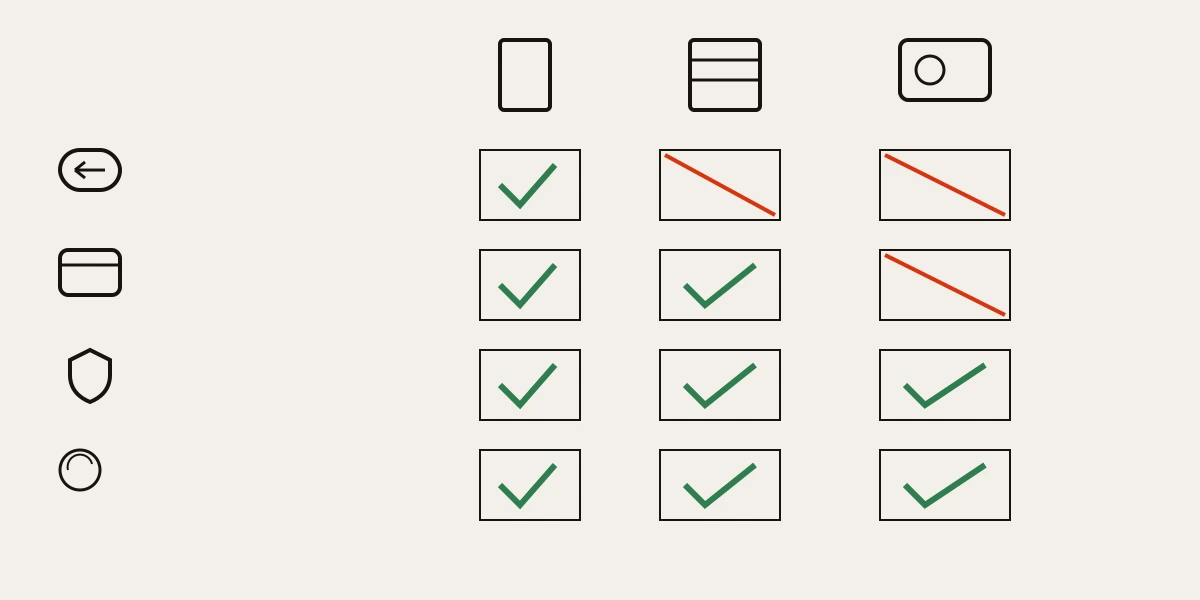
A Snapchat takedown request is a document, not a tap. The in-app Report button is the lowest rung of the same ladder, and the higher rungs all ask the same four questions: who are you to this content, what exactly is the content, which rule or law does it break, and what are you asking Snap to do about it.
Standing is the gate. Snapchat runs separate channels because each one is built around a different claimant.
- In-app report. Press and hold the name or the Snap, then Manage Friendship and Report. Anyone who can see the content can file. Confidential, and it cannot be withdrawn once sent.
- Report a Safety Concern. A web form that works whether or not you hold a Snapchat account, which is the point — it is how a parent, a guardian or a person with no app installed reports harassment, threats or an impersonating account. The impersonation option, "They're pretending to be me", is constructed around the impersonated person proving who they are; a friend reporting on your behalf usually fails on that alone.
- Report Infringement. The copyright and trademark channel, and the only route on this list with statutory force behind it. Under 17 U.S.C. § 512, only the rights owner or an authorised representative may file, the notice carries a good-faith statement made under penalty of perjury, and the other side may answer with a counter-notification that puts the content back. It is also not anonymous — your details travel to the person you reported.
- Username Infringement. Rarely mentioned anywhere, and useful. Where an account is trading on a name you hold rights in, this route targets the handle itself rather than the account behind it. It is the closest thing Snapchat offers to prising a stolen identity loose without needing the whole account terminated.
How to report a Snapchat account to get it deleted
Sequence it. Capture the evidence first. File the in-app report against the specific Snap, Story or profile so the complaint is anchored to something Snap can look at. Then file the matching web form, because that is where an account-level review and a written reply actually happen — Snap tells reporters to expect a response by email, usually within hours. If the content also infringes a copyright or a trademark you own, file that separately rather than folding it into the safety report; the two queues are different, and the infringement queue is the one with a legal deadline attached.
The free-text box is where most filings are won or lost, and most people use it to describe how they feel. Answer the four questions instead, in order, in about six lines. Who you are to this content: the person depicted, the rights owner, the parent of the child involved. What the content is: username, display name, surface, date and time you observed it. Which rule it breaks: name the guideline or the legal basis rather than gesturing at it. What you want done: removal of a specific Snap, removal of a Story, review of an account, release of a username. Then stop. Reviewers work through a queue at speed, and a request they can verify in twenty seconds beats one they have to interpret.
When we file these, the difference between a closed case and a "no violation" reply is almost never the wording. It is whether the report points at one identifiable piece of content with a preserved copy behind it, or at a person in general. Snapchat reviews content. It does not review grudges.
If a Snapchat account is aimed at you and the reports have gone nowhere, ask us for a confidential case review. We will tell you which of these instruments applies, and say so plainly if none of them does.
How to take down a Snapchat story, and when not to bother
Here is the awkward truth about how to take down a snapchat story: for an ordinary Story you will usually lose the race. It expires in about 24 hours on its own, and a filing made at hour three is unlikely to be actioned before hour twenty-four. Filing anyway is still correct where the Story is part of a pattern, because the report joins a record against that account even after the Story has gone. Just do not expect the removal itself to be the win.
The exceptions are where Stories stop being ephemeral, and they are the ones worth your effort:
- Spotlight submissions do not expire. A clip posted to Spotlight stays live until the creator deletes it or Snapchat removes it, and it keeps accumulating views for weeks. This is durable, findable content and it deserves a full filing.
- Saved Stories on a public profile persist indefinitely. A creator can pin a public Story to their profile so it survives the 24-hour window. Snapchat explains the mechanic in its note on where public Stories go.
- Reposted copies outlive the original. Once a Story has been screen-recorded and put on X, TikTok, Reddit or a forum, removing it from Snapchat achieves nothing. The copy is now the problem.
- Memories keep the source alive. Anything the poster saved to Memories can be posted again the moment the first version comes down, which is why a single successful Story removal against a determined account is a pause rather than a result.
How to take down a story on Snapchat that somebody else posted
Report the Story itself rather than the account, using the same press-and-hold route, and pick the reason that matches what is actually wrong with it — harassment, sexual content, impersonation, hate. Then treat the reposts as separate matters on their own platforms, each with its own rules and its own clock. The mechanics of chasing a clip across platforms are set out in our briefing on getting a TikTok taken down, and the reupload problem specifically in why a YouTube removal often does not stay put.
Report a Snapchat account for harassment without weakening your own case
Harassment is the most common reason people arrive here, usually from a search as flat as "report snapchat account for harassment", and the route is narrower than it looks.
Snapchat's Community Guidelines define harassment broadly — unwanted behaviour that would cause an ordinary person real distress, including mockery, shaming, spreading rumours, sharing humiliating imagery and repeated unwanted contact. That breadth is helpful. It means you rarely need to argue that something is illegal; you need to show that it happened, that it was aimed at you, and that it continued.
To report a snapchat account for harassment, file in-app against each offending Snap or Story, then file the Safety Concern web form for the account itself and describe the pattern in it. Two mistakes cost people their cases. The first is blocking immediately, which is emotionally correct and evidentially expensive, because it can put the material out of your own reach before you have captured it. Capture, then report, then block, in that order. The second is deleting the chat to make it stop being visible. Do not. The same sequencing problem, and why blocking is a personal remedy rather than an enforcement one, is worked through in our note on blocking, reporting and appealing.
Where the content is an intimate image, the harassment route is the wrong one and the specialist routes are much faster. Adults should use StopNCII.org, which fingerprints the image on your own device and sends only the hash to participating platforms, Snap included; the file never leaves your phone. For anyone under 18, NCMEC's Take It Down does the same thing. Both sit alongside a legal duty now: the TAKE IT DOWN Act, signed on 19 May 2025, requires covered platforms to remove valid reports of non-consensual intimate imagery within 48 hours, and the FTC began enforcing it on 19 May 2026 with penalties reaching $53,088 per violation. If a child is being coerced or extorted, contact the police first and file second.
The criminal lane, for readers in England and Wales
Platform policy is not the only instrument, and in serious cases it is not the strongest one. Where the same person has targeted you on two or more occasions, that course of conduct may amount to an offence under the Protection from Harassment Act 1997, which is the statute most Snapchat harassment actually falls under rather than anything platform-specific. Sharing an intimate image without consent has been a distinct criminal offence since 31 January 2024, when section 188 of the Online Safety Act 2023 inserted section 66B into the Sexual Offences Act 2003 and, importantly, removed the old requirement to prove the sharer intended to cause distress. Threatening to share carries its own offence under the same section.
Report it to the police and keep the crime reference number. A platform escalation that cites an open investigation moves differently from one that does not, and where a court later orders disclosure or removal, the preserved evidence you captured in week one is what the order rests on.
Regulators are also leaning on this queue directly. The European Commission opened formal Digital Services Act proceedings against Snapchat on 25 March 2026, covering age assurance and — relevantly here — its moderation, transparency and reporting processes. A UK or EU reader filing today has more leverage in an unanswered report than they did a year ago, because an unanswered report is now a compliance question rather than a customer-service one.
How many reports to delete a Snapchat account?
There is no number. Snapchat's enforcement is violation-based: a decision turns on what a reviewer finds when they look, and on the strike history already sitting against that account. Fifty identical reports from fifty friends do not add up to one termination, and coordinated false reporting is itself a policy breach that gets the reporters actioned. We set the arithmetic out at length in how someone actually gets banned from Snapchat, and the same myth priced up as a product in the Snapchat mass report bot teardown. YouTube is the only major platform that publishes a per-account reporting quota at all, which we mapped in the YouTube reporting queue — and even there the quota governs throughput, not outcomes. What a second reporter is genuinely worth is corroboration: an independent account of the same incident, filed separately, reads as evidence. Fifty copies of the same complaint read as a campaign.
What no Snapchat takedown reaches
Some material stays up, and you deserve to hear that before you pay anyone.
A truthful account of something you actually did is not removable because it is unflattering. Nor is an opinion, however unfair, and nor is a public record. Those are suppression problems, not takedown problems, and on Snapchat they usually are not even that, because the durable copy lives on another site by then. Anyone promising you guaranteed removal of lawful content is either going to fail quietly or file something false on your behalf, and a false notice is the fastest route to a reinstated post, a counter-notification with your name on it, and a much larger audience than the original ever had.
We will not forge a copyright claim over content you do not own. We will not send a legal threat we could not stand behind. We will not ask for your Snapchat password, and if you are dealing with intimate imagery we will never ask you to send us the material — the hash-matching routes above exist precisely so that nobody has to. The limits of what we can promise are written down rather than implied, and the people who would actually handle your matter are named on our removals and defamation desk with their qualifications attached.
What we will do is tell you which instrument fits, whether the evidence still exists, and what the honest ceiling is. Sometimes that answer is a filing. Sometimes it is preservation and a police report. Occasionally it is that the Snap is already gone and the real problem is a copy on another platform, which is a different job with a better prognosis. The same instrument-by-instrument approach applied to taking down a Twitter account and to what you control versus what only a platform can decide will give you the shape of it before you ever speak to us. Every briefing we publish is in the archive.