
The one platform that really does publish a reporting endpoint
Every other platform we cover settles the bot question in a sentence: there is no reporting method in the API, so there is no bot. YouTube is the exception, which is precisely why a youtube mass report bot is easier to sell here than anywhere else. It is worth knowing exactly how far that exception runs before anyone sells it to you as a product.
The YouTube Data API v3 ships a method called videos.reportAbuse. It is real, it is documented, and it will flag a video. It also costs 50 quota units per call against a default daily allowance of 10,000 units, which means a single project can file 200 reports in a day and then sits idle until the quota resets. Every call needs OAuth authorisation from a signed-in Google account, so nothing about it is anonymous at the point of submission. YouTube's Terms of Service separately prohibit automated access without prior written permission, and carry a clause about misusing the reporting process that we will come back to.
Two hundred signed reports a day, attributable to a real account, aimed at a platform that removed over twelve million videos in a single quarter almost entirely without human flags. That is the entire technical ceiling of the honest version. Everything sold above that ceiling is something else, and knowing which side of the line a seller is standing on is most of what this briefing is for. Obscura works the other side of it, on behalf of people the campaigns are pointed at.
What a youtube mass report tool actually ships
Strip the dashboard away and the product is a browser automation script plus a pool of logged-in accounts. The script walks each account through the public reporting form, because the form has no quota and no OAuth handshake. The accounts are bulk registrations or credentials lifted by infostealer malware. We mapped the four supply routes in detail when we took apart the Instagram version of this market, and the YouTube listings run on the same wholesale logic: near-zero marginal cost, no refund path, no accountability.
Mass report bot YouTube listings split into two piles
Search the phrase and you land in either a code repository or a shopfront. Repositories hand you a script and leave the accounts, the proxies and the consequences to you. Shopfronts keep all three and hand you a dashboard, which is why their pricing reads like a utility bill rather than a licence fee. Neither is a YouTube product. The shopfront model is usually rented from a Telegram channel rather than a website, which is why we wrote a separate briefing on how panels are sold and what they actually reach. The listings that survive longest are the vaguest about what they deliver, because a specific promise is a refundable one.
Does mass reporting work on YouTube? The 97 per cent problem
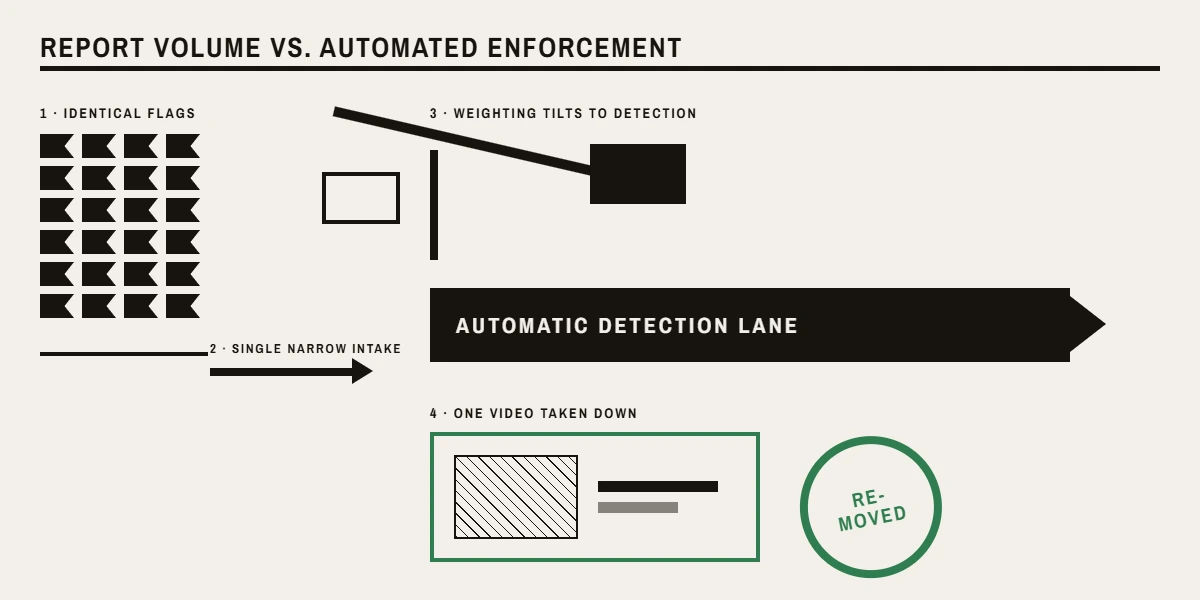
No, and YouTube publishes the reason itself. In the Q3 2025 enforcement period its Community Guidelines report recorded 12,139,839 videos removed and 7,456,811 channels terminated, with more than 97 per cent of that first detected by automated flagging rather than by a person pressing Report. Human flags are a rounding error in YouTube's enforcement, and they always have been. A tool that multiplies human flags is multiplying the smallest input in the system.
The reporting queue is a routing mechanism, not a ballot box. A report tells YouTube where to look and under which policy. A reviewer, or more often a classifier, then decides whether the content matches the policy. Nothing in that sequence counts submissions. We found the same structure on X, where no bulk-report endpoint exists at all, and on Meta, where the honest summary is that violations get counted, not reports.
Mass reporting YouTube videos does not create a violation
Duplicate reports against one video collapse into a single case. That is ordinary queue design, and it means a thousand identical submissions arrive on a reviewer's screen as one complaint with an unusually long sender list. If the video breaks a rule, the first honest report already did the work. If it does not, the thousandth changes nothing except the pattern YouTube can see behind it.
What volume genuinely changes is the shape of the case. A reviewer looking at hundreds of reports filed inside ten minutes, from accounts created the same week, is now examining a coordination problem rather than a content one. The dynamic is identical on TikTok, where we set out what a mass report campaign actually does to the target and how little of it touches the account being aimed at.
Priority Flagger is the only bulk channel YouTube actually runs
There is one sanctioned way to report at scale, and no panel can sell it. YouTube's Priority Flagger programme, formerly branded Trusted Flagger, gives vetted government agencies, NGOs and individuals higher placement in the review queue. Entry is by direct contact with a YouTube representative, not a signup form. Government and NGO applicants complete training before approval. Nothing about the status guarantees removal; it guarantees a faster look.
Alongside it sits the EU's statutory version. Under Article 22 of the Digital Services Act, trusted flagger status is granted by a member state's national Digital Services Coordinator, and it binds every in-scope platform to handle those notices with priority. It is deliberately narrow. Sixteen trusted flaggers had been designated across the entire European Union when the count was published in January 2025.
Read the two mechanisms together and the marketing collapses. Both reward being right, repeatedly, in public: YouTube's version is revocable the moment accuracy drops, and the DSA version requires proof of expertise and independence from the platform. Neither rewards volume. Neither has a checkout. A panel promising trusted-flagger throughput is describing a status it could not obtain, hold or transfer, which is why that promise is always vague about who exactly holds it.
So the phrase every seller borrows describes a government-gated or platform-invited role held by a few dozen organisations, not a purchasable queue-jump. The same false promise circulates on Meta, where we unpicked the spam report bot claim and found the same borrowed vocabulary. Our own filings go through the ordinary routes, correctly evidenced, which is what the people who do this work here spend their time on.

How to mass report a YouTube channel without wasting the report
The question people actually type is how to mass report youtube channel pages at scale. The useful version is narrower: which object do you report, under which policy, with what attached. Get those three right once and you have done more than a panel does in a week.
How to mass report youtube channel pages, and why the object decides the outcome
Reporting a channel for something a single video did tends to fail, because the reviewer opens the channel and sees no channel-level violation. Report the video. Channel-level reports belong to channel-level problems: impersonation across the whole profile, a banner or description that breaks policy, or a pattern of uploads rather than one upload.
Mass report YouTube video and comment requests go to different queues
Reporting a video for something written underneath it fails for the same reason a channel report fails for a video problem. The reviewer opens the object you named, assesses the object you named, and closes the case. Report the comment.
| What went wrong | The object to report | What that route can reach |
|---|---|---|
| One upload breaks a guideline | The video, at the timestamp | Removal, and a strike if it is confirmed |
| Harassment in the comments | The individual comment or user | Comment removal, channel action if repeated |
| The whole profile impersonates you | The channel, via impersonation | Channel-level review of name, art and about text |
| Your footage, music or writing was taken | Copyright removal request, not a report | Removal plus a copyright strike |
| Your face, home, ID or number is shown | Privacy complaint, not the spam flag | Removal on identifiability, not policy debate |
Two habits move outcomes more than anything else. Pick the narrowest accurate category, because a miscategorised report lands in a queue that cannot act on it. Then write the description as though the reviewer has thirty seconds, since roughly speaking they do: name the rule, cite the timestamp, say who is affected. That is the same discipline we apply when routing an Instagram complaint, and it is why single reports filed from this desk outperform campaigns. Capture your evidence first, too. YouTube content can vanish mid-case, and the lesson we learned from Snapchat's disappearing evidence applies here whenever a channel starts deleting under scrutiny.
The copyright lane no mass report bot can imitate
If you own what was taken, stop reporting and start filing. A copyright removal request is a legal notice rather than a policy complaint, and it is the only route on YouTube that reliably removes content and marks the channel in one step. That asymmetry is the reason the paid-ban market keeps stumbling into copyright claims it has no standing to make, a trap we documented in what a Twitter ban service is really selling.
Three mechanics matter. A Content ID claim is not a strike: in 2025 YouTube processed 2,502,941,368 Content ID claims, around 99 per cent of all copyright actions on the platform, and over 90 per cent ended in monetisation rather than removal. A formal removal request is the escalation, and it carries a 90-day strike; three inside that window terminate a channel, per YouTube's strike documentation. The removal form also offers a seven-day delay so the uploader can pull the video before a strike lands, which is worth using when the goal is the content coming down rather than the channel going under.
The counterweight is real. A counter-notification gives the claimant 10 US business days to file suit or the video returns and the strike clears. And 17 U.S.C. §512(f) makes knowing material misrepresentation in a takedown notice actionable, with damages and legal costs. That provision applies to copyright notices only. It does not attach to community guidelines reports, and anyone telling you a false spam flag exposes someone to §512(f) is selling a story.
Being targeted, or trying to get something genuinely harmful taken down? Send us the links for a confidential first review. We will tell you which route fits, what it can realistically achieve, and where it stops, before you pay anything.
The Terms of Service track that catches the reporter first
Here is the part sellers never put on the pricing page. Content violations are judged under the Community Guidelines and produce strikes. Report abuse is judged under the Terms of Service, which prohibit misusing any reporting, flagging, complaint, dispute or appeals process, including through groundless, vexatious or frivolous submissions. That is a separate rulebook with a separate consequence, and the consequence is suspension or termination of the account doing the reporting.
Exposure runs in an order most buyers never think through. The rented account pool goes first, since that is precisely what the automation and misuse clauses exist to catch. The buyer's own account follows if the order was placed from it, or from the same device or address. The target comes last, and only if a reviewer independently agrees a rule was broken, which was always the only variable that mattered.
Where the mass report youtube channel bot buyer is actually exposed
Money is the smaller loss. A campaign buys submissions into a queue nobody controls, with no refund and no counterparty you could complain to. We ran the same maths on the Meta side in what an Instagram ban service actually sells you, and the answer was a form-filling gig with a markup.
The larger loss is the record. Coordinated reporting is visible from inside the platform in a way it never is from outside, and the accounts that generate it are traceable to whoever paid. On TikTok we wrote about what actually gets an account banned, and the pattern holds on YouTube: platforms are far better at spotting manufactured consensus than at being persuaded by it. We publish our scope and fees before anyone pays us, which is not a standard this market has ever been asked to meet.
Your channel is under a report wave: the first 48 hours
Now the other seat. Reach, views and features drop, a notice arrives, and the obvious explanation is that somebody bought a campaign. Sometimes that is right. Often it is not, and acting on the wrong theory burns the window in which an appeal still works.
Read the notice before the theories. If it names a policy and cites a specific video, a reviewer made a specific decision, and your appeal has to answer that decision rather than the campaign around it. A brigade shows up as timing and breadth: a compressed spike, hostile comments seeded to justify the reports, an off-platform thread organising it. Real enforcement is narrow and names the thing it objects to.
Worth knowing what a wave cannot do to you, because the fear is usually larger than the mechanism. Reports do not stack into an automatic penalty, they do not reveal who filed them, and they cannot remove a video that a reviewer has already cleared. Reporting is anonymous in both directions on YouTube, so the absence of names in your notification is normal rather than evidence of a conspiracy. What a coordinated wave can do is surface content that was already borderline, which is the uncomfortable part nobody selling a defence package will tell you. If an old upload gets pulled during a campaign, the campaign found it; it did not manufacture the violation.
- Screenshot the notice in full, with its exact wording, policy name and date.
- Export YouTube Analytics for the 72 hours around the drop, so the spike is timestamped.
- Archive the organising thread or video somewhere that dates it independently.
- Appeal once, from the Studio notification, addressing the cited policy directly.
- If the flagged content genuinely crossed a line, remove it first and say that you have.
Appeal once and properly. Repeat submissions, or friends filing supporting reports on your behalf, look exactly like the behaviour you are complaining about and reset your place in the queue. The confusion between what a user can do and what only the platform can do is worth untangling before you act, which is why we wrote what you actually control on X. Evidence you send us is handled under our privacy notice, and we never ask anyone to send intimate material; for that, hash-matching through StopNCII works without the file leaving your device.
The removed video that still ranks for your name
This is the part the panel market has no answer for, and the reason most people eventually find us. A YouTube video has a web address, a title and a description, and Google indexes all three. So a defamatory upload can be removed from YouTube and still sit on page one for your name for weeks afterwards, alongside the reuploads, the aggregator pages and the reaction videos it spawned.
Removal and de-indexing run on two clocks and two rulebooks. The first is a policy question decided by a reviewer. The second is an indexing question decided by a search engine under entirely different rules, including Google's outdated-content tool, its personal-information policies covering doxxing material and non-consensual imagery, and the right to erasure for UK and EU subjects. We set the same split out in our briefing on account takedowns and the removal-versus-suppression line.
Honesty about the ceiling is the whole job. We do not build, rent, sell or recommend a youtube mass report bot, a panel or a script, for this platform or any other, because they do not work and the buyer absorbs the risk. We will not file a copyright notice over work we do not own or send a legal threat we could not stand behind, since both get the content reinstated and hand the other side a story worth telling. We will not ask for your password. And we will not promise the removal of true reporting, genuine public records or an honestly held opinion, because none of those come down: they can be pushed down, and we say which case you have at the first review rather than after the invoice. Our full limits are published.
One pattern from this desk, for what it is worth. Where a video is genuinely defamatory, YouTube removes on a valid court order rather than on an allegation, and a privacy complaint under YouTube's identifiability rules gives the uploader a 48-hour window to edit or delete before the review even begins. Clients are routinely surprised that the slower legal instrument beats the fast report button. It usually does. The rest of our platform-by-platform briefings are worth reading before anyone spends money on something with a dashboard.