The 24-hour figure that has nothing to do with your report
Of every video TikTok removed in the first quarter of 2026, 86.5 per cent came down within 24 hours of being posted (TikTok Community Guidelines Enforcement Report, Q1 2026). Read quickly, that looks like a promise. It describes the classifier, not the complaints queue. Nearly all of those removals happened before any human complained, because the model caught the upload on its way in. A report filed by a member of the public enters a different process, on a different clock, with no published turnaround at all.
So the question splits three ways, and only one branch is genuinely instant.
If the post is yours, deletion takes seconds. If the content sits in a category TikTok's automated systems already police hard, it may be gone before you finish copying the link. Everything else joins a review queue where evidence quality decides the outcome — not urgency, and not how many people press report.
One narrow same-day lever does exist for content about you. Intimate images shared without consent can be blocked by hash before a reviewer ever opens the file: adults file through StopNCII.org, under-18s through NCMEC's Take It Down, and in the United States the TAKE IT DOWN Act obliges covered platforms to remove reported non-consensual intimate imagery within 48 hours of a valid request. That is the fastest instrument we ever reach for. It is also the only one where the word immediately is close to literal.
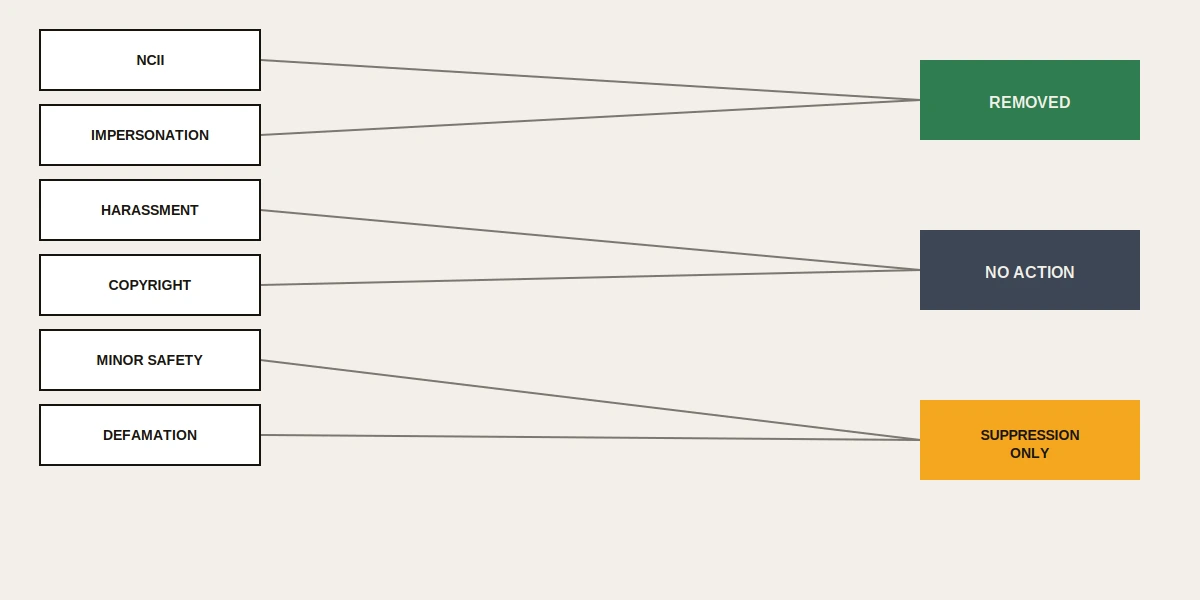
For everything else, the honest framing is narrower than the search phrase suggests. You can file immediately. You cannot remove immediately. What a well-built filing buys you is a decision that holds, not a decision that arrives sooner. The same arithmetic governs account-level enforcement, which we set out separately in what actually triggers a TikTok account ban, and it sits on top of the removal versus suppression split that decides which cases are winnable at all.
Who is allowed to ask? Standing decides the rest
Every route below turns on a question almost no competing guide asks first: what is your relationship to the content? TikTok, like every platform operating at this scale, rations human review toward complaints from people with something demonstrable at stake. A copyright owner can demand removal of their own work. A person filmed or named in a video can invoke privacy and image rights. A registered trademark holder can act against counterfeits. Someone who simply dislikes a video holds, in enforcement terms, almost nothing — their report becomes one anonymous signal, weighed against the content rather than added to a tally.
That is why the identical search produces wildly different outcomes for different people typing it. Standing is the gate. Route selection happens afterwards, and picking a route before establishing standing is the single most common reason a filing dies quietly.
How to get someone's TikTok taken down when it targets you
You have the strongest position available, and it is worth using precisely. Work out which protected interest the video actually breaches, then file under that heading rather than a general one. Footage of you taken in a private setting is a privacy matter. A video using your face to sell something is an image-rights and possibly advertising matter. A false statement of fact presented as true, causing serious harm to your reputation, is defamation. Your own filmed or recorded work reposted without permission is copyright.
Those are four different filings with four different evidence packs, and TikTok routes them to different teams. Choosing the wrong heading is not a neutral mistake: a defamation case filed as generic harassment usually returns a no-violation decision, and the decision then sits on the record when you escalate properly later.
How to take down someone's TikTok account as a bystander
Plainly: you mostly cannot, and the guides promising otherwise are selling something. If the content does not touch your identity, your work, or your registered marks, your only instrument is the in-app report, judged on the video's own merits. Filing it is legitimate when the content genuinely breaches the guidelines. Recruiting others to file the same report is not, and TikTok treats coordinated false reporting as platform manipulation under its integrity policies, which puts the reporters at risk rather than the target.
This is where searches for how to take down someone's TikTok video and how to take down someone's TikTok account tend to collide with reality. Volume is not an instrument. Standing is.
How to get a TikTok video taken down: three lawful lanes
Competing guides list reporting, DMCA and legal letters as if they were interchangeable menu items. They are three separate instruments with different filers, different proof, and different consequences for getting it wrong.
Lane one, the in-app Community Guidelines report. Long-press the video or open the share sheet, choose Report, then select the specific sub-reason rather than the nearest broad category. Reports are anonymous: TikTok states it will not disclose your identity to the person whose content you reported. This lane is free, fast to file, and judged strictly against one named guideline. It is also the only lane open to someone with no legal interest in the content.
Lane two, the legal webforms. These are not the in-app button and they behave differently. Copyright goes to TikTok's copyright report form; privacy, impersonation and data-rights matters go to the privacy portal. Neither is anonymous — both require your name and contact details, which are ordinarily passed to the uploader. TikTok's copyright page warns in its own words that "Misuse of the removal request webform, such as submitting false information, may result in the suspension of using the webform or other legal consequences." Separately, 17 U.S.C. § 512(f) makes a knowing material misrepresentation in a takedown notice actionable in damages. A copyright notice filed over a video you do not own is not a clever shortcut. It is a liability you signed.
Lane three, the legal notice. There is no standalone defamation category anywhere in TikTok's reporting architecture, which surprises most people who come to us. Defamation routes through the harassment and privacy channels, and where that fails it becomes a lawyer's letter to the uploader or a formal notice to the platform. In the UK, section 5 of the Defamation Act 2013 gives operators a defence that falls away once a proper notice of complaint is served, which is what gives a correctly drafted notice its leverage. A sustained campaign by one person can also engage the Protection from Harassment Act 1997. UK and EU residents hold a further instrument in Article 17 UK GDPR, the right to erasure, which reaches personal data on the platform and, separately, search results pointing at it.
How to get someone's video taken down on TikTok when it is not yours
Two exceptions carry real weight. If the footage is your recording that someone reposted, you are the copyright owner and lane two is open to you on the strongest possible footing. If a child in your care appears in it, minor-safety reports skip most of the queue. Outside those, expect lane one and expect it to be judged on the content alone.
Not sure which lane your case belongs in? Have it assessed confidentially before you file — a filing under the wrong heading is harder to undo than to get right first time.

How many reports to take down a TikTok video?
There is no number. TikTok has said so directly, in the plainest wording it has ever used on the subject: mass reporting content or accounts "does not lead to an automatic removal or to a greater likelihood of removal by our Safety team" (TikTok Newsroom, 2021). Reports are assessed against a specific guideline by a classifier or a reviewer looking at the content. They are not votes, and nothing is counted.
The follow-up question is the useful one. If volume does nothing, what does? Three things, in order: whether the content actually breaches a named guideline; whether your filing makes that breach obvious in the first few seconds a reviewer spends on it; and whether you filed in the lane your standing entitles you to. One precise report from someone with standing outperforms a hundred vague ones, every time.
The same finding recurs on every platform we work across, which is worth stating because the mass-report market depends on people not noticing. X publishes no bulk-report endpoint at all, as we traced in our X mass-report briefing; YouTube's is the one real exception, and the 200-reports-a-day ceiling makes it useless for brigading; Snapchat simply publishes no abuse API to call. What the tools actually run on is grimmer than the marketing: rented pools of hijacked accounts on Telegram, buyers handing over their own credentials on WhatsApp, and on Instagram and Facebook a supply chain of GitHub scripts and APK downloads whose real product is your session cookie. Even where a script does fire, automated reports get filtered rather than counted, and what runs behind a "tool" download is rarely what the seller described. We covered the TikTok end of this specifically in what mass reporting does to the target.
How to get a TikTok account taken down, fake or real
Account-level removal is a different request from video removal, and conflating them wastes weeks. A single video comes down on a single guideline breach. An account comes down when strikes accumulate across policies, or when one zero-tolerance breach lands. Strikes expire from an account's record 90 days after they are issued, absent further violations, which means a slow drip of separate reports across a year rarely accumulates into anything.
Nobody outside TikTok can delete an account. Not you, not us, not a vendor charging for it — the platform removes accounts, and the account holder can delete their own. Anyone selling account deletion is selling either a report they could have filed free, or a fiction. We put the actual market prices next to what the market delivers in our TikTok ban-service teardown, and the same pattern runs through what a ban seller can and cannot deliver on Instagram, ban-for-hire economics on X, and the four different things sold under one label on Telegram.
How to get a fake TikTok account taken down
Impersonation is the strongest account-level route available to an individual, and it is the one we file most. Use TikTok's impersonation submission form, which accepts up to ten accounts in a single submission and requires photo identification — a hard requirement, checked by a human, and the reason the route works. Businesses acting against counterfeits use the separate trademark channel and need registration proof, because a user report carries none of the legal standing a trademark claim requires.
Scale explains why this route moves. TikTok removed 86,288,705 fake accounts in the first quarter of 2026 alone (Community Guidelines Enforcement Report, Q1 2026). Impersonation is a category the platform is already actively hunting, so a clean filing joins an existing current rather than fighting one. The report categories platforms genuinely act on follow the same shape across the industry, as we mapped for Meta, for who has standing to file on Facebook, and for which categories Snap enforces against.
Page or account: how to get a TikTok page taken down
Searches for how to get a TikTok page taken down almost always mean the profile. TikTok has no separate "page" object of the kind Facebook runs; a profile is the surface, reachable on the web at the handle URL, and the report route is the profile's three-dot menu rather than any different form. One caveat matters if the profile is an old one of your own that you have lost access to: you cannot report your way back in. That is a recovery flow, not a violation report.
Removal speed by route, and where "immediately" is honest
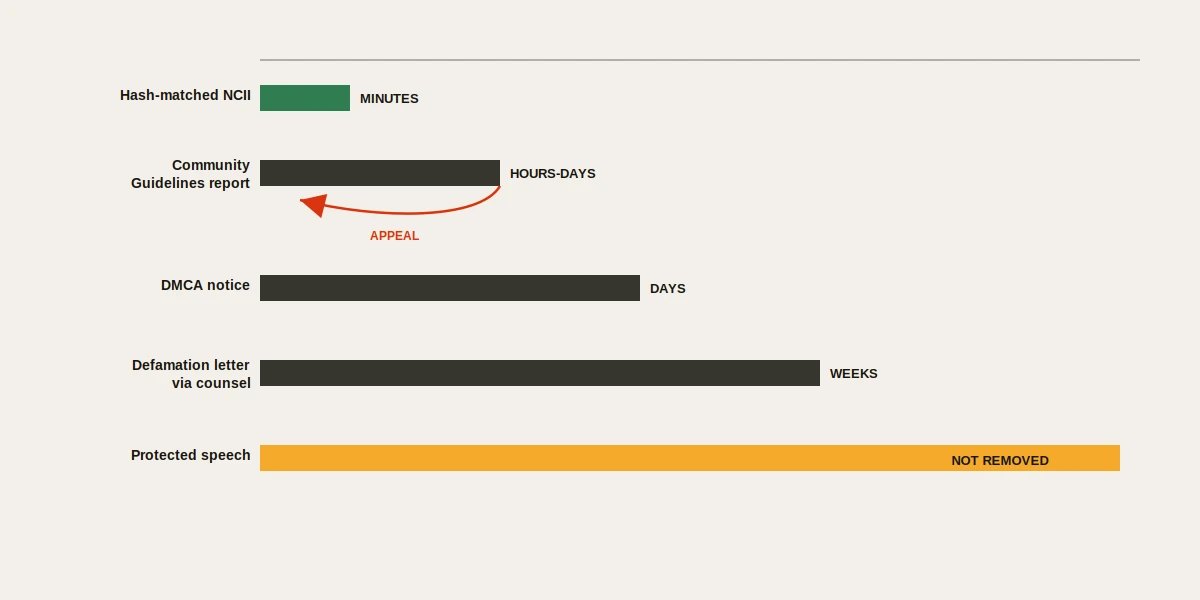
TikTok publishes no service-level agreement for report review. The "24 to 48 hours" figure repeated across dozens of guides is not an official commitment and never has been — it circulates because it sounds reasonable, not because anyone measured it.
What we can describe is the shape of the lanes. Hash-matched intimate imagery is the fast lane, running in minutes to hours because no judgement call is required; the match either exists or it does not. In-app guideline reports on clear-cut breaches resolve in hours to days. Copyright notices take days, because a human checks ownership. Defamation notices through counsel take weeks, because the platform's legal team assesses a contested question of fact. Protected speech takes forever, in the sense that it never comes down at all.
When we file these, the difference between a fast result and a stalled one is almost never the channel. It is whether the reviewer can see the breach without hunting for it. A notice that names the guideline, timestamps the moment, and states the filer's standing in the first two lines gets decided; one that opens with three paragraphs of background gets deferred. That is the whole trick, and it is why we spend more time on the first two lines than on everything after them. If you want the full instrument set laid out for a comparable platform, our five-instruments briefing covers X, and the limits of this guidance apply throughout.
Speed is not the same as permanence, either, and this is the risk nobody selling takedowns mentions. The uploader can appeal, and where their appeal succeeds the content comes back — usually with the person now aware that somebody complained about it. A thin filing that scrapes a removal is therefore worse than no filing at all. It spends the element of surprise, shows the other side exactly which policy you reached for, and ends with the video restored and a hardened opponent behind it. Where a case looks likely to be contested, we would rather spend an extra week building the notice than win a removal that reverses inside a fortnight.
Preserve the evidence before you file
Do this first, because filing is what makes the evidence vanish. A successful removal takes the video down for everyone, you included, and TikTok does not send complainants a copy of what they complained about. Capture the post URL, the handle, the upload date, and a screen recording showing the content playing with the profile visible in the same frame. A still screenshot is the weakest form of this, since it carries neither audio nor context. Archive the page through a timestamping service so the record does not rest solely on your own device, and note the view count on the day you file.
Where a matter later becomes a legal claim, that pack is the claim. The commonest reason a genuinely strong case cannot be run is not that the law failed. It is that the only surviving record is one blurry screenshot taken after the fact.
TikTok video taken down for no reason? The other queue
Roughly a third of the people who reach this page are not trying to remove anything. Their own video went, and the notification explained nothing.
Start with the record rather than the guesswork. Settings and privacy, then Support, then Account Status shows what was actioned and under which policy — "no reason" is almost always a reason that was never surfaced clearly. From there the in-app moderation notice carries an Appeal control, and appeals do succeed at meaningful volume; TikTok reinstates a substantial share of removed videos each quarter after further review. As a general caution, do not delete the video or switch it to private while an appeal is open, because you may lose the thing you are asking to have restored. Strikes themselves expire 90 days after they are issued, so a single removal is rarely the disaster it feels like on the day.
Where the automated system was wrong about you, the appeal is the instrument. Where a coordinated group triggered the removal, the appeal still comes first, and the evidence of coordination supports it. We set out what you actually control versus what only the platform controls in our what-you-control briefing, and the block, report and appeal chain in a different context.
How to take down a TikTok post you own
This is the only genuinely immediate takedown on the platform. Open the post, use the three-dot menu, choose Delete. Deleted clips sit in a recently-deleted archive for around 30 days, so a hasty deletion is recoverable. A Story expires by itself after 24 hours. A Repost is undone from the original video's share sheet with Remove Repost, and no notice reaches your followers. There is no official bulk removal tool for reposts, and the third-party services offering one ask for your password, which makes them account-takeover schemes wearing a convenience label.
What we will not file, and what nothing reaches
Some of the phrasings that lead here are attacker-shaped, and we would rather say this plainly than take the traffic quietly. We do not take down a rival's, a critic's, or an ex-partner's account because someone wants it gone. We will not file a copyright notice over material we know the client does not own, draft a defamation threat over an opinion, or bluff a lawsuit nobody intends to bring. Those are not scruples we can afford to trade: a forged notice hands the other side a counter-claim, and a bluff that gets called turns a small problem into a public one.
Nor will we ask for your password, demand payment up front in cryptocurrency, or promise guaranteed removal. Every case starts with a confidential review that tells you which lane you are in — including when the answer is that you have no lane.
And there is a category nothing reaches. Truthful reporting, genuine public records, and honestly held opinion do not come down through any route in this article, because no policy and no statute requires it. For those, the work is suppression rather than removal: building and ranking material you control so the damaging result stops being the first thing anyone sees. That distinction is the honest heart of this trade, and we treat it that way in our lawful-routes briefing and across every takedown briefing we publish. If you want to know how we assess a case before you share anything sensitive, our removal and defamation practice sets out the team and the method.