
What a Facebook ban service is selling when it quotes you a price
A facebook ban service sells a filing. That is the entire product. Meta decides whether a profile, a Page or a Group comes down, and the seller decides only two things: what wording lands in the report box, and how many accounts push it. Strip away the dashboards, the escrow badges and the success-rate claims, and every listing in this market reduces to drafting plus volume. Drafting carries some genuine value, because most people report badly and pick the wrong category. Volume carries none, and has not for years. So the honest description of a facebook account ban service is a copywriting service with a courier attached, sold at a price that implies a decision it cannot make.
That gap between what is charged and what is controlled is where the whole trade lives.
The success-rate figures deserve the same scrutiny. A seller advertising 90-something per cent is quoting a number nobody can audit, calculated on a denominator they choose, over cases they select. Where a rate is defined at all, it usually counts jobs the seller marked complete rather than accounts that stayed down, and an account restored on appeal a week later still sits in the numerator. Ask what the denominator is and the conversation tends to end.
It also explains the refund language. Read enough listings and you notice sellers guaranteeing "delivery" rather than removal, or promising a re-file rather than a result. That is not sloppy wording. It is the seller drawing a precise line around the only thing they actually hold. Our teardown of the panels behind these offers traces the same product one layer further down, to the browser automation doing the clicking.
We do not sell this, broker it, or run it for anyone. The people who handle these reviews file evidenced notices under their own names, which is a different business with a different risk profile.
How much does a facebook ban service cost? The August 2026 bands
Advertised prices cluster into six bands. The figures below come from live marketplace listings observed in August 2026 on SWAPD, the escrow-based account marketplace where most of the mid-market supply sits, plus gig platforms at the cheap end. Every figure is a seller's asking price, not a verified outcome, and we have deliberately not linked the listings.
| What is advertised | Advertised price | Source type (Aug 2026) |
|---|---|---|
| Single post ban or removal | $99–$200+ | Escrow marketplace, vendor-claimed |
| Mass reporting / "FB reporting" gig | from $20 | Gig platform, vendor-claimed |
| Account or profile ban service | $350+ | Escrow marketplace, vendor-claimed |
| Page or profile removal | $450+ | Escrow marketplace, vendor-claimed |
| "Premium" page removal | $580–$1,295 | Escrow marketplace, vendor-claimed |
| Page restriction removal (the reverse service) | $450 | Escrow marketplace, vendor-claimed |
Two things stand out. The first is the spread: a twelve-fold range for a task the seller describes in almost identical words at both ends. Pricing that loose is a signal that the seller is pricing your urgency, not their cost. The second is the last row. The same marketplaces that sell you a ban also sell the restriction-removal service to the person you banned, at a comparable fee. That is not a coincidence of supply; it is a market with two customers per dispute.
Anyone weighing whether to buy a facebook ban service should also price the alternative honestly. A properly categorised report costs nothing and takes about four minutes. A solicitor's letter for a genuine defamation claim costs more than $1,295 and actually compels something. The paid ban sits in the worst position on that curve: expensive enough to hurt, powerless enough to fail. Our breakdown of TikTok ban-service quotes found the same shape on a different platform, and the ban-for-hire market on X prices it the same way again.
Escrow, crypto, and why an fb ban service refund never arrives
Escrow is the reassurance that closes most of these sales. The marketplace holds your money, the seller does the work, and the funds release once the job is marked delivered. Buyers read that as protection. It is not, and the reason is structural rather than a matter of any particular marketplace's honesty.
An escrow agent can verify delivery. It cannot verify an outcome that belongs to a third party who never joined the transaction. Meta is that third party. So the release condition on a facebook ban service order can only ever be "reports were submitted", which the seller can satisfy in an afternoon whether or not anything is ever removed. The dispute you would want to raise is the one escrow is structurally unable to hear.
Payment rails narrow the exit further. Cryptocurrency and irreversible transfers dominate the top of this market precisely because they are irreversible, and a card chargeback is not available for a transaction you would struggle to characterise to your bank. Sellers who insist on crypto before any review are not managing volatility. They are managing recourse.
Then there is the reporting problem. A buyer in the UK who wants to report a fraud goes to Action Fraud, the national fraud and cybercrime reporting centre. Doing so means describing the transaction, and describing the transaction means describing what was commissioned. Most buyers read that sentence, work out the implication, and write off the money instead. That single dynamic explains more about this market than any pricing analysis: it is not that complaints are rare, it is that complaining is expensive in a currency other than money.
What "facebook ban service reddit" actually returns
We ran the query in August 2026 expecting the usual scam-warning threads. There are none. Searching facebook ban service reddit does not surface a single genuine Reddit discussion of these sellers; page one fills with news about Reddit's own moderation policy, coverage of celebrity account bans, and vendor pages that have optimised for the word "reddit" precisely because no real thread competes for it.
That absence is worth more than a thread would be. On most scam-adjacent purchases, Reddit is where buyers post the receipts afterwards. Here the receipts do not appear, because a buyer who paid $350 to have someone's account banned has an obvious reason to stay quiet, and because the outcome is usually indistinguishable from nothing happening at all. Treat the empty result as data, not as a clean bill of health. You are looking at a market with no public feedback loop, which is exactly the condition under which sellers can keep pricing a coin flip like a service.
The one Facebook product where paying genuinely changes enforcement
There is a version of "paying Meta" that works, and it runs in the opposite direction to everything above. Meta Verified is a subscription that includes proactive impersonation monitoring, and Meta's wording on its own product page is unambiguous: "Protect your brand with proactive impersonation monitoring. Meta will remove accounts that we determine are pretending to be you." The published tiers run at $14.99, $49.99, $149.99 and $499.99 per month (meta.com/meta-verified, accessed August 2026), with faster support and active case monitoring at the upper end.
Look at what that money buys. It buys enforcement pointed at your own identity, applied by Meta, against accounts pretending to be you. It does not buy enforcement pointed at a person you dislike, and no tier of it ever will.
So the market has an odd symmetry. For roughly the price of one "premium page removal" from an escrow marketplace, a business can subscribe to a Meta product for several months that genuinely does remove infringing accounts, lawfully, with an audit trail and a support contact. The difference is direction. One is defensive and contractual; the other is offensive and deniable. Buyers who arrive at a facebook page takedown service after a fake Page has cloned their brand are frequently in the first category and have not realised it. That is the single most useful thing on this page for a business owner: check whether the thing you want is protection, because protection is purchasable and attack is not.
Be clear about the boundary, because the product is narrower than the marketing implies. Meta Verified removes accounts pretending to be you. It does not remove accounts criticising you, competing with you, or telling an unflattering truth about you, and no support tier changes that. A subscription is a faster door into Meta's enforcement, not a different set of rules once you are through it.
The Instagram version of this market runs the identical playbook on Meta's other app, and YouTube sellers make the same category error between reports and strikes.
Facebook account takedown and page takedown are three different purchases
The phrase collapses three separate transactions, and sellers rely on the confusion. Sorting them takes a minute and saves most of the money.
Own-account or own-Page deletion. You hold the credentials and you want out. No purchase exists here at all, because it is a form in your own settings. A great deal of search traffic for page takedown facebook is this, and it never needed a vendor.
Rights-holder takedown. Your trademark, your copyright, your brand on someone else's Page. This is the one lane where Meta runs a fast, formal process, and it is free. Meta's own transparency reporting states that where "the report is complete and valid, the team will promptly remove the reported content, typically within a day or less" (Meta Transparency Center, accessed August 2026). Businesses with a registered trademark can also apply for Brand Rights Protection, Meta's search-and-report tool for rights holders (Meta Business Help Centre), which requires an active trademark and a clean IP-violation history rather than a fee.
Third-party ban-for-hire. Someone else's account, no rights claim, no standing. This is what the marketplaces are actually selling, and it is the only one of the three with no formal channel behind it. There is no queue for "this person should not be on Facebook". There is a queue for specific, categorised violations, and standing to file one comes from the violation rather than from a fee.
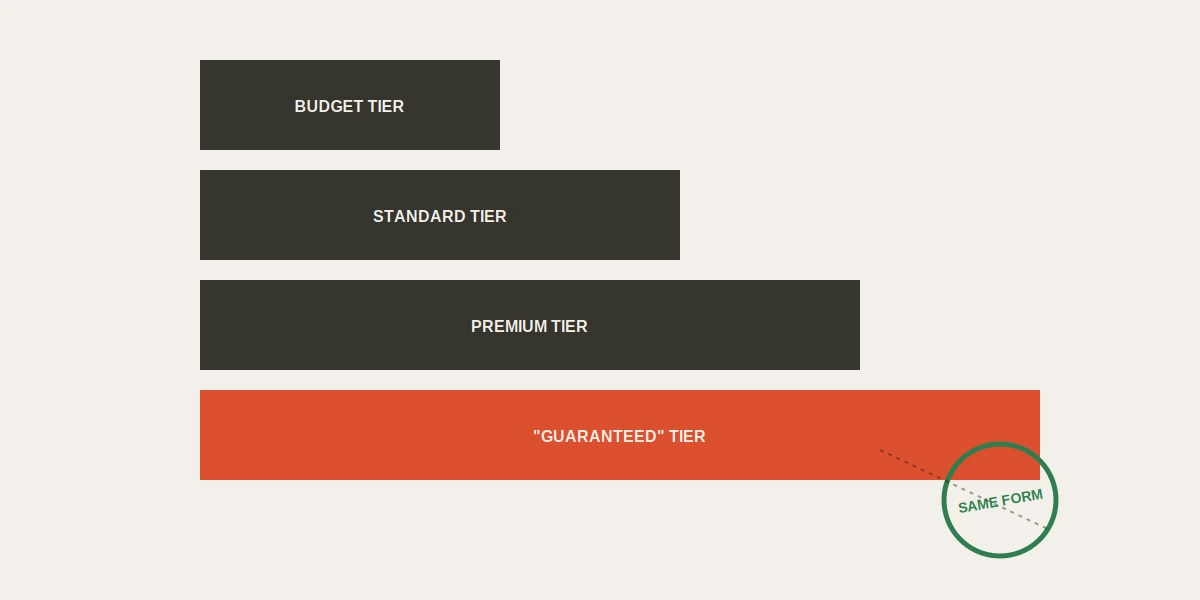
The reason this matters commercially is that the three lanes have wildly different prices for reasons that have nothing to do with difficulty. Lane one is free because it is your own settings page. Lane two is free because Meta wants rights holders reporting infringement and has built tooling to encourage it. Lane three costs hundreds of dollars not because it is harder but because it is the only lane where the seller can plausibly claim to be doing something you could not do yourself. That claim is thin. The report form in lane three is the same form in everyone's app.
Anyone shopping for a facebook takedown service should know which of the three they are in before reading a single quote, because lanes one and two are free and lane three is the expensive one. One caveat on lane two that sellers never mention: rights-holder reports are not anonymous. Meta states that it notifies the user "that content was removed for IP reasons, and providing information about the report and reporting party". File a trademark claim and your name travels to the person you filed against.
The route-by-route mechanics of lane one and lane two are set out in our guide to taking down a Facebook account, and the removal-versus-suppression framing carries across Meta's apps. Telegram's channel market splits along the same three lines.
Is it illegal to pay someone to get a Facebook account banned?
Not a single statute makes the purchase itself a named crime, and anyone who tells you otherwise is guessing. The exposure is real anyway, and it stacks from four directions. This is general information rather than legal advice, and it is written from a UK vantage point.
Start with contract. Filing reports you know to be false breaches Meta's terms and its Inauthentic Behavior policy, which forbids misusing Meta's reporting systems to harass or silence people. Meta's remedy is your account, and enforcement here increasingly lands on the reporting side rather than the target.
Then criminal law. In England and Wales, section 179 of the Online Safety Act 2023 created a false communications offence: sending a message conveying information the sender knows to be false, intending to cause non-trivial psychological or physical harm to a likely audience, without reasonable excuse. It came into force on 31 January 2024 (legislation.gov.uk). A knowingly fabricated abuse report aimed at destroying someone's account is a reasonably close fit for that description.
Paying someone else to send it does not insulate you. Under section 44 of the Serious Crime Act 2007, a person commits an offence if they do "an act capable of encouraging or assisting the commission of an offence" and intend to encourage or assist it (legislation.gov.uk). Commissioning is an act. That is the provision buyers overlook when they assume the seller carries the risk alone.
Finally, method-specific law. If the service files a bogus copyright notice in your name, a knowing material misrepresentation in a US takedown notice is actionable under 17 U.S.C. § 512(f). If it uses compromised or automated accounts, the Computer Misuse Act 1990 and its US equivalents come into view. And the ordinary fraud risk sits on top of all of it, since the most common outcome of buying a facebook account ban service is losing the money and receiving nothing.
There is a fifth exposure that buyers almost never price in, and it is the one that has teeth in practice: the target's civil claim. A person whose account or Page is destroyed by a campaign of knowingly false reports has a potential claim for the loss, and a paper trail leading to a payment is close to the ideal evidence for it. Marketplace records, escrow logs and messages to a seller are all discloseable. The seller is usually anonymous, offshore and judgment-proof. You are none of those things, which makes you the defendant worth suing.
None of that means a person with a genuine grievance is powerless. It means the paid route converts a strong case into a weak one, because the moment bad faith is arguable, the file stops being about the other person's conduct and starts being about yours. Our LinkedIn briefing works through what grounds actually survive that test, and our engagement terms set out what we will and will not put our name to.

Does report volume move Meta at all?
The entire market rests on one assumption: that more reports mean more enforcement. Meta's own published position contradicts it, and has for years. Reports route content to review; they do not vote on the outcome. A single well-evidenced report in the correct category reaches a reviewer with everything needed to act. Two hundred vague reports reach the same reviewer with less.
What volume does reliably produce is a pattern. Bursts of near-identical reports from low-trust accounts are one of the easier signals to detect, and detecting them is cheaper for Meta than adjudicating them individually.
It helps to picture the queue as it actually works. A report is a routing instruction: it tells Meta which policy to test the content against and hands over whatever evidence came with it. Where the category is right and the evidence is attached, one reviewer can resolve it. Where the category is wrong, additional copies of the wrong category do not become the right one. A hundred harassment reports filed against a copyright problem produce a hundred correct decisions that nothing was violated, which is worse than filing nothing, because the content now has a review history saying it was checked and left up.
That review history is the quiet cost. Buyers imagine reports accumulating like votes. In practice a cleared decision makes the next genuine complaint harder, and a genuine complaint is often what the buyer had all along.
That is the failure mode buyers are never quoted for. The brigade does not merely fail to ban the target; it can mark the campaign, and occasionally the accounts running it. We covered what Meta actually acts on in detail, and the X mass-report audit reached the same conclusion from the other side of the industry.
When the Page under attack is yours
Roughly half the people who reach us through this phrase are not buyers. They are the other side of the transaction: a business whose Page has just been restricted after a burst of coordinated reports, or a person watching a competitor try to get their account pulled before a launch.
If that is you, the sequence matters more than the speed. Preserve first, and do it before you appeal. Screenshot the restriction notice, the report notifications, and any public post where someone is organising the campaign. Note the exact times. Then appeal through the notice itself, and say plainly that you believe the reports were coordinated and made in bad faith, because a reviewer who is told to look for a pattern will see one that a reviewer reading a generic appeal will not.
Preserved evidence is also the difference between a complaint and a case. Where the campaign is being organised in public, the organiser has usually written down more than they realise.
Three practical points, because the first hours decide most of it. Do not delete the reported post while the review is open, even if it is the thing drawing fire, because a reviewer comparing the notice against a missing post has nothing to clear you with. Do not open a second Page to keep trading, because a duplicate created during an enforcement action reads as evasion and can pull the new asset into the same file. And do not answer the campaign in public, since a visible argument gives the next wave of reporters a fresh surface and gives Meta's systems two parties behaving badly instead of one.
If the Page carries revenue, the commercial clock matters as much as the enforcement one. A restricted Page usually loses ad delivery and Shop functionality before it loses reach, so the loss starts compounding well before any decision arrives. That is the argument for filing a precise appeal on day one rather than a thorough one on day four.
Sellers on this market ask buyers for access, credentials or a linked account, which is a second reason the buyers rarely complain publicly: they handed something over. Our WhatsApp panel investigation documents that hand-over in detail, and the Instagram panel supply chain shows where the software itself comes from.
The invoice a lawful takedown desk can itemise
Here is the difference in plain commercial terms. A ban seller invoices for an outcome they do not control. We invoice for work we do control, and we say in advance which category your case falls into.
What goes on our invoice: a review of what is actually removable, evidence assembly, the correct notice drafted and filed under our name, escalation where the first filing stalls, and a written record of every step. What never goes on it: a promise that Meta will act, a report brigade, a forged notice, or a fee taken before anyone has looked at the file.
When we file these, the pattern is consistent enough to state plainly. Cases with documentary standing — a registered mark, an original photograph, a court finding, a clear impersonation of a named person — move. Cases resting on how unfair something feels do not move, however strongly worded the notice. The work is almost entirely in deciding which one you have before anything is sent, and a fair share of our intake conversations end with us telling someone there is no filing worth making.
On pricing, the only honest structure is one that does not pretend to sell certainty. We quote for the work, in writing, after the review that tells us what the work is. A fixed fee where the route is known and the filing is standard, a scoped fee where escalation or counsel is likely, and no fee at all where the answer is that nothing should be filed. What we will not do is quote a number against an outcome sitting inside Meta's review queue, because that is the pricing model this entire page has spent its length taking apart, and adopting it with better manners would not make it truer.
If your Page or account is under a coordinated reporting campaign, or someone is impersonating you on Facebook, book a confidential case review. We do not sell bans, we do not run report brigades, and nothing is charged until a route is mapped.
For the free route on a genuine violation, our no-bot walkthrough applies the same logic across Meta's apps.
What no fee removes
Some things stay up regardless of who is paid or how the notice is worded. A true news report, a genuine public record, an unflattering opinion that stops short of a false statement of fact: Meta will not remove these, and neither will we pretend otherwise. Forcing the point with a bluffed legal threat or a fabricated rights claim gets the content reinstated, exposes the sender, and hands the other side a story better than the original post.
Where removal is unavailable, the honest instrument is suppression: authoritative owned content pushed above the damaging result, and where personal data is involved, a de-indexing request or a right-to-be-forgotten filing. It is slower, quieter, and it has a ceiling we will describe before you spend anything.
We will not ask for your password, we will not ask an NCII client to send us the material, and we do not take payment before a route exists. Those limits live in our disclaimer rather than in the small print. The rest of our platform work sits in the briefings archive.