
The only bulk call Meta ships for WhatsApp is a block
Meta publishes the WhatsApp Business Cloud API in full, which makes this checkable rather than arguable.
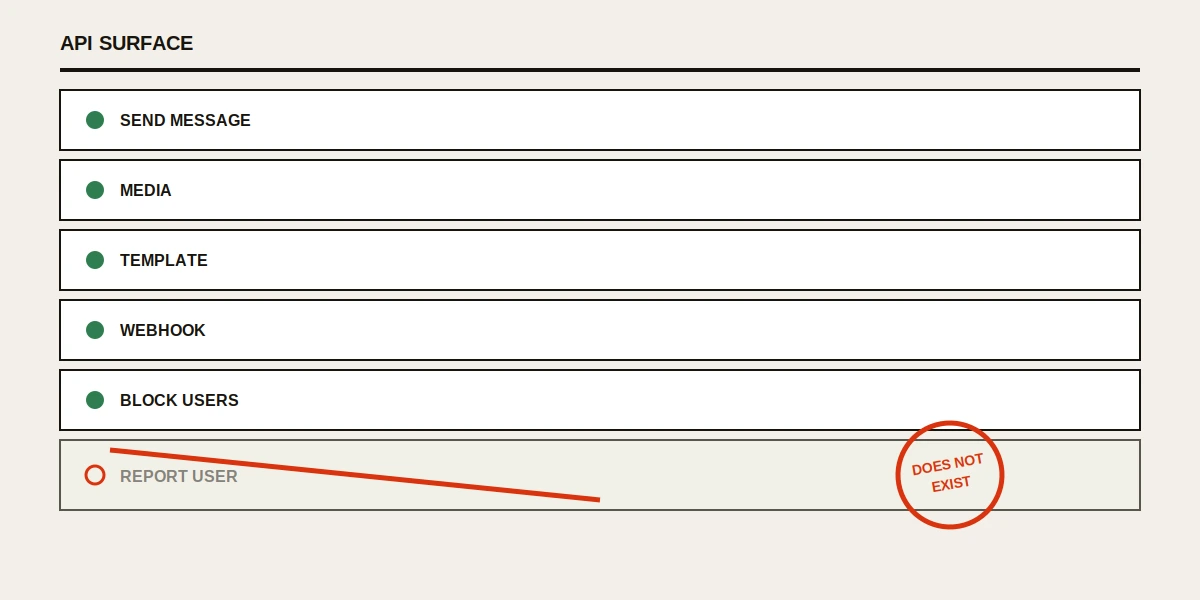
The documented surface covers messages, media, message templates, phone numbers, business profiles and webhooks. Exactly one endpoint on that list accepts work in bulk, and it is block_users: a POST to /<API_VERSION>/<PHONE_NUMBER_ID>/block_users that takes up to 1,000 numbers in a single request, against a blocklist holding 64,000 in total. It carries a condition worth reading twice. A business may only block people who messaged it within the last 24 hours; attempt anyone outside that window and Meta returns error 131047, "Re-engagement required" (WhatsApp Cloud API, Block Users).
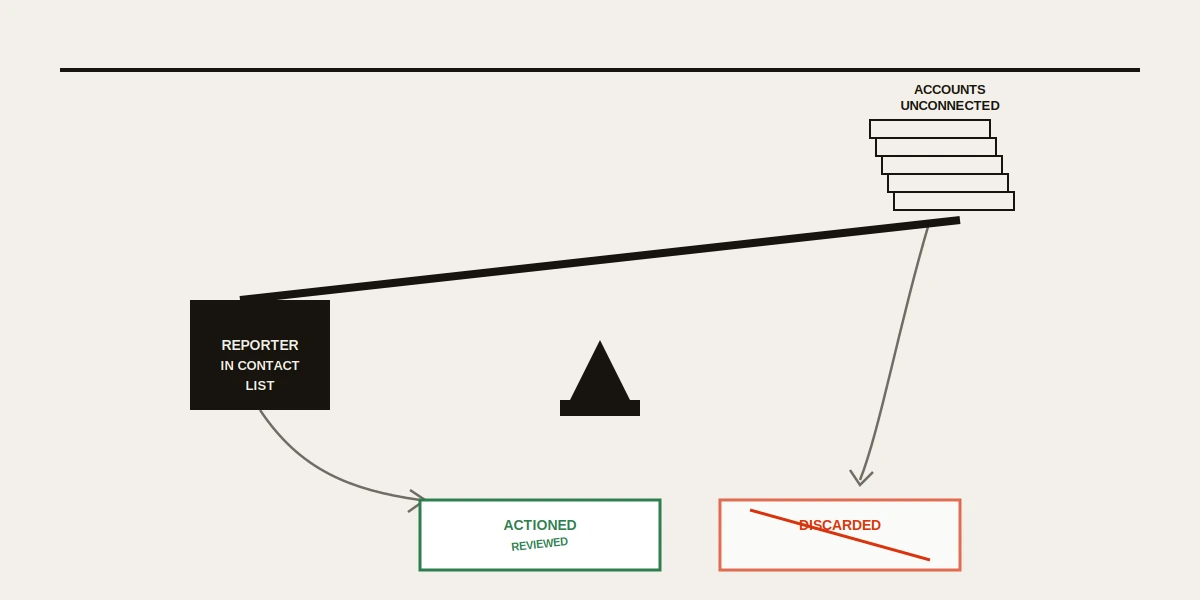
Read the shape of that rather than the function. The single bulk operation Meta ships is defensive, applies only to your own account, and is gated on the other party having contacted you first.
There is no counterpart pointing outward. No report endpoint, no flag endpoint, nothing anywhere in the reference that submits a violation complaint about somebody else's account. Reporting on WhatsApp remains what it looks like on your handset: a person, a menu, a tap.
That absence is the whole story of this product category. A platform that wanted to let software file complaints at scale would have shipped the call, and Meta demonstrably knows how to ship a bulk call, because it shipped the block. The gap is a decision, not an oversight. We ran the same test across the platforms that expose no bulk-report endpoint either, and WhatsApp is the starkest case, because here the bulk endpoint exists and points the other way.
API behaviour described here was checked in August 2026. This is briefing material, not legal advice, and the people who wrote it publish their limits rather than their promises.
So what is a whatsapp mass report bot actually wired to?
Something, obviously. Money changes hands and screens do move. The question is what sits on the other end of the connection, and there are only three answers in circulation.
The mailer. The most visible open-source example on this search is a Telegram bot that composes complaint emails and fires them at WhatsApp support addresses over Gmail SMTP, ten to fifty a session. It never touches a WhatsApp API of any kind, because it cannot. It also aims at a door that closed: WhatsApp stopped accepting support requests by email, and messages to addresses at whatsapp.com now go unread. The tool works perfectly and reaches nobody.
The front-end. A Telegram bot, a web panel, a dashboard with a progress bar. Behind it sits a pool of rented or stolen accounts and, frequently, a human being tapping the ordinary in-app report button. This is the same supply chain we mapped inside the panel trade, and the same three-product confusion we untangled for Meta's other properties. The progress bar is the product.
The library. The technically real option, and the one that matters. Baileys, whatsapp-web.js and WPPConnect are reverse-engineered re-implementations of the WhatsApp Web protocol. Baileys speaks WebSockets directly and impersonates a linked companion device. WPPConnect and whatsapp-web.js drive a headless browser to the same end. All three authenticate the way your laptop does — a QR scan or a pairing code — and then persist the session so it survives a restart. None is affiliated with Meta, and Baileys says so on its own front page: the project is "not affiliated, associated, authorized, endorsed by, or in any way officially connected with WhatsApp", and its maintainers "discourage any stalkerware, bulk or automated messaging usage" (Baileys, WhiskeySockets).
The libraries are legitimate engineering. What is sold on top of them is not, and the sourcing map we drew for Instagram's version of this market transfers almost unchanged. The myths do too, which is why we keep a running column on the ones that survive because nobody checks them.
Has your number, group or Business account been hit by a report wave? Ask us for a confidential review. You will hear which route fits before anyone pays anything, and you will hear it plainly if the honest answer is that nothing needs doing.

What a whatsapp mass report tool takes from you first
Here is the part the sales page leaves out, and it is not a small omission.
A linked device is not a limited permission. WhatsApp allows four companion devices alongside your phone, and each one gets your message history, your contacts, the ability to read every incoming chat and the ability to send as you. When a whatsapp mass report tool asks you to scan its QR code, that is what you are granting. Not access to a reporting function, which does not exist. Access to your account.
Consider who is on the other side of that scan. An anonymous operator, contactable through one Telegram handle, with no company, no jurisdiction and no reason to behave once the payment clears. Meta has litigated this exact pattern before: its 2022 action against the developers behind HeyMods and related modified WhatsApp clients alleged those apps harvested credentials from over a million accounts and turned them into a spam fleet (BleepingComputer). Nobody who installed one thought they were joining a botnet either.
Then there is what you have agreed to on WhatsApp's side, which is four separate clauses of the same document. Its Terms of Service bar you from reverse-engineering or decompiling the service, from creating accounts "through unauthorized or automated means", from "bulk messaging, auto-messaging, auto-dialing, and the like", and — most directly — from misusing "any reporting channels, such as by submitting fraudulent or groundless reports or appeals" (WhatsApp Terms of Service). A campaign run through an unofficial client breaks the first three by construction. The fourth it breaks on purpose.
So the buyer is in breach on four counts, running from an account WhatsApp can identify precisely, having handed the keys to a stranger. The target is in breach of nothing yet. We have written before about what the money actually buys in these markets and about the bill that arrives after a ban-for-hire desk takes the job. This is the version with the worst risk transfer of any platform we work on.
For what it is worth, we refuse this work when it is offered to us, and the refusal is written into our engagement terms rather than left to a conversation.
Does a whatsapp mass report wave decide anything?
Less than the sellers claim and more than nothing, which is an awkward answer and therefore the true one.
WhatsApp does use user reports as an enforcement signal. What it does not run is a counter. Its published anti-abuse reasoning is that a system banning any account crossing a report threshold would be trivially weaponisable, so it weighs the relationship between reporter and reported instead. A report from somebody the account actually messaged carries evidentiary weight, because there is a five-message extract behind it that a reviewer can read. Fifty reports from accounts the target has never contacted carry a different signal entirely: they identify a coordinated campaign, and the campaign is the anomaly.
Compare that to YouTube, the one platform that publishes a hard ceiling on programmatic reporting, and the contrast is instructive. YouTube caps you. WhatsApp does not need to cap you, because volume without relationship is already worth close to zero on arrival.
The pattern holds across every service we handle. Enforcement is decided by classifiers reading content and context, not by crowds voting, which is the same conclusion we reached about TikTok's queue. Reporting genuine automated abuse is a separate matter and does work — we drew that line carefully in the spam-report bot briefing, and it is worth keeping: reporting a bot is not the same act as being one.
Mass report WhatsApp: the three jobs hiding in one phrase
People arriving on the phrase mass report whatsapp are rarely after the same outcome, and separating the three saves a great deal of wasted effort.
Getting a number off the platform entirely
This belongs to WhatsApp and to nobody else. Your contribution is the quality of a single report, not the quantity of many, and the mechanics of what that report carries are set out in our companion briefing on reporting a number. Volume is not a lever here. Recency is.
Clearing a spam or scam wave hitting several people
Genuinely a multi-person situation, and the honest version works. If eight people in a group each received the messages, eight individual reports each carry their own five-message extract from their own thread. That is eight independent evidence packets, not one packet counted eight times. It looks superficially like a whatsapp mass report and is structurally the opposite of one, because every filing is from somebody the sender actually messaged.
Removing somebody from a group you run
Yours entirely, and instant. Removal is not a ban, though: WhatsApp keeps no per-group blocklist, so resetting the invite link is the step that actually holds. This is the same distinction between the controls you own and the decisions only the platform can make that we set out for X.
What actually moves a WhatsApp case
Stripped of the tooling, the work that succeeds is unglamorous and mostly sequencing.
Capture first. Chat history lives on your device rather than on WhatsApp's servers, so nobody can retrieve it for you later — screenshot with the number and timestamps visible before you touch anything else. Report the object that breached the rules, not whatever is easiest to tap: the contact for a stream of abuse from one number, the group for a group. Report while the abusive messages are still the most recent thing in the thread, because recency is the only filter the extract applies. Block in the same flow so contact stops. Then stop replying, because nothing you write is transmitted and engagement is what most harassment and sextortion scripts are waiting for.
Where a case needs to travel further, it leaves the platform rather than escalating inside it. Threats, blackmail and extortion are police matters, and a clean record of numbers and dates is what makes them actionable. The same evidence discipline applies wherever proof expires on a timer, which we set out at length in the Snapchat briefing.
One thing worth internalising about Meta's grammar: it counts violations, not complainants. We took that apart in how Facebook enforcement actually tallies, and WhatsApp runs the same logic with less of it visible. A hundred reports of nothing enforceable produce nothing. One report of something enforceable produces an action.
And when the platform declines, the case is not necessarily over — it changes category, from removal to suppression, which is a different discipline with different tools. We mapped that fork here.
If you think you were mass reported
Some readers arrive here from the other direction, having lost an account and wanting to know what hit them.
Start by testing the assumption, because it is usually wrong. Coordinated reporting is a poor explanation for most WhatsApp bans, given how heavily unrelated filings are discounted. The far commoner causes are mundane: an unofficial client such as GB WhatsApp or WhatsApp Plus, bulk sending from a personal account, or an automation library left running against a number that was never meant to carry one. Check those first. When we audit a restricted account, the single most frequent finding is not a brigade against the client — it is a piece of software the client installed themselves and had stopped thinking about.
If a genuine campaign is running, it usually leaves a signature outside WhatsApp: the same accusation appearing across several platforms in a short window, often with the same phrasing. That is the part we can act on, because it is the part that indexes. What a report flood looks like from the receiving end is something we documented for TikTok, and the psychology transfers exactly.
Practical note before you send us anything: read how we store and handle evidence first. Chat exports contain other people's messages as well as yours, and we would rather you knew our retention position before you export a thread than after.

Where we stop
Stated before money changes hands rather than after, which is the only point at which it means anything.
We do not build, sell, operate, rent or recommend a whatsapp mass report bot or panel. We will not point one at a person or a business for any fee. We do not forge legal notices, we do not threaten litigation nobody intends to file, and we will never ask for your password, your PIN, your two-step code or a QR scan.
We also cannot guarantee an outcome, and anyone in this market who does is describing a decision that is not theirs to make. WhatsApp publishes no appeal timeline we could bind ourselves to. What we can do is file the strongest available case, escalate it correctly, and tell you early when the answer is no.
The harder boundary is this one. True accounts of events, genuine public records and honestly held opinion do not come down, whatever anyone charges to try — and forging a notice against them tends to produce a reinstatement, a lawsuit and considerably more attention than the original post ever had. Cases in that category are won by outranking rather than deleting. You will hear which of the two you have in the first conversation rather than after three invoices, and our full limits are published so you can check them before you get in touch.
If the abuse involves intimate images, that case jumps the queue and costs nothing to review. We never ask you to send us the material, to assess a case or to prove one, and there are no exceptions to that. Where the person depicted was under 18, NCMEC's Take It Down is the right first call and works by hashing on your own device, so the image never leaves it.
The rest of the platform briefings sit alongside this one, and the desk itself is here when the reading runs out.