
Three products get sold as a "facebook mass report tool"
The name covers three different things. They cost different amounts, they behave differently, and only one of them contains software worth the description. Telling them apart takes about a minute, and for most people that minute ends the purchase.
The first is an open-source script. It lives on a public repository or arrives as an APK, it drives a browser session through Facebook's ordinary report form faster than a person could click, and it needs accounts to drive. The second is a hosted panel: a dashboard, a target field, a slider for report volume, and behind it a pool of accounts somebody else farmed. The third is a progress bar. Nothing runs behind it at all. You pay, a counter climbs to a hundred per cent, a green tick appears, and no report was ever filed against anybody.
| What is sold | What actually runs | What it needs from you |
|---|---|---|
| Open-source script or APK | Browser automation over the normal report form | Accounts, and usually your login |
| Hosted panel or dashboard | A rented pool of farmed accounts | Payment, a target URL, sometimes your session |
| Progress bar | Nothing | Payment only |
Sorting a listing into one of those three rows is nearly always possible before money changes hands. Ask what it needs. A script asks for credentials because it has none of its own. A panel asks only for the target, because the accounts are already sitting in somebody's inventory. The third asks for nothing except payment, which is the tell.
We mapped the same taxonomy on the other Meta platform in four supply routes, one dead end, and the pattern held there too. Repositories contain real code. Dashboards are real dashboards. The advertised capability is the part that does not exist, and the gap between those two facts is where the money goes.
The rented-inventory model is the one people underestimate, because it looks the most professional. Buying access to a rented pool of accounts wearing a dashboard feels like buying software. It is closer to renting a crowd. And when the same script gets rewrapped under a tidier product name and a cleaner landing page, the underlying mechanics do not change at all, which is why the Instagram spam report bot claim reads almost word for word like the Facebook one.
Policy and case detail below is current as of August 2026. This is briefing material rather than legal advice.
Why no facebook mass report bot can call an API
Here is the technical question nobody selling one of these will answer directly: what endpoint does it hit?
Meta publishes an extensive developer platform. The Graph API reference documents thousands of edges covering Pages, ads, messaging, commerce, insights and business management. It documents no endpoint that submits an abuse report against a user, a Page or a post. The closest-sounding node, "reported_content", reads reports that already exist inside a commerce-compliance context rather than filing new ones, and its "reported_object_id" field was deprecated at Graph API v12.0. There is no public write path for reporting. Any product calling itself a facebook mass report bot is therefore not integrating with Meta. It is puppeting a browser through the same form a human would use, one session at a time.
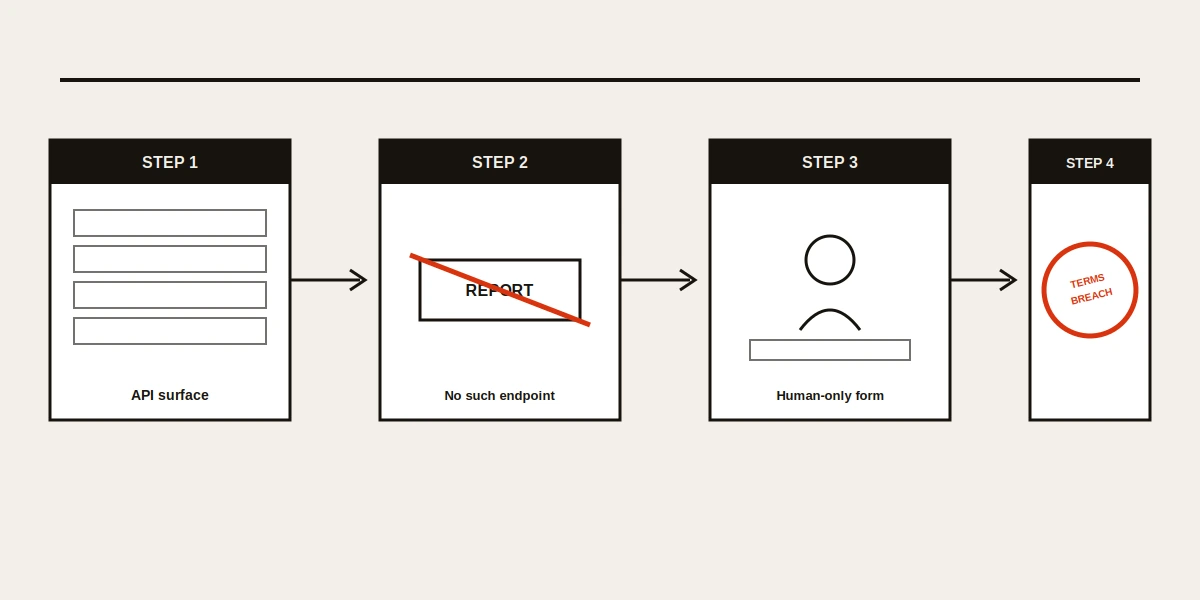
That distinction is not pedantry. It determines everything downstream. An API integration would be fast, stateless and hard to detect. Browser automation is slow, needs a logged-in session per account, breaks whenever the front end changes, and leaves a behavioural signature that looks nothing like a person using a phone.
It also puts the operator straight into a terms breach. Meta's Automated Data Collection Terms are unusually blunt about it: you may not access or collect data from its products by automated means without prior permission, "regardless of whether such automated access or collection is undertaken while logged-in to a Facebook account" (Meta, Automated Data Collection Terms). Logging in first does not launder the automation. That clause exists precisely because operators assumed it did.
The absence is not a Facebook quirk either. We ran the same check on X and found no bulk endpoint exists there either. The one genuine exception across the major platforms is YouTube, whose Data API does expose a reporting call, and even that is capped at 200 reports a day before the quota simply stops. A cap of two hundred is not a mass-reporting instrument. It is a rate limit doing its job.
Meanwhile the enforcement most people imagine they are triggering usually fires without any report at all. Classifiers catch the bulk of clear-cut violations before a human complains, which is why so much enforcement fires without anyone pressing report and why buying volume aims at a lever that was never load-bearing.
What the tool collects before it reports anybody
Follow the accounts and the business model explains itself.
Automation needs authenticated sessions. A script has none, so it asks you for yours, usually framed as "connect your account" or "add reporter accounts". What it receives is a username and password, or increasingly a session cookie, which is the more valuable of the two because it walks straight past two-factor authentication. Some builds request a one-time code as a "verification step". No legitimate process asks for that. A six-digit code handed to a third party is an account transfer, not a verification.
The panels take a different route to the same place. They do not need your login because they already hold thousands of farmed accounts, and those came from somewhere: credential stuffing, bulk registration, or people who used the previous version of the tool. The inventory is self-replenishing by design. Today's customer is tomorrow's stock.
Then there is the target file. Whatever you upload becomes a record on somebody else's server showing that you paid to have a named person reported. Two years later that record still exists, and it is exactly the artefact you would least like produced in a dispute.
Compare that against how a regulated desk handles the same information. We publish what we store, and for how long, and we do not retain material we have no reason to keep. The distinction that matters is not politeness, it is that one side has a documented retention policy and the other has an unindexed database with no stated purpose.
Every one of these mechanics is older than the product page selling it. The credential-harvest step, the phantom counter, the "verified reporter accounts" upsell all appear in the Instagram market too, alongside the myths that survive because nobody checks them. If you want a single rule of thumb that works across every platform: nobody who can genuinely help you needs your password. The people who run this desk have never once needed a client's login to file a takedown, because no lawful route requires one.
Meta takes automation operators to court, and has lost once
The legal exposure here is not hypothetical, and the honest version of the story includes a defeat.
Meta has spent a decade suing automation and scraping operators in the Northern District of California. In Meta v. Voyager Labs, filed 12 January 2023, the allegation was that Voyager built more than 38,000 fake accounts to harvest data from over 600,000 users; the case settled with a permanent injunction and a monetary payment approved in December 2024 (Meta Newsroom). In Meta v. BrandTotal and Unimania, filed October 2020 over two browser extensions, the court found the harvesting breached both Meta's terms and anti-hacking law before the parties settled in September 2022 with a permanent injunction. Meta filed against the scraping-as-a-service operator Octopus in July 2022 on similar grounds.

Now the loss, because leaving it out would be selling you something.
On 23 January 2024, in Meta v. Bright Data, Judge Edward M. Chen granted summary judgment to the defendant. Bright Data had scraped publicly available data while logged out, and the court held that Meta's terms did not bind it in that posture. Sellers occasionally cite this case as proof that automation is fine. It proves something much narrower. Logged-out collection of public data was not a contract breach. A mass-reporting tool does the opposite of that: it logs in, and it writes rather than reads. The one factual finding that shielded Bright Data is the one factual finding a reporting bot cannot claim.
The pattern is identical to what sits behind every ban-for-hire offer, where the buyer carries liability too and the operator is the only party with a plausible defence. For the avoidance of doubt, Obscura does not accept these instructions. We do not report accounts that have broken no rule, we do not forge notices, and we do not bluff litigation nobody intends to bring; our acceptable-use terms put it less politely. The same shape recurs on every platform we cover, which is the point of keeping the whole briefing archive in one place rather than writing it once.
What a facebook mass report actually does inside Meta's queue
Assume everything works. The accounts hold, the script runs, four hundred reports land on one profile inside an hour. What happens?
Meta states the answer on a live help page, in one sentence: the number of reports on content does not determine whether it will be removed, and the same standards are applied each time a review runs (Facebook Help Centre). Volume is not an input to the decision. Category fit, evidence a reviewer can actually see, and the reported account's existing record are the inputs. Four hundred identical complaints resolve to the same finding as one, because they are assessed against the same written standard.
Does a facebook mass report ever work?
It works when the underlying report was going to work anyway. That is the whole of it.
If a post genuinely breaches a policy, one accurate report through the right channel gets it reviewed. If it does not, four hundred reports produce four hundred rejections and one new problem, because coordinated filing is itself a listed violation. Meta's Inauthentic Behavior policy prohibits accounts that "misuse Meta reporting systems to harass, intimidate or silence others" (Meta Transparency Center). The usual outcome is that the reports are discounted as a set and the reporting accounts get a closer look than the target does.
Meta also removes the raw material continuously. In July 2025 it said it had actioned around 500,000 accounts for spammy behaviour and fake engagement, and removed roughly 10 million profiles impersonating large content producers, in the first half of that year (reported by CNBC, 14 July 2025). Farmed accounts are a depreciating asset. That is why panels sell access by the campaign rather than by the account.
The mechanics sit alongside the ones in our Facebook enforcement briefing, where Meta counts violations, not reporters. For the receiving end, what mass reporting does to the target transfers to Facebook almost unchanged. And on Meta's other messaging surface the transmission is even thinner: what a single report actually sends is far less than most people assume.
What a "facebook mass report service" is charging for
The pitch has not changed in a decade. A handle, a fee somewhere between twenty and three hundred pounds, removal promised inside twenty-four to forty-eight hours, and a screenshot of a queue.
Strip the branding and a facebook mass report service is charging for one of four things. Filing the free report you could have submitted yourself in ninety seconds. Renting the farmed-account pool described above. Harvesting your credentials under a verification pretext. Or nothing whatsoever, behind a convincing dashboard.
None of those is a removal. Removal is Meta's decision, made against Meta's standards, by Meta's reviewers and classifiers. That is the structural reason the guarantee is always the tell: a vendor promising you the outcome of a decision they do not make is either misinformed or lying, and the money leaves either way.
The offer is portable across platforms with only the logo swapped, which is why our teardown of what the money actually buys on Instagram reads as though it were written about this market. It nearly was.
What a legitimate desk charges for is different in kind, not degree. It is assessment, evidence assembly, routing to whichever lawful instrument fits, escalation where a channel exists, and an honest answer where none does. That is the work, and it is priced as work rather than as an outcome.
If a mass report campaign has been aimed at you
A significant share of the traffic on these keywords is defensive. Somebody watched their reach collapse or their Page restrict overnight, went looking for the name of the thing that hit them, and landed here.
The reassuring part first. A brigade rarely succeeds on its own merits, because volume is not scored. What it can do is trip an automated restriction while a review runs, which feels identical to a ban and is not one. The distinction matters because the response differs completely: a policy action needs an appeal, and an automated hold usually needs time plus a clean appeal that does not make things worse.
- Capture everything before it disappears. Screenshots with visible URLs and timestamps, the restriction notice in full, and the exact wording of any policy Meta cites.
- Appeal inside the stated window, once. Repeated submissions do not escalate a case and can reset a queue position.
- Do not create a replacement account while an appeal is live. Evasion is a separate violation and it forecloses the recovery you were otherwise entitled to.
- Record the pattern, not just the outcome. Timestamps clustering inside a narrow window is the signature that distinguishes a coordinated campaign from ordinary enforcement.
- If the campaign is aimed at one person over time, note that a course of conduct causing alarm or distress can engage the Protection from Harassment Act 1997 in the UK, which is a different lever entirely from a platform report.
If the appeals have gone in and nothing has moved, or the material has already spread beyond Facebook, the report button has done everything it can. Send the evidence to a reviewer. We map the route before you pay anything, and we will say plainly when the free channels are all you need.
Evidence discipline is the part people get wrong most often, and it is worst where content expires on a timer. The capture habits in our Snapchat briefing apply here without modification: secure it first, report it second. On the defensive levers that genuinely sit with you rather than with the platform, what blocking really does draws the same boundary we would draw on Facebook.
What actually removes a Facebook post, and what only buries it
Some of what damages people cannot be taken down, and pretending otherwise is how firms in this industry lose both cases and clients.
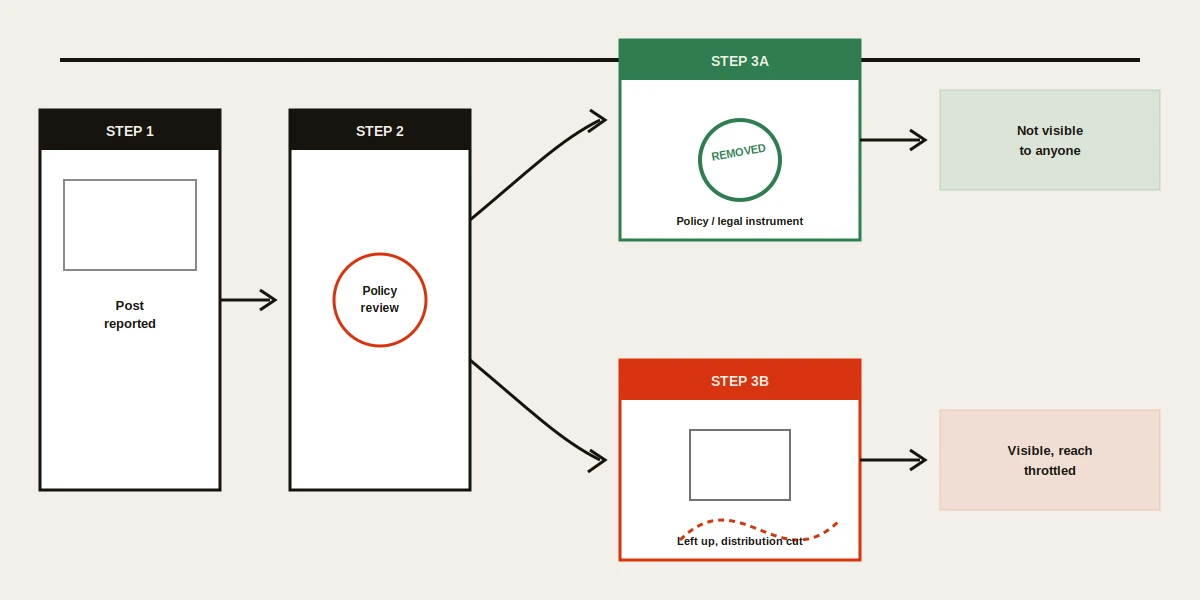
A truthful news report about a real event stays up. A negative opinion, however unfair it feels, is protected expression in most jurisdictions and under most platform policies. A public record remains a public record. None of those breaches the Community Standards, so a report against them is not a near miss. It is a category error that returns nothing, and escalating it into a forged notice returns considerably worse than nothing. A copyright notice is a sworn statement, and filing one in bad faith carries liability for damages and legal costs under 17 U.S.C. section 512(f).
Where removal is genuinely available, the instrument decides the outcome: a policy complaint routed to the correct form, a copyright notice where rights are actually held, a legal notice where a statement is provably false and damaging, or an erasure request where a legal basis exists. Where none applies, the honest answer is suppression rather than removal, and saying so early is the difference between a strategy and a sales pitch. Removal and suppression are not the same outcome, and our stated limits set out plainly what we will not promise.
A practitioner note to close, since this is the question I field most.
When a case reaches my desk, the first thing I establish is not how damaging the content is. It is which instrument the content is actually eligible for, because that determines the whole sequence afterwards. Most cases that stall before they reach us stall for the same reason: a real grievance filed through a channel never built to hear it. Nobody has ever fixed that by filing it four hundred more times.