Which Telegram takedown do you actually need?
Four separate operations share this phrase, and they are not variations of one another. Deleting a channel you own is a setting. Banning a member is an administrator action inside a single chat. A platform takedown is a decision made by Telegram's moderators. A legal removal is a notice with a statute behind it. Different operator, different trigger, different ceiling.
The search results make the muddle visible. When we checked the first page for how to take down a telegram channel in August 2026, four of the seven organic results explained how to delete a channel you already own, and two dealt with reporting somebody else's. If you have read three articles on this and come away with nothing usable, that is why. Most of the web is answering a question you did not ask.
So take the fork early. Is the channel yours? Close it from Channel Info and you are done here. Does it belong to someone else? Then you are asking Telegram to act against a stranger, and everything below applies.
Between those two sits the administrator ban, which people reach for constantly and which almost never does what they want. Telegram's documentation on chat rights defines it precisely: a set of banned-rights flags, covering whether someone can view messages, send messages, send media or invite users, applied to one person in one chat, optionally with an expiry. It takes zero reports and one tap, because the power was already yours. It also travels nowhere. The account keeps its profile, its other groups, and its ability to open a fresh channel that afternoon. We drew the same boundary around the controls X actually hands its users, and again when readers asked about banning a WhatsApp number. The lever you hold and the lever you want are rarely the same object.
One more source of noise. Search telegram takedown, or telegram take down written as two words, and a good share of the August 2026 results are news stories about Telegram itself being briefly delisted from Apple's App Store, after its chief executive said a takedown extortionist had planted content in order to trigger it. Genuinely interesting, entirely unrelated, and it buries the pages you need. Our desk works only the other meaning.
What a telegram ban service is actually selling
Vendors own this query, and they sell one product under several labels: telegram channel ban service, telegram account ban service, telegram takedown service. Strip the packaging and three things are on the shelf.
The cheapest tier resells the in-app Report button. You are paying someone to press a control that sits four seconds away on your own phone and costs nothing.
The middle tier runs a coordinated reporting push. This is where the buyer's exposure begins and where the seller's promises stop being merely useless. The machinery behind it is a rented pool of burner and session-stolen accounts, and we took the Telegram end of that trade apart in an earlier briefing rather than repeat it here.
The top tier attaches paperwork, a stated turnaround and an appeals add-on to a decision the seller cannot make. Prices in the neighbouring markets are public and instructive: on TikTok the broker ladder runs from roughly $250 to $1,500, and that spread tracks how much theatre a seller is willing to build, not what any of them can deliver.
None of the three tiers holds a lever. Telegram's spam and abuse FAQ states that reports go to a team of moderators for review, and that an account is limited only if those moderators decide it should be. A human reads a case. Nothing in that sentence is quantitative, which is precisely why volume-based selling survives: it promises to move a number that does not exist. We reached the identical conclusion about what an Instagram ban service is really charging for and about the X ban-for-hire market, where the buyer carries the exposure.
How to report a Telegram channel, group or account
Here is where most guidance goes wrong. It publishes the list of routes and stops, as though the list were the skill. It is not. Choosing between them is, because each route is a different instrument with a different reach, and a well-evidenced complaint sent down the wrong chute simply dies quietly.
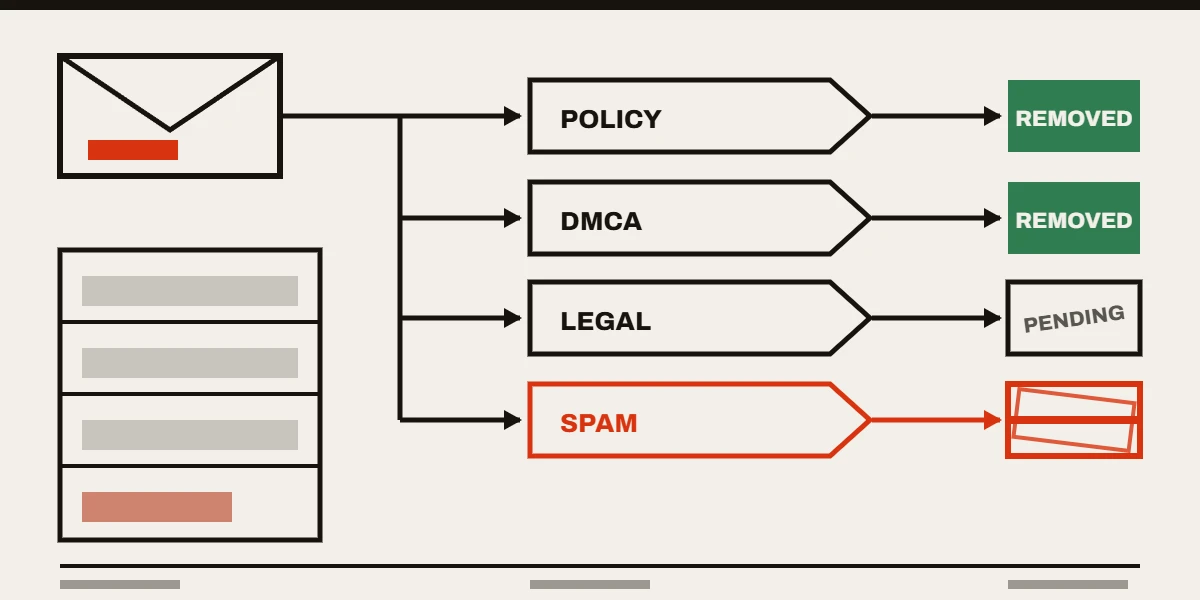
| Route | What it is | What it can compel | Where it stops |
|---|---|---|---|
| In-app Report | A categorised flag attached to your account and the exact object | Human review of one specific message, channel, group or profile | The category you choose decides the queue; a wrong category is a dead letter |
| [email protected] | Free-text complaint with evidence attached | Review of harassment, threats, impersonation, coordinated abuse | No formal deadline, no case number, no appeal you can point at |
| [email protected] | A formal copyright notice | Removal of infringing material you own the rights to | Public content only, and only where copyright genuinely applies |
| @NoToScam | A purpose-built bot queue | Review of financial fraud, scam sellers, investment fraud | Nothing outside the fraud category |
| [email protected] | Child-safety route | Highest-priority review | Report to national authorities in parallel, always |
The telegram abuse report email people send to the wrong address
The four addresses above are the entire published surface, and one wrong turn accounts for a startling share of wasted effort: @BotSupport is Telegram's help account for developers building bots, documented as such in its own bot FAQ. It is not an abuse line. Complaints sent there are not routed onward. If you have written to @BotSupport about a harassing channel and heard nothing, that silence is the system working as designed.
The choice itself is simpler than it looks. Ask what the reviewer would have to verify. Copyright is checkable against a registration or a publication date, so it goes to dmca@. Fraud has a purpose-built queue, so it goes to @NoToScam. Harassment and impersonation require someone to weigh context, which is slower and vaguer, and that is abuse@. Anything visible to you inside the app can also be flagged in-app, and often should be in addition, because the in-app report attaches the precise object rather than a description of it. Report discipline is what separates outcomes here, the same discipline we apply when routing an Instagram complaint and when the evidence is about to expire.
If it is intimate images, do not wait in the queue
This route runs differently and should start immediately. Do not send us, or anybody else, the material. Use StopNCII, or NCMEC's Take It Down if anyone in the images was under eighteen, both of which generate a cryptographic hash on your own device and share only the hash with participating platforms. The image never leaves your phone. Report the channel in-app in parallel, and preserve links and timestamps before anything is deleted. We triage these at no charge and we do not ask to see the content, ever.
Being targeted, or trying to get something genuinely harmful taken down? Send us the links for a confidential first review. We will tell you which route fits, what it is likely to achieve, and where it stops, before you pay us anything.
What Telegram cannot read, and what that rules out
A rule circulates that Telegram ignores anything private. It was true, and it stopped being true in September 2024, when the FAQ was revised and in-app reporting was extended to illegal content inside private one-to-one and group chats. The wall is not public versus private. It is readable versus sealed.
Secret chats are the sealed side. They are end-to-end encrypted and stored on the two devices involved, so there is no server-side copy for a moderator to open. A report about a secret chat asks Telegram to act on something it cannot see, and no amount of escalation changes that. Copyright keeps its own narrower boundary: the DMCA route still applies to public content, which is the one place the old public-only wording survives.
That constraint is worth understanding rather than resenting. It is also why no bulk-reporting product can exist on Telegram in the shape buyers imagine, a pattern that repeats across platforms — Snapchat publishes no reporting endpoint at all, and YouTube, the one platform that does expose a reporting call, caps it at 200 a day and queues it anyway.
Telegram DMCA takedown: the only notice with law behind it
Every other route asks. This one asserts a right, and that difference shows up in how it is handled.
A telegram dmca takedown is a formal notice sent to [email protected] identifying the work you own, the infringing t.me links, and your good-faith statement that the use is unauthorised. The US Copyright Office's DMCA pages set out what a compliant notice contains. It is paperwork, it is checkable, and a reviewer can verify it without forming a view about anybody's character. That is the whole reason it moves.
It also matters more on Telegram than most people realise. The RIAA's October 2025 submission to the United States Trade Representative named Telegram alongside Discord as a primary hub for pre-release music piracy, and USTR published its 2025 Notorious Markets review in March 2026. Rights-holder pressure of that kind is what keeps a copyright queue staffed. Nothing comparable exists behind a harassment complaint.
The obvious temptation is to dress a non-copyright grievance as a copyright claim, and it is a bad trade. In the United States a knowing material misrepresentation in a takedown notice is separately actionable under 17 U.S.C. § 512(f), and the practical damage arrives sooner than any lawsuit: a notice that collapses on inspection makes every later filing from you look like noise. We will not send one. The limits we work inside are written down rather than implied, and our note on Instagram account takedowns sets out the same removal-versus-suppression logic in more detail.
When I file these, the pattern I have come to expect is that the category picks the queue and the queue picks the timeline. A copyright notice reads like paperwork and is handled like paperwork. The same underlying facts, sent to abuse@ as a harassment complaint, go somewhere slower and softer. Where both are honestly available, I now lead with copyright — not because it matters more, but because it is the claim a stranger can verify in ninety seconds. That instinct is the opposite of what the volume market teaches, and it is the same reason violations get counted rather than reports and why the "tool versus bot" distinction is mostly marketing.
How to take down a Telegram group you do not run
This is the least-served question in the whole cluster, and the honest answer has two halves.
You cannot take it down. Telegram can, and only where a rule was genuinely broken. What you control is the quality of the case that lands on a moderator's desk: the precise links, the timestamps, the specific rule you say was breached, and a description written for someone with thirty seconds and no context. Screenshots help; screenshots with the surrounding thread visible help more. Crop your own username out before you send them.
People arrive at how to get someone banned on telegram expecting a number, because dozens of pages publish one. There is no published threshold, no report count that triggers anything, and the figures in circulation trace back to vendor blogs rather than to Telegram. Scale is not the variable. Telegram blocked roughly 43.5 million groups and channels across 2025 according to Check Point Research's March 2026 analysis, and almost none of that volume originated in user reporting — automated detection did the work. Adding your report to a swarm changes the sender list on one case, nothing else. We have documented the identical arithmetic on Facebook, where standing matters more than headcount, and traced where the panels selling that promise actually source their accounts.
And if you are considering buying the swarm anyway, look at what you would be handing over. The WhatsApp equivalent runs on the buyer's own live session, which is to say on the buyer's own account. Meanwhile the genuine version of this problem — real spam bots swarming you — has a real and much duller fix.
There is a request we turn down, and it is worth stating plainly rather than piously. If the channel is a competitor, a critic, or lawful opinion about you or your business, there is no ground and we will not manufacture one. Forged notices get content reinstated, get the filer identified, and hand a small story a much larger audience. We say so in the first review, at no charge, and point you at what can actually be done instead.
When the channel comes down and the link stays up
Removal is not the end of the matter, and this is the part the vendor pages never reach.
A t.me link can outlive the channel it pointed at. Search engines hold the URL, the title and often a cached description; aggregator sites republish channel directories; archives keep their own copy. A person searching your name may still meet the result long after Telegram has acted on it. That is a separate job with separate tools: search-engine removal requests, personal-information removal filings, right-to-be-forgotten applications where UK and EU law applies, and owned content built to occupy the positions the dead link vacates.
Some things cannot be removed at all, and you deserve to hear that before you pay anyone. Truthful journalism, genuine public records and protected opinion stay up. What is available there is suppression — pushing the result off the first page — not removal, and anyone promising otherwise is either mistaken or selling. We do not guarantee removal, we do not forge notices, we do not bluff lawsuits, and we will never ask you for a password. Our scope and fees are published before anyone pays us, and the limits are set out in full.
If your own channel is the one under attack, the defensive playbook is the mirror image: appeal immediately, preserve everything, and do not retaliate. We wrote it up for X and from the target's side on TikTok, and the sequence transfers cleanly to Telegram. The rest of our platform briefings sit in one place.