The video came down. The copies did not
Day three is when this message usually arrives, and we get it more than any other. The original is gone. The client can see the empty page where it used to sit. And the same footage is still circulating, because four other accounts duetted it, two stitched it, someone reposted it, and the audio was lifted into a sound that nine other videos are now using.
Nothing went wrong with the filing. The filing worked exactly as filed.
What went wrong was the brief. A takedown aimed at one video removes one video, and on TikTok a video is the smallest of the five things that can carry your problem. Every derivative is a separate upload by a separate account with its own URL and its own moderation record. The platform does not treat them as one item because, structurally, they are not one item. That is the difference between a removal and a finished case, and it is the most common reason people arrive here having already paid somebody else.
Scale explains why nobody at the platform will connect the dots for you. In its sixth Digital Services Act transparency report, covering July to December 2025, TikTok reported removing roughly 112 million pieces of content across the EU alone — the first of these reports to count comments as well as videos, live streams, ads and Shop listings — and said 93.8% of it was actioned without any human review. Automated review is fast and it is literal. It answers the report in front of it. It does not go looking for the other eleven copies, and it will not infer that the duet is the same grievance as the original.
So the useful question is not whether a removal service can get something taken off TikTok. Often it can. The question is whether the brief covers everything that carries the harm, and whether anyone told you which parts were never going to come down at all.
Five objects, five filings: what a tiktok content removal service is really removing
Ask for "a TikTok removal" and you have named a category, not a job. There are five distinct objects on the platform, and each one routes to a different form, a different policy and a different standard of proof.
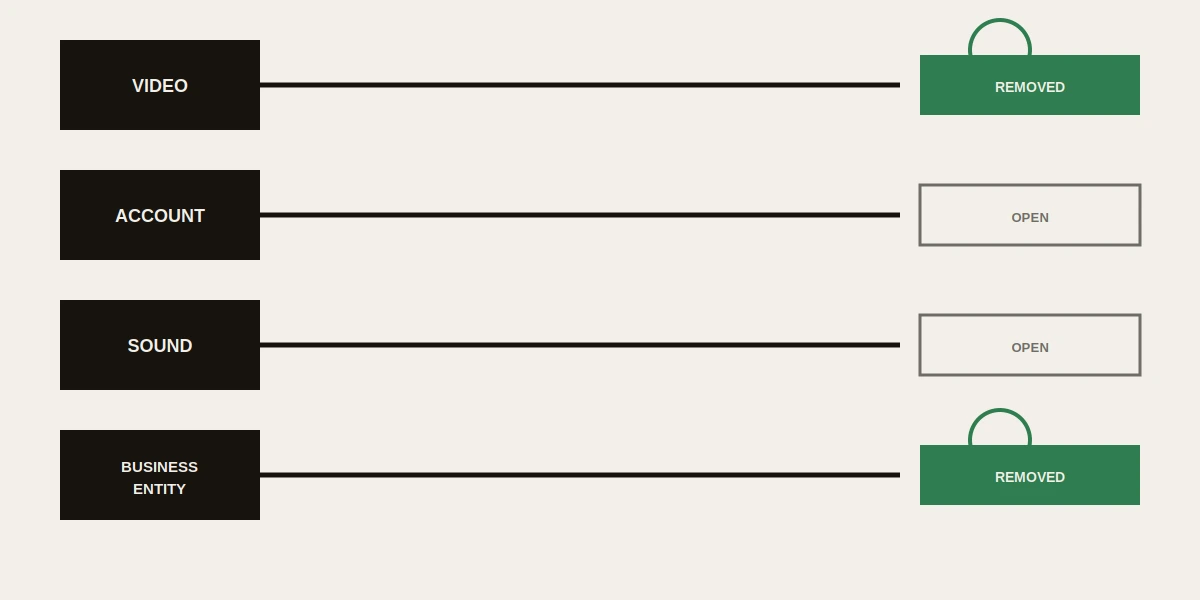
The video is the unit most people mean. It is reported in-app, or through TikTok's copyright, trademark or privacy forms, and it is decided against the specific frames you complain about.
The account is a different request with a much higher bar. Accounts go for accumulated strikes, for a severe single violation, or for impersonating a real person or brand. No quantity of reports against one video removes an account.
The sound is the object nearly everyone forgets, and it gets its own section below.
The derivative, meaning a duet, a stitch or a repost, is a new upload owned by whoever made it. Removing the parent does not automatically clear the children.
The commercial entity (a Business account, a Shop listing, an ad) sits partly outside the Community Guidelines and partly inside advertising and commerce policy, which is why trademark evidence works there and rarely works anywhere else.
We drew the equivalent map for Meta in our briefing on the four objects an Instagram removal request can target, and the shape looks similar until you compare the middle rows. Instagram's four are profile, post, Reel and Story. TikTok's list runs longer because two of its objects — the sound and the derivative — are things the platform actively encourages other people to make out of your content. Remix is a product feature there, not an edge case. A route that closes an Instagram case can therefore leave a TikTok case half-open, and our cross-platform map of the instruments that force a takedown needs a different fifth column for TikTok than it does for X.
Tiktok account removal services and the object nobody counts
The sound is the sleeper. When a video is published, its audio can be extracted into a reusable sound page with its own permanent URL, and other creators attach that sound to their own videos with two taps. If the harm in your case lives in the audio — a voice recording, a phone call, a name being read aloud, a track you own — then removing every video on earth that uses it still leaves the sound page live, and the next person who finds it starts the cycle again.
Serious tiktok account removal services file against the sound page as its own object, on the same copyright or privacy grounds that applied to the parent video. It is a short filing and it is frequently the one that ends the spread, because it takes out the mechanism rather than the output. When a quote for TikTok work does not mention audio anywhere, that is the quickest way to tell how many of these the vendor has actually run.
Duets, stitches and reposts: the copies that outlive a removal
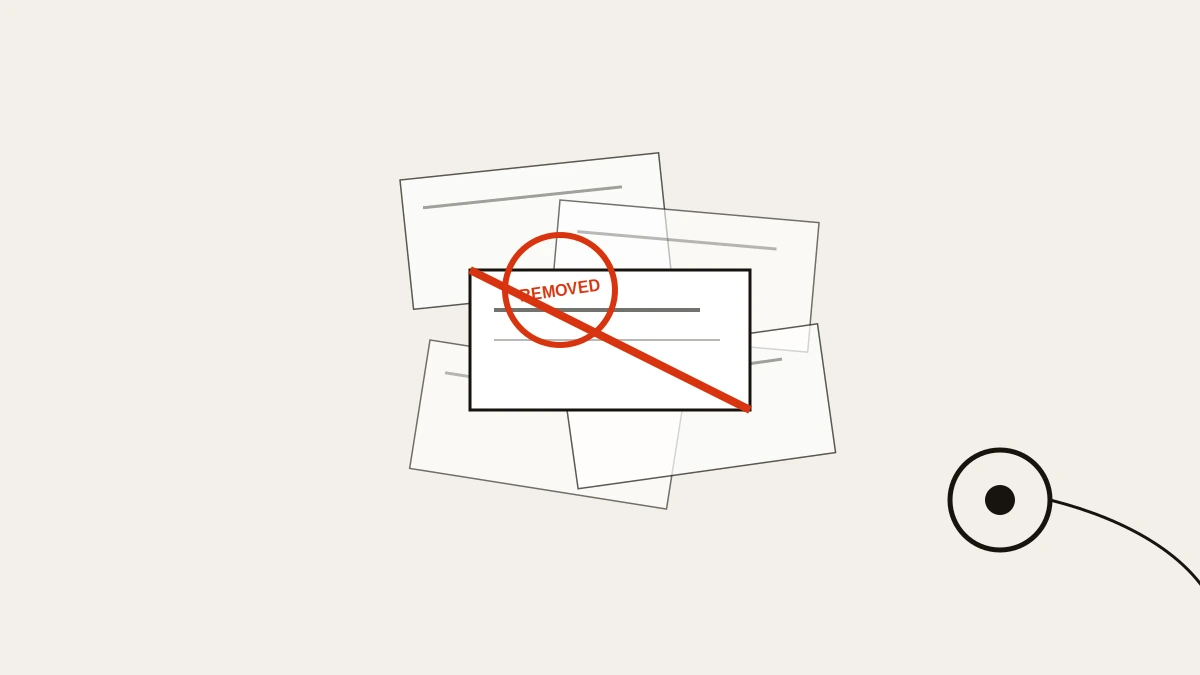
TikTok publishes no promise that derivatives fall when a parent falls. Its own guidance on the creation features points the other way: switching duet and stitch off after publication governs what can be made from that moment forward, and the duets and stitches already made stay where they are. Permission settings look forward. They are not a recall.
When we file these, the pattern is consistent enough to plan around. A successful copyright claim against an original will often carry the duets that reproduce it substantially, because the same protected work sits inside them. A successful Community Guidelines report usually does not, because that decision was made about one upload's compliance and nothing else. A privacy or doxxing removal lands somewhere between the two and depends almost entirely on how much of the offending material the derivative actually reproduces. None of that is published policy and we would not present it as such — it is what our case records show as of August 2026, and it is why we scope derivative sweeps as a separate line in every quote instead of folding them into the headline number.
There is a second problem that no filing reaches. TikTok videos are downloadable, and downloaded copies migrate — most visibly into messaging channels, where a clip that has been off TikTok for a fortnight is still being forwarded to new people every day. That is a different jurisdiction with different report routes, which is why we treat channel work as its own engagement and why sites like telegrambanservice.pro exist as a separate category of service rather than an add-on. Planning for reupload instead of reacting to it is the whole game, and the reasoning matches what we set out for video platforms in how to take a video down and keep it down.
How to remove a tiktok post that someone duetted or stitched
Report the derivative on its own terms, not as an appendix to the original. Open the duet or stitch itself, capture its URL, and file against that URL with the ground that fits what it actually contains. If it reproduces your copyrighted footage, that is a copyright claim. If it adds fresh harassment or a false factual allegation of its own, that is a Community Guidelines or defamation matter, and the parent's outcome has no bearing on it.
Do this before you file against the parent wherever you can. Once the original is gone, some duets render as a blank half-screen, which makes the derivative harder to describe and harder for a reviewer to assess — your own evidence gets weaker at exactly the moment you need it most. Capture everything first, file in one wave, keep the URLs.
How to remove a post from tiktok when the post is not yours
You have four routes, and picking the wrong one is the usual reason a case stalls for a fortnight.
In-app reporting covers the Community Guidelines: harassment, bullying, hate, violent threats, adult content, dangerous acts. It is free, it is fast, and it is decided by the automated systems that handle the overwhelming majority of TikTok's caseload. Use it when the video plainly breaks a written rule.
Copyright is the strongest lane if you own the footage or the audio. TikTok runs a dedicated copyright infringement report form, and it operates under the notice-and-takedown framework the US Copyright Office sets out for section 512. The trade-off is real and you should know it before filing: a copyright notice is a sworn statement, your details go to the uploader, and a counter-notice puts the material back unless you sue. Appearing in a video is not the same as owning it.
Trademark is the lane for brand impersonation and counterfeit Shop listings, filed through TikTok's separate trademark report form. It needs a registration number, and with one it is among the most reliable routes on the platform.
Privacy covers personal information, doxxing and non-consensual imagery through TikTok's privacy report route. This is the lane most defamation-adjacent cases actually travel, because a false allegation attached to your name, address or workplace is usually reportable on privacy grounds long before anybody argues about libel.
Our separate briefing on getting a single TikTok taken down quickly and lawfully goes route by route with the timings we observe on each.
Not sure which of the five objects your case actually involves? Send us the links and nothing else. We will tell you which route fits, what evidence it needs, and which parts are not going to come down — before there is anything to pay. Start a confidential review.
What a removal request has to contain before anyone reads it
A reviewer spends seconds on this, and a report that makes them hunt for the violation loses to one that hands it over. Give the exact URL of the specific video, not the profile. Give a timestamp — the point in the video where the violation happens, to the second. Name the policy you are relying on in the platform's own words rather than your own. State who you are in relation to the content: the person depicted, the rights holder, the parent, the authorised representative.
Then stop. Long submissions do not read as thorough; they read as a dispute, and disputes get deprioritised. One violation, one policy, one URL, one sentence of context. If the same account has posted eleven of these, file eleven reports rather than one report listing eleven links — the second form gets closed as a single item, and you have spent your evidence on nothing.
Deleting your own: how to remove a tiktok account, a post, or both
This section is for people who want their own content gone. If that is you, there is nothing to buy and nobody to hire. The whole answer is below, it takes under a minute, and no removal service should ever quote you for it.
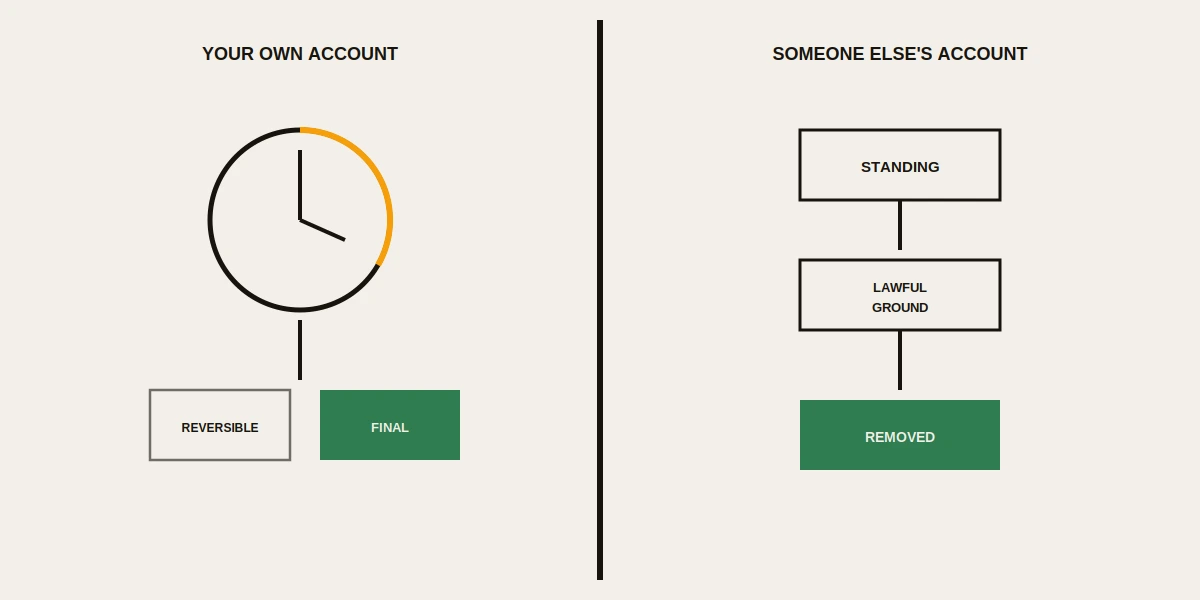
The two lanes are not symmetrical, and the asymmetry is the point. Removing your own account is a setting. Removing somebody else's is a case. You need standing, a lawful ground and evidence, and the platform decides. That split runs through every platform we cover, and we walked it in detail for Meta in taking down a Facebook account, yours or theirs.
How to remove account on tiktok from inside the app
Profile, then the menu, then Settings and privacy, then Account, then Deactivate or delete account. Choose delete. TikTok then holds the account in a deactivated state for 30 days before erasing it: invisible to everybody else, fully restorable by you if you log back in during that window, gone afterwards. The grace period is the part people misread. If you are deleting to make something disappear before a deadline, the account stops being publicly visible straight away, but the data is not irretrievable until the thirty days run out.
One caution outweighs the rest. If the account holds evidence you might need, whether a harassment pattern, a threat or a fraudulent listing, export or screenshot it before you start, with URLs and dates attached. We have had cases arrive where the only proof of a six-month campaign had been deleted by the victim on day one, for entirely understandable reasons, and could not be brought back. The same warning applies wherever content expires by design, which is why our Snapchat takedown briefing opens on retention clocks rather than routes.
How do i remove a post on tiktok, and what deletion does not undo
Open the video on your profile, tap the three dots, tap Delete. That is the whole procedure and it is immediate.
What it does not do is retrieve the copies. Anything already duetted, stitched, reposted or downloaded survives your deletion, and the sound extracted from your video may stay live on its own page after the video itself is gone. So if you are deleting a post because it is being used against you, delete it and then go and check the sound page and the duet feed — that is where the material usually still is. Deleting is also not a defence to anything. If the post is the subject of a complaint, removing it does not close the complaint, and screenshots taken beforehand remain perfectly usable by whoever took them.
How to remove someone from your tiktok account: four questions wearing one sentence
Four completely different things reach us under this one phrase, and the fix for each is unrelated to the others. Only one of them is a takedown.
Somebody else is logged in to your account. Settings and privacy, then Security and permissions, then Manage devices, where every active session is listed and can be removed individually. Change the password immediately afterwards and switch on two-step verification, or the same device signs straight back in.
A follower you do not want. Open your followers list, tap the follower, remove them; blocking does the same job more permanently and hides your content from that account entirely. Neither action notifies them, and neither retrieves anything they have already saved.
A member of your Business Center. That is an admin permission change, covered in the business section below, and it has no effect on any TikTok account's existence.
Somebody is running an account pretending to be you. Here is the one that really is a takedown, and it is a different job from all three above. The platform will not act on your say-so; it acts on identity evidence, and the burden sits with you to prove which account is the real person. We set out how that queue works, and why the wrong evidence gets a case closed rather than escalated, in what happens when someone is impersonating you. The mechanics transfer to TikTok almost unchanged.
How to get a tiktok account removed when it is not yours
Standing decides this before evidence does. TikTok acts on complaints from the person or brand affected, from a legally authorised representative, from a parent or guardian of a minor, and from law enforcement. A bystander reporting content they merely find objectionable is filing into the general queue, and the general queue is where volume goes to die.
Worth stating plainly, because a great deal of money changes hands on the opposite premise: report volume does not remove accounts. We took the arithmetic apart in what mass reporting actually does to the target, and the short version is that duplicate reports against one item collapse into a single moderation decision. The honest answer on getting someone banned from TikTok reaches the same place from the other direction. A whole market sells the opposite — tkbanservice.pro is the plainest example of the category, and equivalents exist for every platform, twitterbanservice.pro among them for X. What they sell is filing labour. Filing labour is a genuine cost and it is not the same thing as an outcome, and a quote that blurs the two is telling you something useful about the vendor.
What does remove an account: accumulated Community Guidelines strikes within a policy area, one sufficiently severe violation, a verified impersonation of a real person or registered brand, or a court order. Strikes are the ordinary route and they decay — a strike ages out after roughly 90 days, so a campaign spread thinly across six months achieves less than the same evidence filed inside a fortnight. Timing is a strategy here, not an afterthought.
The evidence bundle that decides it
Every account-level case we win is won before anything is filed. The bundle that works has four parts: identity, pattern, harm and ground.
Identity means proof you are who you say you are: for an individual, government photo ID; for a brand, the trademark registration number and the certificate itself. Pattern means the full set of URLs with capture dates, arranged chronologically, showing a course of conduct rather than one bad video. Harm means the concrete consequence, dated: the lost contract, the withdrawn offer, the police report number. Ground means the specific policy or law each item breaches, item by item.
Assemble that and most cases become straightforward. Skip it and you are asking a reviewer to build your case for you in under a minute, which is not something reviewers do. Our Twitter removal briefing makes the same argument at greater length, and the people who assess these bundles here are listed with their credentials on our team page.
How to remove business account on tiktok: three questions, one phrase
Almost nobody typing this wants TikTok to delete a business. In our experience the phrase splits three ways, and only the third is removal work at all.
Unlinking an account from Business Center. An administrative permission change made by an admin inside TikTok's Business Center, documented directly in TikTok's help pages on removing a TikTok account from Business Center. It detaches the account from your organisation's asset list. The account carries on existing, keeps its content and its followers, and is otherwise untouched.
Switching a Business account back to a personal or Creator account. Also a setting, also reversible, also not a deletion. People reach for this when the Business account type has cost them access to commercial sound libraries, and it is the right answer to that particular problem.
Getting a commercial entity removed because it is harming you. This is the real removal case, and the one where a business has better instruments than an individual. A registered trademark turns an impersonating shopfront into a documented infringement rather than an argument about intent, which is why that route resolves faster than almost anything else available on the platform. Counterfeit Shop listings, fake company profiles and review manipulation each have their own evidence shape, and the strongest bundles pair the registration certificate with incorporation documents and dated screenshots of the listing. The pattern is close to the one we describe for professional networks in LinkedIn clone and defamation takedowns. Whatever you send us in that bundle is handled under our privacy policy and is not retained beyond the case.
Reach restriction is not removal: what the best tiktok content removal service says first
TikTok has an outcome sitting between "live" and "gone", and it is the one most often sold to clients as a win. A video can be made ineligible for the For You feed: it stays up, it stays on the profile, anyone holding the link still watches it, and it simply stops being distributed. Views collapse. The client sees the number fall and reasonably concludes that something was removed.
Nothing was removed.
Suppression is the word for it, and suppression is legitimate work. Sometimes it is the only available result, and it is most of what search-side reputation work achieves too, a line we draw in removal versus suppression on account takedowns. But it has to be named as what it is on the invoice. A reduced-reach video is one repost away from full distribution again, and a client who believes the matter is closed will not be watching for that.
Which brings us to the practical test. Five questions, askable in a first call, separate a removal desk from a storefront:
- Which of the five objects does this quote cover, and what does the derivative sweep cost separately?
- Which route are you filing under, named: copyright, trademark, privacy, or Community Guidelines?
- What is your standing to file, and if the standing is mine, what evidence do you need from me?
- What does the honest failure case look like, and what happens to my fee when it arrives?
- Will the outcome be removal or reach restriction, and how will you show me which one I got?
A desk that has run these answers immediately. A storefront changes the subject to turnaround times and guarantees. Our teardown of what a TikTok ban service quote is actually buying walks the same questions through real market pricing, and the channel takedown equivalent does it for messaging platforms.
What we will not file, and what nothing reaches
We do not file notices we cannot stand behind. A copyright claim over footage you do not own is a false sworn statement carrying its own liability, and we will say no to it. We do not send bluffed legal threats, we never ask for your password or your login, and we take no payment before a person has reviewed and scoped the case.
Some things do not come down at all. Truthful reporting about you, genuine public records, and honest opinion — however unfair it feels — are not removable through any lawful route, and the attempt is worse than silence: a rejected notice is a documented rejection, and a legal threat over protected speech is a story in itself. Where that is the position we will say so on the first call and put the work into suppression and de-indexing instead. The full statement of our limits sits in our disclaimer.
Two exceptions run on different rails, and we triage both without charge. If intimate images of you have been shared, do not send them to us or to anyone else — StopNCII.org generates a hash from the image on your own device, so the file itself never leaves it, and participating platforms act on the hash. And if anyone involved is under 18, the case moves to statutory reporting channels immediately rather than into a commercial takedown queue.
More of these briefings, platform by platform, sit in the Obscura briefing room.