What Instagram counts as impersonation, and the one thing it will not touch
Instagram's impersonation policy is narrower than almost everyone assumes, and that narrowness is where most complaints quietly die. The platform acts on an account pretending to be a specific person or entity — you, someone you follow, a public figure, or a business. It does not act on an account that is merely dishonest about itself. Instagram's help centre draws the line in one sentence: you can report an account for impersonating someone or something, "but not for misrepresenting itself." A profile inventing a fake florist in a city where no such florist exists is misrepresenting. A profile using your name, your photographs and your city is impersonating. Only the second is reportable on these grounds, and filing the first under an impersonation category produces a refusal that reads like indifference but is really a category error.
The distinction matters more than the outrage does. Meta removed more than 20 million accounts impersonating large content creators during 2025, having taken down over 23 million the year before, and reported that impersonation complaints from those creators fell by a third (Meta newsroom, 13 March 2026). Enforcement at that scale is not indifference. It is a filter, and the filter is looking for one thing: a verifiable identity claim. Reports that supply it move. Reports that supply indignation instead do not, however deserving the person filing them.
Everything below assumes the account is a clone rather than a hacked version of your own profile. If your real account has been taken over, that is a recovery problem with a different queue entirely. And if you are trying to work out which categories Meta acts on across its whole stack, we set out the report categories Meta actually acts on separately, along with what moves a Facebook enforcement decision.
What to do if someone is impersonating you on Instagram: there are two filings, not one
Someone is impersonating me on Instagram is one of those searches where the obvious action and the effective action are different actions. Here is the fork that explains most of the "Instagram ignored me" stories, and it is almost never mentioned in the guides ranking for it.
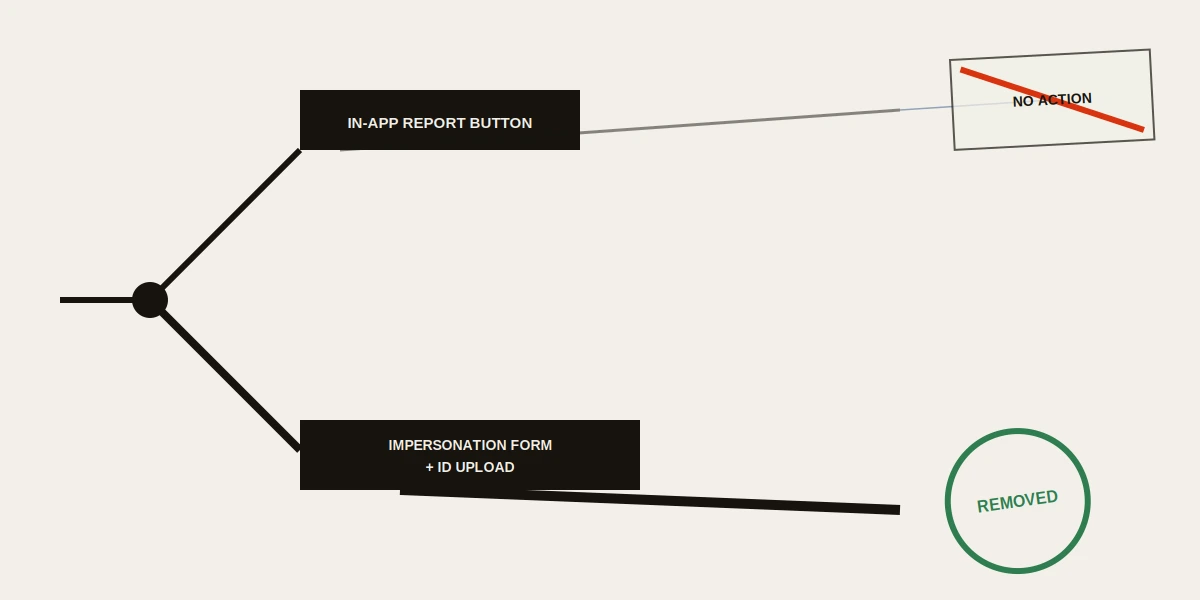
Instagram runs impersonation through two doors. The first is the in-app menu on the offending profile, which branches the moment you tap "It's pretending to be someone else" and asks you to choose who is being impersonated: you, someone you follow, a celebrity or public figure, or a business. The second is a dedicated web form, "Report an Impersonation Account on Instagram or Threads", which collects your name, your email, your relationship to the person being impersonated, both usernames, and a photograph of your government ID. Instagram states the ID is used only to confirm identity and is deleted within 30 days.
Those two doors do not lead to the same place, because they do not carry the same evidence. A first-party filing asserts an identity and can substantiate it. A third-party tap, whether from a friend, an assistant or a follower who noticed the clone, asserts an identity claim on behalf of somebody who has not verified anything, and no reviewer can confirm it from the report alone. That is the weak version of the case. It is not a conspiracy and it is not a broken button; it is a filing without the one document the decision turns on. Reviewers work from a fixed set of inputs, and where identity is the whole question, an unverified assertion gives them nothing to decide with. This is also why the timing advice circulating on forums misses. Filing at a particular hour, from a particular device or from a fresh account changes nothing about which queue receives your complaint. The branch you select and the document you attach change everything.
Instagram effectively concedes this itself. On its page for people who spot a clone of someone they know, the platform lists two options: report it from the profile, or "contact the person being impersonated by email, telephone, or Direct message to encourage them to report it to us." When a platform's own guidance tells your friends to go and fetch you, it is telling you which filing it prefers. Representatives — a parent filing for a child, an agent filing for a client — are pushed off the in-app route entirely and directed to the form, as is anyone being impersonated who has no Instagram account of their own. For those two groups the form is not the stronger option. It is the only one.
People who search account impersonating me instagram usually mean one of three different situations: a dormant duplicate, a clone actively messaging their followers, or a profile that has been reported already and survived. The route is the same; the urgency and the wording are not. Which of those you are in also decides whether this is a reporting exercise or a takedown that needs escalation.
How to report an Instagram account impersonating you, step by step
Do both filings, in this order, on the same day.
- Capture the evidence before you report. Screenshot the fake profile in full, including the handle, the bio, the follower count and the grid. Save the profile URL as text, not just as an image. Screenshot any message the clone has sent in your name, with the recipient's permission where you can get it. Once the account is removed, this material is gone, and you will want it if the clone returns or if the matter becomes legal.
- File in-app, choosing the correct branch. Open the fake profile, tap Options next to the username, then Report, then Report Account, then "It's pretending to be someone else". Select Me — not "someone I follow", even if a friend is helping you, because the branch you pick determines what evidence Instagram can ask for next.
- File the dedicated form as well, at Instagram's impersonation report form. This is the filing that carries your ID.
- Ask two or three people to report it honestly, and no more. Not a brigade. Genuine independent reports add signal; manufactured volume is its own policy problem, which is why the spam report bot myth costs people more than it gains them.
What to write in the impersonating Instagram report
Give the reviewer a pairing, not an accusation. Name your real account and the fake one side by side. State which specific photographs were taken from your grid and roughly when you posted them. Say plainly what the clone is doing, whether that is soliciting money, contacting your clients or posing as you in DMs, because severity changes the queue a case lands in, and a clone running a payment scam is not weighed the same way as a dormant duplicate. Keep it to facts a stranger can check in ninety seconds. Reviewers are not adjudicating whether you have been wronged; they are matching a claim against a policy, and the report that makes that match easy is the report that wins. Skip adjectives. Skip the history between you and whoever you suspect is behind it.
One paragraph, two profile URLs and the ID upload will beat three pages of context every time. Your report stays anonymous, incidentally: the account you report is not told who filed, unless you file on intellectual-property grounds, which we come to below.
Instagram won't remove account impersonating me: how to read a refusal
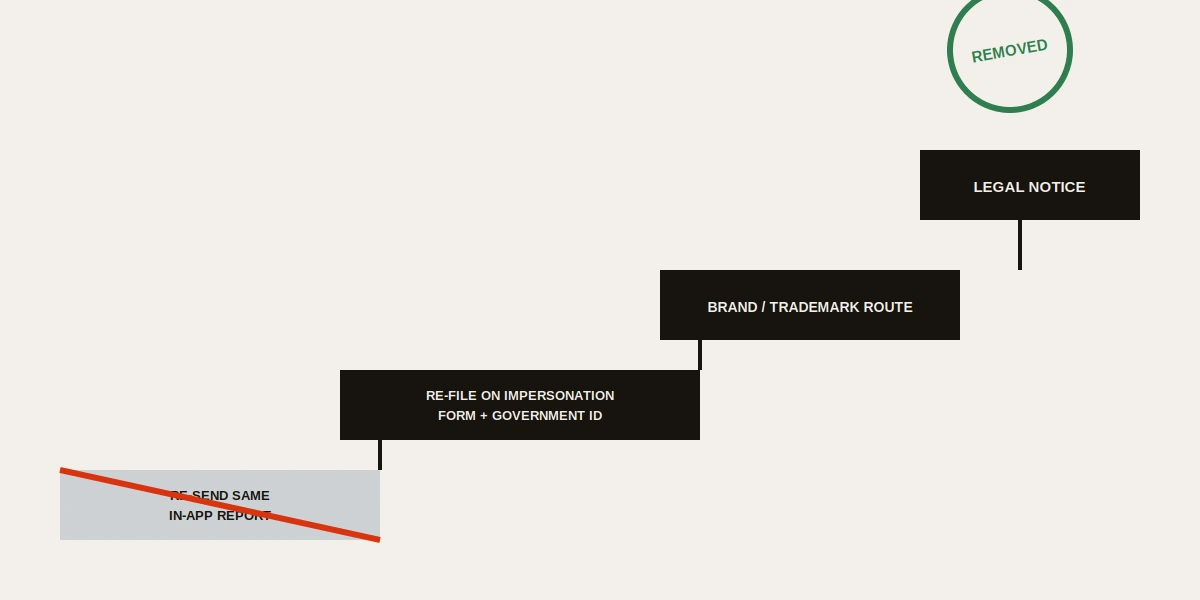
A refusal is information, not a verdict. In our own casework the commonest thing we change about a failed impersonation case is not the evidence but the door it was pushed through — roughly two in three of the cases that reach us have already been filed once from the in-app menu, without ID, and refused (our internal records as of August 2026). Re-sending that identical report is the wasted rung on the ladder. It arrives as the same unverified claim it was the first time.
Work up instead. Re-file through the ID form if the original went in-app only. If the clone is using photographs you took, you have a second and entirely separate ground in copyright, and a copyright complaint is judged on documentary evidence rather than on a judgement call about identity, which is why it often succeeds where an impersonation report stalls; the mechanics are the same ones we set out for keeping a video down once it is removed. If a registered trademark is involved, the trademark route opens. If the account is threatening you or publishing intimate images, those are different policies again, and faster ones. That principle survives every interface change Meta makes: when one ground stalls, find a different ground with better evidence behind it rather than repeating the same ground more loudly. Each has its own reviewers, its own standard of proof and its own timescale, and a case that looks hopeless under one can be routine under another.
What will not help is buying volume. The market that sells "Instagram removal" to people in exactly this position is largely reselling the free forms above at a markup, and we have written plainly about what a paid removal actually delivers and about the panels and APKs sold as mass-report tools. Price bands do not correlate with outcomes here; the same pattern shows up in Facebook ban-service pricing. Nor does volume: coordinated reporting is itself actionable behaviour, and it can turn a sympathetic complainant into a policy problem, as the reporting-volume myth on X shows.
Two practical things you can do immediately, without waiting for any decision: restrict or block the clone from your own surfaces, and tell your audience. A pinned post or story saying "this is my only account, I will never DM you asking for money" defuses the actual harm faster than any takedown will. Controlling your own surface is the part that never depends on a platform's decision, a point that generalises across what you actually control on any platform.
How to find out who is impersonating you on Instagram
Start with the honest answer, because every guide that dodges it wastes your week: Instagram will not tell you. There is no setting, no support ticket and no escalation that ends with Meta emailing you a name. Reports are anonymous in both directions by design.
What exists instead is a legal process with real preconditions. Meta's own guidance on obtaining account information states that US federal law does not permit private parties to obtain account content — messages, photographs — from providers like Instagram at all. It may release "basic subscriber information", and only then on a valid subpoena or court order, only where the information is indispensable to a case and not already in your possession, and only after notice to the affected account holder. Read that last condition twice. The person behind the clone is told that somebody is seeking their details, which means unmasking is not a covert step and should never be sold to you as one. The order also has to be served on the correct Meta entity — Meta Platforms Ireland Limited or Meta Platforms, Inc., depending on where you are domiciled — and must identify the account by username, profile URL and date, because Meta cannot look up an account without them.
In England and Wales the usual instrument is a Norwich Pharmacal order, a High Court order compelling a third party mixed up in wrongdoing to disclose identifying information. It is not a formality. You need a good arguable case, a genuine intention to pursue the wrongdoer, and the costs of the application typically fall on you, not on the platform. In the United States the ordinary route is a civil claim against a "John Doe" defendant, with identity emerging through discovery. Both are proportionate responses to a campaign of harassment or a fraud running in your name. Neither is proportionate to a dormant fake profile, and any adviser who reaches for them first is selling you litigation you do not need.
What you can do lawfully and immediately is preserve. Archive the profile, the URL, the timestamps, the recipients of any DM sent in your name. Ask people who were contacted to forward the messages rather than describing them. Do not attempt to bait, hack or socially engineer the account into revealing itself — it contaminates the evidence and can expose you to the very offences discussed further down. The same sealed-records problem applies across platforms, and it is why a fee cannot unseal an encrypted account and why anonymous accounts on X need unmasking before removal. How we handle anything you send us is set out in our privacy notice.
If a clone is trading on your name, messaging your followers, or running a payment scam in your handle, this is a takedown case rather than a reporting one. Ask for a confidential review and we will map the route before naming a fee. We never request your password, never file a notice we cannot stand behind, and non-consensual intimate images jump the queue at no charge, handled without our ever needing the file itself.
Someone is impersonating my business on Instagram: a different form, a harder trade-off
A company has doors a private individual does not, and the strongest one costs something the individual's route does not cost.
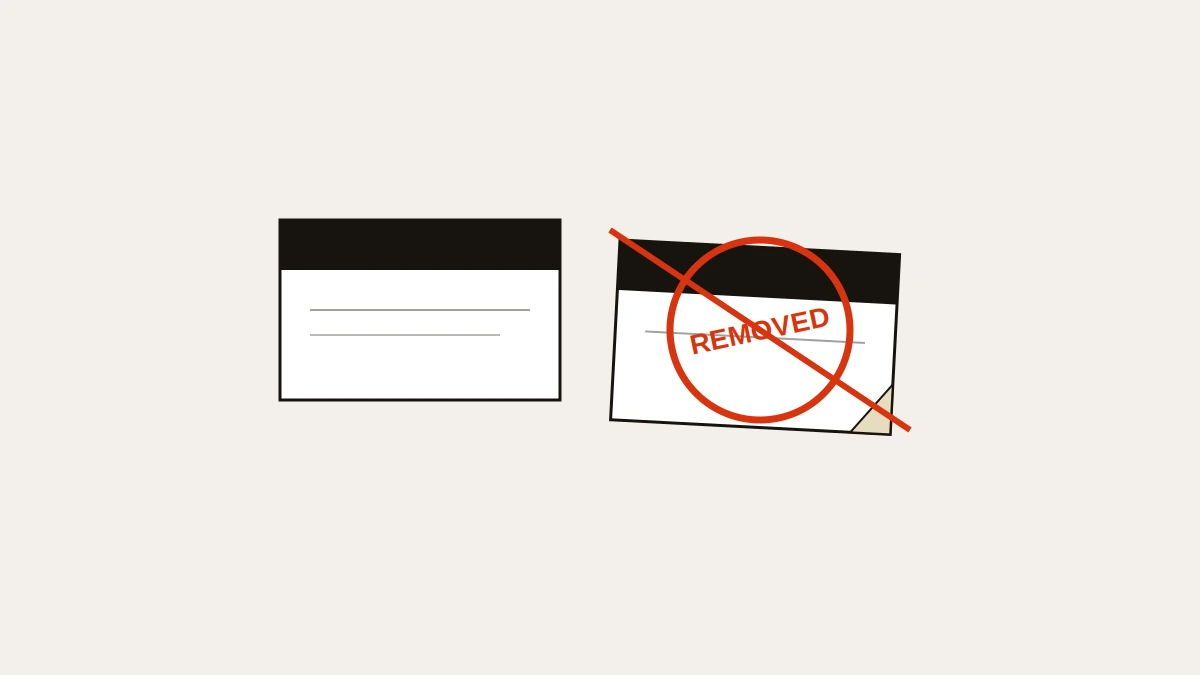
The impersonation route treats a fake company profile as a false identity claim, and a reviewer weighs it. The trademark route treats it as misuse of a registered mark, and a reviewer checks it. That is the difference that decides outcomes: judgement versus documentation. Instagram takes trademark complaints through a dedicated intellectual-property form, which asks for the mark, the registration and the jurisdiction, and there is a specific path for a username that infringes a mark, meaning the handle itself rather than only the content posted under it. That username path is the one most businesses miss, and it is often the one that matters, because a squatted handle keeps generating confusion even after every offending post is deleted. A registered brand that files on trademark grounds usually gets a cleaner answer than the same brand arguing identity, because the evidence is a certificate rather than an impression.
Note what copyright will and will not carry here. Copyright protects original expression — your product photography, your campaign images — and Instagram's own guidance is explicit that it does not protect names, titles or slogans. So the stolen photographs on a clone are a copyright matter, while the stolen name is a trademark matter, and a business with both grievances has two filings available rather than one stronger one.
Now the cost. Instagram keeps reports anonymous except where the complaint is an intellectual-property one. File on trademark or copyright and information about the report is passed to the person who posted the content. For a limited company reporting a counterfeiter that is usually irrelevant. For a sole trader whose home address sits on the trademark register, or a founder being harassed personally, it is a real decision, and it should be taken deliberately rather than discovered afterwards. Filing on identity grounds keeps you anonymous but relies on judgement; filing on IP grounds is stronger but puts your name in front of the person you are complaining about.
Businesses also tend to get cloned in more than one place at once. If the same brand is being duplicated on Facebook, that is the same Meta stack and the Facebook takedown routes run in parallel; a cloned professional identity on LinkedIn follows its own evidence-pairing pattern.
Fan accounts and parody: why Instagram labels differently from X
This is where Instagram diverges from the platform most people compare it to, and copying the wrong mental model produces a wasted filing.
X requires parody, commentary and fan accounts to identify themselves through a public, three-limb test you can run yourself in under a minute — a qualifying word in the display name, the same disclosure in the bio, and a non-identical avatar. We set that test out in full in our briefing on how Twitter impersonation removal is decided, and it works because it is checkable from the outside.
Instagram does not work that way. Meta describes applying "friction points" when it detects potential impersonating behaviour — requiring an ID to create an account using a celebrity's name, or forcing the account to choose a label such as a fan account. The critical difference is when: those frictions land at account creation and inside Meta's detection systems, not as a public rule you can audit on a live profile. So there is no equivalent checklist to run before you file. You cannot look at an Instagram fan account, tick three boxes and conclude it is compliant.
What follows from that is practical. On X, the label test often settles the case before you file. On Instagram, the question a reviewer is actually asking is whether an ordinary viewer would be deceived into thinking the account is you. A profile that says "fan account" in the bio, uses a different avatar and never speaks in the first person is unlikely to deceive anyone. A profile using your name, your face and your voice, with "parody" buried at the end of a bio nobody reads, plainly might. Deception is the test, not the presence of a word. And an account that clears that bar can still breach something else entirely — harassment, your copyright, your trademark — which is a separate filing on separate grounds rather than an argument to bolt onto the impersonation report.
Why is someone impersonating me on Instagram?
Motive is not idle curiosity here. It changes which policy your case belongs under, and therefore how fast it moves.
Four patterns cover almost everything we see. The commonest by a wide margin is financial: the clone copies your grid, follows your followers, and slides into DMs with an investment tip, a giveaway that needs a small fee, or a crypto link. Your audience is the target; you are only the costume. Second is romance and catfishing, where your photographs build credibility with strangers who will never contact you, and where the last person to find out is usually the person being impersonated. Third is harassment, where a clone exists specifically to post things in your name that damage you, frequently after a real-world falling-out. Fourth, and mostly affecting businesses and creators, is audience harvesting: build a lookalike account, accumulate followers on your reputation, then repurpose or resell it.
Notice that only the third pattern is about you personally. That is the counter-intuitive part, and it is worth absorbing before you spend a fortnight trying to work out who has a grudge. Most impersonation is opportunistic rather than targeted, selected because your follower count and your photograph supply made you convenient. People who go looking for a personal enemy behind a purely commercial clone usually find one, because a determined search always finds something, and then file a report shaped around a private theory that a reviewer has no way to evaluate. Keep the motive out of the filing unless it is evidenced, and keep it out of your own head until the account is down. There is one exception worth making. Where a clone forms part of a documented pattern of harassment by a known person, motive stops being speculation and becomes context a reviewer can act on.
If the clone is DMing your followers for money
Say so explicitly in the filing, and say it in the first sentence. A clone soliciting payment is a fraud pattern rather than a vanity duplicate, and severity is one of the few things a complainant genuinely controls in how a report is weighted. Then warn your audience directly and publicly, before the takedown lands. Every hour the clone spends unchallenged is an hour it can convert somebody who trusts you — and unlike the removal, the warning is entirely within your gift and takes about ninety seconds.
Can you get in trouble for impersonating someone on Instagram?
Yes, and considerably more seriously than the people doing it tend to assume. This is not merely a terms-of-service matter.
The position in the United Kingdom
There is no single offence called "online impersonation" in English law, which is precisely why so much published advice on this shrugs. Several offences do the work instead. Section 2 of the Fraud Act 2006 covers fraud by false representation: a dishonest false representation made with intent to make a gain or cause loss, and the Act expressly contemplates representations made through a system or device. A clone asking your followers for money is close to the paradigm case. Where the conduct forms a course of behaviour aimed at one person, the Protection from Harassment Act 1997 is engaged. And section 179 of the Online Safety Act 2023 created a false communications offence, in force since 31 January 2024, which can reach a fake account built to cause non-trivial psychological harm. Instagram also operates a dedicated UK Online Safety Act complaints route for users in the United Kingdom.
The position in the United States
There is no federal impersonation offence of general application; it is a state patchwork. California Penal Code §528.5 makes it a misdemeanour to credibly impersonate a real person online in order to harm, intimidate, threaten or defraud, carrying up to a $1,000 fine and up to a year in county jail. Texas Penal Code §33.07 is broader and heavier: using another person's name or persona to create a profile with intent to harm, defraud, intimidate or threaten is a third-degree felony. Many states have nothing specific and fall back on fraud, harassment or identity-theft statutes.
Two cautions before anyone gets ideas. Criminal exposure runs both ways: fabricating evidence, filing a notice you know to be false, or accessing the clone's account to "prove" who is behind it are all routes to being the defendant. And a criminal complaint is not a removal mechanism. Police involvement and a takedown are separate tracks, and the first rarely accelerates the second. Who we are and how we work is set out in our practice.
What the "someone impersonating me on Instagram Reddit" search actually turns up
Worth saying plainly, because nobody selling you something will: when we searched this in August 2026, no genuine Reddit thread ranked for it. Queries aimed at that phrase return author blogs, newsletters, a professional-network post and news coverage — not the r/Instagram discussion the search implies. Pages built to capture the query tend to imply a body of crowd-sourced wisdom that is not actually there.
The recurring complaint underneath the search is real, though, and it is consistent: people report a clone, receive an automated response or nothing at all, are asked for government ID they find intrusive, and conclude the platform does not care. Two of those three steps are explicable. The ID request is the system working, being the thing that converts an assertion into a decidable claim, and the automated response usually means the report never reached a queue that could act, which loops back to the two-door problem at the top of this page. The frustration is legitimate. The inference that nothing works is not. What forum advice consistently gets wrong is the remedy it proposes, which is almost always volume: rally the group chat, get fifty people to report, escalate by repetition. That advice is not merely ineffective. Coordinated reporting is itself a policy violation, and it converts a clean complaint into a messy one.
The genuinely useful thing forum threads do carry is pattern recognition: seeing that the clone which targeted you also targeted eleven other people in your niche, with the same bio structure, is worth knowing and worth putting in a filing. Our other takedown briefings cover the same ground across the other major platforms.
How to stop someone impersonating you on Instagram for good, and what no report can promise
Removal is an event. Staying un-cloned is a posture, and the two need different work.
Once the fake account is gone, assume the handle pattern is known. Register the obvious variants of your username on the platforms you care about, even dormant, so the cheapest imitation is unavailable. Keep a reverse-image search on your two or three most-copied photographs. Consider whether a verified badge is proportionate for you: Meta Verified is a paid subscription and lists impersonation protection among its benefits, which for a creator whose face is the business can be cheaper than the alternative — though it is a monitoring benefit, not a guarantee, and it should be weighed as one. Tell your audience, once, in a pinned place, what you will never do: no giveaways, no DMs about money, no second account.
Now the honest part, which we would rather say here than after you have paid somebody. Nothing on this page guarantees a removal. The decision belongs to Meta, and there is no queue, contact or fee that overrides it — anyone promising a guaranteed Instagram takedown is either reselling the free form above or lying about their access. We do not file notices we cannot stand behind, we do not send bluffed legal threats, and we will never ask for your password or for the impersonator's. A false or exaggerated notice is not a clever shortcut; it exposes you personally and it hands the other side a grievance. Where content is truthful, lawful or genuine commentary, it cannot be removed at all, and the honest options narrow to suppression rather than takedown. Our disclaimer sets out those limits in full, and it is worth reading before you instruct anyone — us included.