What a removal desk does with your first forty-eight hours
Almost none of it is filing.
The opening day of a twitter account removal service engagement goes on capture and classification, and the order matters more than most people expect. Capture first, because posts get deleted by their authors the moment they sense a complaint coming, and a deleted post you cannot evidence is a case you can no longer run. We take dated screenshots, the full post URLs, the account creation date, the follower overlap if a clone is involved, and an independent archive copy of each item. Classification second: which of X's rules, or which legal right, the material actually breaches, and whether the person asking has the standing to invoke it. Those two steps decide the odds. Everything after them is administration, and administration is what people imagine they are buying from a twitter account removal service. They are not. They are buying the judgement that happens before the form is opened, because a filing aimed at the wrong rule is refused no matter how well it is written.
That sequence is why an honest desk will sometimes tell you in hour three that you have no route. It is a cheaper answer to receive on day one than after a month of filings, and it is the answer the storefronts almost never give. Across roughly 900 cases we have taken 3,700-plus results off the open web (our internal records as of August 2026), and a meaningful share of that intake never became a filing at all, because the evidence would not support one.
Twitter content removal is not one job
The phrase covers at least five different pieces of work, and they behave nothing alike. Removing a defamatory allegation about a named person is a legal question. Removing a cloned profile is an identity question. Removing your own photograph from someone else's post is a copyright question. Removing a sustained pile-on is an evidence-of-pattern question. Removing your own old posts is a two-minute settings task you should not pay anybody for.
Lumping them together is what produces the wrong filing, and the wrong filing does not fail quietly. A refusal is logged. When you come back four weeks later with the correct instrument, you come back to a reviewer who has already seen a rejected complaint about the same account. We set out the five instruments that reach X in a separate briefing on account-level takedowns; this page is about which of them fits the thing you are actually looking at. If your question is what the commercial market sells rather than what the routes are, our teardown of the X ban-for-hire trade covers that side of it.
What we ask for, and what we never ask for
A link. Dates. What outcome would make the problem survivable for you. That is the intake.
We do not ask for your password, your login codes, or access to your account, and no legitimate desk will. We do not ask for the material itself in intimate-image cases either — those run through hash-matching at StopNCII.org, which generates the hash on your own device so the image never leaves it, and they are triaged the day they arrive at no charge. The people reading these filings are lawyers and policy specialists rather than salespeople, which is the whole reason we publish who sits behind the desk.
Twitter impersonation removal turns on a label test you can run yourself
Before any impersonation filing goes out, we run a three-part check that costs nothing and settles most cases inside a minute. It is the check the ranking guides skip, and skipping it is the commonest reason a genuine complaint comes back refused.
X's authenticity rules have required parody, commentary and fan accounts to identify themselves since April 2025. The requirement has three limbs and an account has to satisfy all of them: a qualifying word at the start of the display name, the same disclosure repeated in the bio, and an avatar that is not identical to the real person's. Miss one limb and the account is reportable as a deceptive identity. Satisfy all three and it is labelled commentary, which X permits, however unflattering that commentary happens to be. Run the test in that order before you file, and check X's current wording as you go, because the enforcement detail has shifted more than once since the rules landed. Failing the label test is not a technicality on the way to a removal. It is the removal.
Which is why people searching remove impersonator on twitter are usually one test away from their answer rather than one form away from it.
The distinction cuts the other way too. An account that clears the label test can still breach a different rule entirely — targeted harassment, private information, a copyrighted photograph — and that is a separate filing on separate grounds. Parody protects the identity claim. It protects nothing else the account does.
How to take down a fake twitter account pretending to be me
Report it through the dedicated impersonation route rather than the in-app menu, because the impersonation report form collects the identity evidence a reviewer needs and the in-app flow does not. The form branches three ways: you are the person being impersonated, you represent a company or brand, or you are reporting on behalf of somebody else. The first branch asks for government identification, which is the step most people abandon and the step that most reliably produces a suspension.
Give the reviewer the pairing rather than the accusation. The real account and the fake one, side by side, with the creation dates, the copied images identified as copied, and any message the clone has sent in your name. A clone that has solicited money or credentials from your followers sits in a different severity tier from a dormant duplicate, and saying so in the filing changes which queue it lands in. The mechanics run close to what we documented for cloned profiles on LinkedIn, where the identity-verification step does the same heavy lifting.
Twitter account removal service for brand impersonation runs a different route
A company has two doors here, and they are not interchangeable. The impersonation route treats the problem as a false identity claim. The trademark route treats it as misuse of a registered mark, and it asks for the registration number, the jurisdiction and the classes the mark covers — which means a brand with a registered mark often gets a faster and cleaner outcome through trademark than through identity, because the evidence is documentary rather than judgemental.
Choose by what the fake account is doing. A profile using your logo and handle to run a bogus support desk or a giveaway scam is a trademark and fraud case. A profile posting invented statements attributed to your chief executive is closer to impersonation and, if those statements are damaging and false, potentially defamation as well. Businesses frequently need both filed, in a deliberate order rather than at once. The same split runs through the fake-support-account trade we examined in our briefing on spam and impersonation accounts.
When fake twitter account removal is refused and the clone is still there
A refusal is information, not a verdict, and the second attempt is only worth making if something about it has changed. Re-sending the same complaint through the same form is the commonest wasted month in this work. What changes an outcome is new grounds, new evidence, or a new filer with better standing than the first one had.
New grounds means a different rule. An impersonation report that failed the label test may still succeed as a copyright complaint over the profile photograph, or as a private-information report if the account has published an address. New evidence usually means time: an account that was dormant when you first reported may since have messaged your customers, and that message is the thing a reviewer can act on. New standing means the right person files. Where a company reported a clone of an employee, the employee filing personally, with identification, carries evidence the employer never could.
Write down which of the three you have before you re-file. If the honest answer is none of them, the account is not coming down through that route, and the next decision is whether a different instrument exists or whether the work moves to suppression instead.
Report fake X account filings made by somebody who is not the target
You can, and the bystander branch exists precisely for that — it is the route people want when they search report fake x account without being the person in the frame. What you cannot do is supply the identity evidence, so a bystander report is inherently weaker and is best aimed at scam behaviour rather than at proving impersonation. If you know the person being copied, the genuinely useful move is to tell them, because their filing carries evidence yours never will. That standing problem holds across platforms — we set out the same limitation for Snapchat account takedowns, where the person harmed holds levers no observer has.
Remove impersonator on twitter without making the problem larger
One tactical note, because it costs people dearly. Do not announce the filing publicly, and do not quote-post the clone to warn your followers. Both actions hand the account exactly what it wants, which is reach, and both create a public record that the impersonation was noticed and survived. Warn the people who need warning by direct message or by a post that does not link the account. File quietly. Where the clone has already reached your customers, a short factual notice on your own channels, published without naming or linking the fake, does the protective work without amplifying it.
Remove defamatory tweet, or find out on day one that you cannot
English law does not protect you from being criticised. It protects you from false statements of fact that cause serious harm to your reputation, and the gap between those two things is where most defamation enquiries end.
The query usually arrives typed flat — remove defamatory tweet — as though a form existed for it. What exists is a threshold, and the threshold is met by a minority of the posts we are sent.
Section 1 of the Defamation Act 2013 sets the threshold: a statement is not defamatory unless its publication has caused, or is likely to cause, serious harm to the reputation of the claimant, and for a body trading for profit that harm has to amount to serious financial loss. The practical effect is that a nasty post seen by forty people rarely clears the bar, while the same words in front of an industry audience that includes your clients may. Reach, audience and consequence do the work — not how much the post hurt to read. That is an uncomfortable filter, and applying it honestly on day one is the single most valuable thing a removal desk does for a defamation client. It also explains a result that surprises people: the vicious post from an account with nine followers is often the one with no route, while the mildly worded one quoted by a trade publication is the one that moves.
The second filter is fact against opinion. "He is a fraud" reads as an allegation of fact. "I would never work with him again" is comment. Posts mix the two constantly, and the mixed post is the hard case: the actionable sentence sits inside three that are not, and a notice quoting the whole post invites a refusal on the paragraphs that are protected. Quote the sentence. Then say why it is false.
What a twitter removal request has to contain
Six fields, and a filing missing any one of them is doing the reviewer's work badly. The exact post URL, not a screenshot alone. The capture timestamp. An independent archive copy. The specific words you say are false, quoted verbatim. The identifiable harm, stated concretely. And your standing — who you are to the statement.
The field that sinks most requests is the fourth. People send a paraphrase, or the whole post, or a description of how it made them feel, and the reviewer is left with nothing precise to act on. A second confusion is worth clearing up while we are here: X's Transparency Center publishes a report it also calls removal requests, but that report counts legal demands from governments and courts. It has no bearing on your request as a private individual, and nothing in it will tell you anything about your own odds.
When the tweet is about your business rather than about you
Companies read the same law through a narrower window. Because a body trading for profit has to show serious financial loss rather than general reputational harm, a business complaint that stops at "this is damaging our brand" has not yet said anything the threshold recognises. Lost contracts, cancelled orders, a named client who withdrew and said why: that is the shape of the evidence, and gathering it is usually the longest part of a corporate case.
There is a trap here worth naming before anybody walks into it. A hostile post about a company is very often a customer complaint, and a customer complaint that is substantially true is protected however commercially inconvenient it is. Firms that respond by trying to remove genuine criticism, or by commissioning favourable posts to bury it, move from a reputation problem into a regulatory one — fabricated or incentivised reviews sit squarely inside consumer-protection enforcement on both sides of the Atlantic. The lawful corporate route is narrow and it is the one worth taking: act on the false statements of fact, leave the opinions alone, and answer the rest publicly.
Where the poster is anonymous the notice does not stop being useful — it stops being the whole plan, and identifying the author becomes a separate legal step, slower and more expensive than the notice itself. Blocking, meanwhile, does nothing whatever to the post; we separated the controls you hold from the ones only X holds because that confusion routinely wastes weeks. Channel-level equivalents elsewhere behave differently again, as our Telegram takedown routes briefing shows, and speed expectations are worth calibrating against how fast a TikTok actually comes down.
Twitter copyright removal is the fastest lane and the least private one
If you own the image, the video or the words that have been reposted, copyright is usually the quickest instrument available to you. It is also the one that hands your name to the person you are reporting.
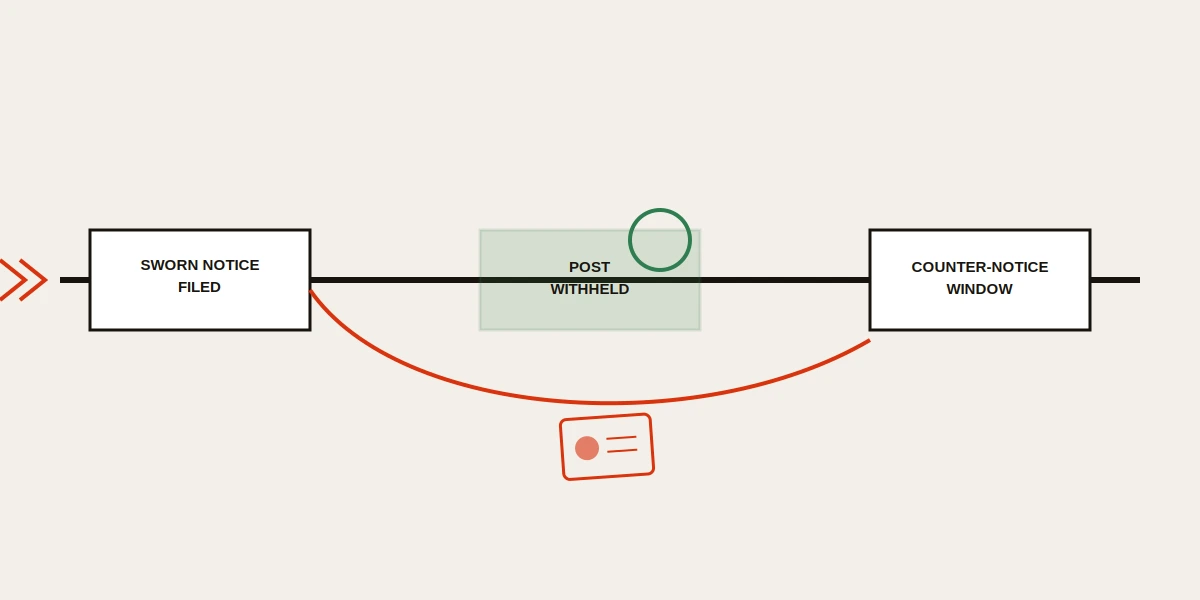
X runs a notice-and-counter-notice process under its copyright policy, inside the framework the US Copyright Office administers. A valid notice identifies the work, identifies the infringing post, and carries a sworn statement made under penalty of perjury. The post is withheld. The account holder is then notified and may file a counter-notice, and where they do, the material can be restored unless court proceedings follow within the window. Three stages, each running on its own clock, and only the first of them is inside your control at any point.
Being in the photograph is not the same as owning it
This is the misunderstanding that wastes the most time in copyright takedowns, so it is worth stating flatly. Copyright belongs to whoever pressed the shutter, not to whoever is in the frame. A selfie you took is yours and a photograph a colleague took of you at a conference is theirs, however much the second one is a picture of your face.
That leaves two workable moves when the image is not yours. The photographer can file the notice themselves, or assign the rights to you in writing so that you can file it, and a short assignment is very often quicker to obtain than people assume it will be. Failing that, the complaint is not a copyright complaint at all: an image of you published to harass, to expose private information, or without consent in an intimate context runs through completely different routes with their own thresholds, and those routes do not care who owns the file. Choosing copyright because it looks like the fastest door, when you do not hold the rights, is the specific error that turns a strong case into a sworn false statement, and it is an error the person you reported can point at later.
The privacy cost is structural rather than incidental. Because the notice is sworn, the details of the person swearing it travel with it to the person reported. One practical mitigation exists and it is worth knowing before you file rather than after: a notice may be submitted by an authorised representative acting for you, so the contact details that travel are the representative's rather than your home address. That is a large part of why a rights holder with a safety concern uses a desk at all, and it has to be decided before anything is sent.
One warning applies to every reader. A copyright notice over material you do not own is a sworn false statement rather than a clever workaround, and the exposure sits with whoever signed it. Do not reach for the copyright lane because it is fast. Reach for it because you own the work. The same discipline governs single-item removals elsewhere: taking down one YouTube video and keeping it down turns on the identical ownership question, and what actually terminates a channel shows where repeated valid notices eventually lead.
If a post has already been reported once and survived, the second attempt is not a retry. It is a different instrument, filed on different grounds, or it is nothing. Send us the link for a confidential review and we will tell you which instrument fits, or that none does, before you spend anything.
A twitter harassment takedown is built from a pattern, not from a post
Harassment cases fail for a reason that has nothing to do with how bad the harassment is. They fail because they arrive as one post.
X's abusive behaviour rules turn on targeting and persistence: the same account, or a coordinated group of them, directing sustained abuse at a specific person. A reviewer looking at a single hostile post sees an argument. A reviewer looking at forty posts across nine weeks — dated, ordered, and showing the same account returning after being blocked — sees a campaign. Same facts, same accounts, completely different decision. The work of a harassment filing is therefore archival rather than rhetorical, and it is slow: building the dossier routinely takes longer than the review it is eventually submitted to, which is the part nobody warns you about.
Sequence matters as much as volume. Show the escalation. Where it started, what changed after you blocked, when it moved to new accounts, when it moved off-platform. Where a group is involved, show the coordination rather than asserting it: shared phrasing, timestamps clustered inside minutes, accounts created the same week. And keep your own conduct out of the file's way, because a reviewer who finds you responding in kind has been handed a reason to call the whole thing a dispute.
The off-platform half of most harassment cases
Campaigns rarely stay on one platform, and a filing that describes only the X half systematically under-states the harm. The same handful of people will typically be posting on X, coordinating somewhere with looser moderation, and occasionally reaching your employer or your family directly. A reviewer at X can only act on what happens on X, which is true and also a reason to file everywhere at once rather than sequentially: parallel filings mean the platforms are each seeing a slice of the same dated timeline rather than four unconnected grievances arriving months apart.
It also changes what a good outcome looks like, and it changes it in a way that is easy to miss. Removing the X account can quietly displace a campaign rather than end it, and the version that reassembles somewhere else is harder to evidence because you have lost the continuity your first dossier depended on. So keep archiving after a suspension, not just before one, and keep the same file rather than starting a fresh one. The one thing we would ask you not to do is spend your evenings reading it. Hand the monitoring to somebody else — a desk, a colleague, a friend with a spreadsheet — because the person being targeted is the worst possible choice of archivist, reads every post twice, and is the most likely to burn out halfway through a case that needed them for another two months.
What volume does not do
More reports do not raise the odds. Reporting is not a poll, and X's rules on misusing the reporting features mean an organised burst of complaints can put the reporters in the frame instead of the target — we took the mass-reporting claim apart in detail after finding that the tooling behind it does not do what it is sold as doing. One complete, dated, well-sequenced report beats fifty thin ones, on X and on every platform we work across; the same asymmetry shows up in what Meta actually acts on.
Two of these searches are asking for something else entirely
Some of the traffic that reaches a page like this one is not shopping for a service at all, and the honest thing is to say so before anybody pays for anything.
Delete negative tweets that you posted yourself
If the posts are yours, this is free and takes minutes. Remove them from your own timeline. Nobody should be charging you for it, and a desk that quotes a fee to delete your own posts is charging you for access to a button you already have.
What deletion does not do is reach anything that has already been copied, and by the time most people go looking, copying has happened. Quote-posts that captured your words survive as somebody else's post, under their control rather than yours. Screenshots survive permanently and sit outside any platform's reach. Web archives keep their own copy on their own schedule. Search engines hold an index entry until they recrawl, which is why the order of operations matters: Google's tool for refreshing a removed page only works once the live page has actually changed, so deleting first and requesting the refresh second is the sequence that works. Filing before you delete simply fails, and the failure is silent enough that people assume the request is still pending weeks later. Whether removal or suppression is the realistic goal is worth settling early, because it changes what you should be spending on.
Delete fake twitter account means two different jobs
Read one way it points at an impersonating account somebody else created, which is the impersonation route above. Read the other way it means a duplicate or burner account you made yourself and now want gone, and that is self-service deactivation rather than a takedown. This is the same fork we drew for Facebook accounts, yours or theirs, and it changes everything about who has to act.
A third reading deserves naming, because the search results are full of it and it catches people out constantly. A large share of the pages currently ranking for fake twitter account removal are not selling removal of anything: they are selling fake-follower cleanup, tools that audit your own audience and strip bot accounts out of your follower list. Useful software, no argument, and priced like software. It has nothing whatever to do with removing an impersonator on Twitter, the two jobs share no mechanism at all, and buyers land on those tools believing otherwise because the vocabulary collides.
Twitter post removal when the post is neither yours nor unlawful
This is the case with no instrument in it. Somebody has posted something true, unflattering and lawful about you, and no policy report, no notice and no lawyer will move it. Pretending otherwise is where reputation firms lose people money. What remains is suppression: building and ranking authoritative material you do control, so the post stops being the first thing anyone finds. It is slower and quieter than removal, and honest about its ceiling. The economics of that trade-off are the ones we set out in what a TikTok ban service actually costs.
What a tweet removal service cannot do, and should tell you first
Three things do not come down, whoever files and however well: true reporting, genuine public records, and protected opinion. That is the boundary. It does not move for a fee, and a desk implying otherwise is selling you a refusal.
Forcing the point makes things worse rather than better. A notice sent over lawful material gets refused, the sender is identified, and the attempt itself frequently becomes the story — coverage of an aggressive takedown attempt reliably outranks whatever the original post was. We publish the full limits on what we take on precisely so that nobody discovers them after paying. Even a successful removal has a ceiling worth stating plainly: it reaches the post, not the screenshots, the quote-posts, or the archived copies of it.
How long any of this takes, honestly
Nobody can quote you a date, and the reason is worth understanding rather than resenting. Three separate clocks run in a removal case and only one of them is written down anywhere.
The first is platform review. X publishes no committed turnaround for reports or notices, so every specific figure you will read on a competitor's page is somebody's anecdote promoted to a statistic. What we can say is that queue position responds to how complete the filing is far more than to how long you wait. The second clock is statutory and it is the one you can actually plan around: where a counter-notice is filed against a copyright complaint, the framework gives roughly ten to fourteen business days before withheld material may be restored unless proceedings have been started. That window is fixed, it is short, and it arrives at the worst possible moment if nobody warned you it existed. The third clock is legal correspondence, which runs on the other side's solicitor rather than on you.
Plan around the second. Prepare for the first. Budget for the third only if the first two have already failed.
Five questions that separate a removal desk from a storefront
Ask which instrument they intend to use, and make them name it. Ask what standing you have to use it. Ask what happens when it is refused. Ask what they need from you, where the correct answer is a link and some dates and never a password. Then ask what they will not take on, because a desk claiming it can remove anything has just told you the most important thing about itself.
Price signals matter less than people assume, though two patterns are reliable. Upfront-only, crypto-only demands with no written scope tend not to end well. A guaranteed suspension for a flat fee is a promise about a decision the seller does not make. We have documented that market repeatedly, most closely in what a ban actually buys you and in the price bands and legal risk on Meta.
What we would tell you if you rang this afternoon
Most cases reaching us already have a failed report behind them, and in the majority of those the failure was procedural rather than substantive: the right complaint filed under the wrong rule, or filed without the evidence that would have carried it. That is genuinely good news for a new client, because a procedural failure is fixable and a substantive one is not. It is also why the first conversation is diagnostic rather than commercial. Where your case has a route, we will name it. Where it has none, we will say so, and you will have lost an afternoon rather than a retainer. The rest of the platform-by-platform work sits in our briefing archive.