
What a WhatsApp ban service actually puts in front of a Meta reviewer
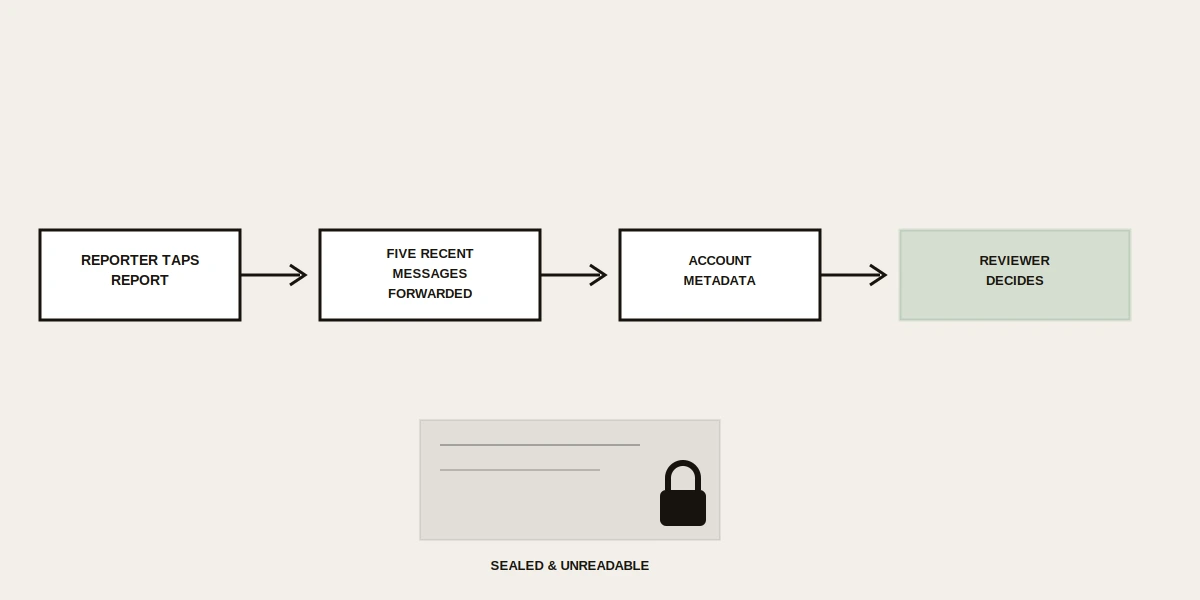
Every personal WhatsApp conversation is end-to-end encrypted. Meta's servers move the ciphertext and hold nothing readable, which is why the company's own documentation on end-to-end encryption states that not even WhatsApp can read your messages. A reviewer opening a case about a number is therefore not reading a chat log. They are reading a small package that the reporter assembled and sent.
That package has a fixed size. When you tap Report on a contact or a chat, WhatsApp forwards the five most recent messages from that thread to its review team, along with account metadata: the reported number, roughly when the account registered, whether it fans messages out to large groups, and how many separate people have flagged it recently. WhatsApp sets this out on its reporting and blocking page. Nothing outside that envelope arrives. No paid intermediary can widen it.
Sit with that for a moment, because it is the whole argument on this platform. On Instagram or YouTube a reviewer can open the offending post and look at it. On WhatsApp there is no post to open. The evidence is whatever the reporter preserved before it scrolled out of the last five, and a fee changes none of it.
Metadata does a lot of the remaining work, and it is worth being precise about what that word covers here. Meta can see that a number registered eleven days ago, that it has messaged four hundred people who never messaged back, that its traffic spikes at the same hour daily, and that thirty unrelated accounts reported it inside a week. What Meta cannot see is the content of any of those conversations. So the system that removes accounts at scale is a behaviour detector, not a reading comprehension exercise, and the report you file is one data point feeding it rather than a case file being adjudicated.
We have made a version of this point on other platforms, that the vendor is selling a filing rather than an outcome, in our teardown of the WhatsApp mass report bot trade, and again when we went looking for the API a Snapchat panel would have to call and found no endpoint to call. WhatsApp is the sharpest case. Elsewhere the argument is commercial. Here it is cryptographic.
Is there a service to ban a WhatsApp number?
Yes, in the sense that people will take your money for it. No, in the sense that anyone selling a ban controls one. Only Meta's enforcement team can disable a WhatsApp account, and it does so against its Terms of Service and the behavioural signals described above. A whatsapp number ban service is a drafting-and-submission agency. It writes your complaint, files it through routes you can use yourself for nothing, and sometimes coordinates several accounts to file in parallel.
The distinction decides what you should buy, if anything. Paying a specialist to structure evidence is a real service with real value, in the way that paying a solicitor to draft a letter is. Paying for a guaranteed ban is buying a promise the seller has no authority to keep. Every listing that quotes a success rate is quoting a number it invented, because the only party holding per-case outcome data is Meta, and Meta does not share it with third parties.
That is the same shape we found when we costed what an Instagram ban service is really selling. What differs on WhatsApp is the ceiling. On Instagram, a well-built report at least gives a human something substantive to examine. Here the human gets five messages, and if those five are the target saying "ok" four times, the case closes before it opens.
The unpaid version of the same sequence sits in our field guide to blocking, reporting and appealing a WhatsApp number.
Report a WhatsApp number to get it banned: the sequence that reaches a human
The phrase people type into a search box is report whatsapp number to get it banned, and it contains the mistake. Reporting is the middle step, not the first one, and the two steps around it decide whether the middle one carries any weight at all.
If you want to report a WhatsApp number to get it banned, the order of operations decides everything. Screenshot first. Report second. Block third. Reversing the last two is the most common mistake we see, because blocking ends the thread, and once the thread ends the abusive messages stop arriving. The five most recent messages then become five older, milder ones, and that is what a reviewer receives.
Concretely, as of August 2026: open the chat, capture screenshots with the timestamps and the number visible, then use the chat menu to report, choosing the category that names the actual harm rather than the generic option. Spam is the default many people reach for and the weakest signal available. Impersonation, threats, and child safety route differently and carry more weight. Add the block only after the report has gone in, and keep the screenshots. If the sender rotates to a new number, report each one; WhatsApp's metadata layer sees the registration and device patterns you cannot.
A practitioner note from our side of the desk. When we prepare these, most of the work is not the filing. It is deciding which five messages should be the last five, and, where a case is heading anywhere near a solicitor or the police, capturing them so they survive being questioned later: full screen, unedited, device clock in frame. That work is worth paying for. The submit button is not.
The volume theory that panel operators sell has been tested to destruction elsewhere. We traced what a Telegram mass report panel actually reaches and pulled apart what runs behind a Facebook mass report tool. The pattern repeats. Reports are a queue signal, never a vote.
How much does a WhatsApp ban service cost in August 2026?
Here is the honest answer, and it is stranger than the question expects. The resale market prices unbanning with precision and banning with a shrug. On SWAPD, the trading board where most of this business is actually done, WhatsApp unban listings observed in August 2026 sit at roughly $350 to $500, with 24-hour turnaround claims, escrow, and crypto settlement. Ban listings exist on the same board, and buyer-side requests for them exist too, but they rarely carry a published price. Where a figure appears at all it lands in the low hundreds to four figures, consistent with the bands we documented for Facebook ban service pricing and for TikTok, where $250 buys a report and not an outcome.
That asymmetry is the tell. Unbanning has a mechanism: an appeal, an account the seller can access, a defined form with a defined reply. Banning has none. A seller who cannot describe the mechanism cannot price it, so they price the attempt instead, then let the buyer infer that the attempt and the outcome are the same thing.
Read any quote against that. If the listing prices per submission, you are buying labour. If it prices per ban, ask what happens when no ban arrives, and read the answer carefully. A refund clause that survives contact with a real dispute is rarer than the listings suggest, and on a board where accounts are disposable it is enforceable only for as long as the seller wants a reputation.
One more figure is worth holding next to the price. Whatever the fee, the deliverable is a report that WhatsApp receives identically to the free one you could file in ninety seconds from your own phone. There is no priority lane, no partner queue, and no reviewer who sees a paid filing differently. The money buys drafting, coordination, and somebody else's time, and those are the only three things it can buy.
Why "buy WhatsApp ban service" listings quote a turnaround, not an outcome
Search buy whatsapp ban service and the results converge on a house style: a stated window, usually 24 to 72 hours, and a payment method that does not reverse. The window is doing rhetorical work. It sounds like a service-level commitment while promising only that the seller will have acted by then, which they will have, because acting takes four taps.
Crypto and escrow complete the structure. Escrow on a trading forum releases when the seller marks the job delivered, and delivery here means reports filed, not account gone. By the time you can prove otherwise the funds have moved and the counterparty is a username. We walked the same economics in Twitter ban-for-hire, and the WhatsApp version improves on none of it.
What "whatsapp ban service reddit" actually returns
Very little, which is worth knowing before you spend an evening looking. We ran the query and its site-restricted variants in August 2026 and found no substantive Reddit threads discussing whatsapp ban service offerings as a product category. The results are help-centre pages, vendor blogs, and news coverage of bans in general. There is no thread of buyers comparing sellers, because the trade lives on closed forums and Telegram, where a reputation is a username rather than a post history.
Treat any page claiming to summarise what Reddit says about this as fabricated social proof. The same absent community trail showed up when we chased four sources for an Instagram mass report bot and found one dead end.
Six checks before you buy anything
Run a listing through these before the money moves. They are the questions we would ask on your behalf, and none of them requires you to know anything technical.
- Who makes the decision? If the seller does not volunteer that Meta decides and they only submit, the rest of the conversation is decoration.
- What exactly is delivered? A number of filings, a drafted complaint, an evidence pack, a coordinated wave. Ask for the noun. If the answer is a ban, the seller is describing something outside their control.
- What is the evidence? On WhatsApp there is one correct answer: the five most recent messages plus what you screenshotted. A seller who claims access to chat history is either lying or describing a device compromise.
- What happens on failure? Not whether there is a refund policy, but the mechanism. Who holds the funds, who decides the dispute, and how long the seller's identity outlives the transaction.
- Is the report true? Every word of it. You are the named complainant even when someone else typed it, and section 179 exposure below does not attach to the drafter.
- What is the alternative price? Free, in most cases, for the same envelope. Paying is defensible when you are buying expertise, evidence handling, or someone to run a multi-number case while you get on with your life. It is not defensible as a shortcut, because the shortcut does not exist.
If a listing fails checks one, three, or four, close the tab. Those three are where the harm sits, and they are the three that vendors answer with adjectives.
WhatsApp number ban service or WhatsApp account ban service?
The two phrases get used interchangeably and they should not be. On WhatsApp the number is the account, but what sits on top of it varies, and enforcement follows the layer rather than the phrase.
A personal account is one number, one device registration, and a profile. A WhatsApp Business app account adds a catalogue, a business name, and public-facing fields. A WhatsApp Business Platform account, the API tier bought through providers, sits inside a Meta Business Manager and can be restricted at the business level while the underlying number survives. So a whatsapp account ban service quoting one price for an account is quoting for three enforcement paths with three different thresholds. The Business Platform tier is the most reachable of the three, because it carries commercial obligations, a verified entity behind it, and a provider who can be notified.
If the number harassing you runs a business account, say so in the report and name the business. That single detail moves the case from an anonymous consumer dispute to a policy question about a commercial entity, which is a materially different queue. The same logic drives our approach to taking down a Facebook account, yours or theirs.
WhatsApp number takedown and WhatsApp account takedown are not one instrument
Takedown is a word borrowed from copyright and defamation work, and it does not map cleanly onto a messaging app. A whatsapp number takedown, strictly, means removing that account's ability to use the service. A whatsapp account takedown in the wider sense usually means something else: removing a public surface attached to the number.
Those public surfaces are where genuine takedown instruments bite. A profile photo using your image, a business catalogue selling counterfeits, a Channel broadcasting defamatory claims, a group name carrying your trading name. Each of those is content, each is reachable by an intellectual-property or defamation complaint, and none of them requires a reviewer to read an encrypted chat. It is the same removal-versus-suppression line we set out for Instagram account takedown.
Put plainly: the encrypted part of WhatsApp is the part a takedown cannot touch, and the unencrypted part is where the ordinary instruments still work exactly as they do everywhere else. Most people asking for a ban want the second thing.
It helps to name the surface before choosing the instrument. Ask what a stranger can see without being in the chat. If the answer is a profile picture, a business catalogue, a Channel, a group invite link circulating publicly, or a display name, then something concrete exists to complain about and the complaint has a subject. If the answer is nothing, the harm lives entirely inside encrypted threads, and the honest routes narrow to the in-app report and, where the conduct is criminal, the police. Clients often find this reframing more useful than the ban question they arrived with, because it converts an impossible request into a list of two or three actionable ones.
What Meta's own ban figures show about who gets removed
Meta publishes monthly WhatsApp enforcement figures for India under that country's IT Rules, and they are the closest thing to a public scoreboard this platform has. In the June 2026 report, published on 1 August 2026, WhatsApp recorded 5,104,127 Indian accounts banned, of which 1,369,080, around 27%, were banned proactively before any user complaint arrived (MediaNama, August 2026).
The grievance side of the same report is the number nobody quotes. WhatsApp received 15,182 grievances through its designated officer channel that month and actioned 414 of them, roughly one in thirty-seven. The largest single category was ban appeals: 7,873 complaints, 92 actioned.
Read those together and the picture resolves. Millions of accounts are removed by automated abuse detection reading behaviour, registration patterns, message fan-out and velocity, while a comparatively tiny number move because a person complained. That is not an argument for skipping the report. It is an argument for dropping the belief that the complaint is the lever, and for seeing that a paid filing buys a place in the queue that produced 414 actions.
India is not the world, and the figures are published because Indian law requires them rather than because Meta volunteers transparency at this granularity everywhere. The proportions still travel, though, for a simple reason: the detection system is one system. It is the same behavioural model watching registrations and fan-out in Manchester as in Mumbai, and there is no evidence of a separate, more report-responsive pipeline running elsewhere. Treat the ratio as directional and the mechanism as universal. Our analysis of what actually terminates a YouTube channel reached the same structural point from the opposite direction: strikes terminate, reports merely queue.
If a number is threatening you, impersonating you, or publishing your material, the useful question is not which service will ban it. It is which instrument reaches the part of WhatsApp that is not encrypted. Ask us for a confidential review and we will tell you which one applies to your case, including when the answer is that none does.
When "whatsapp takedown service" is the honest phrase
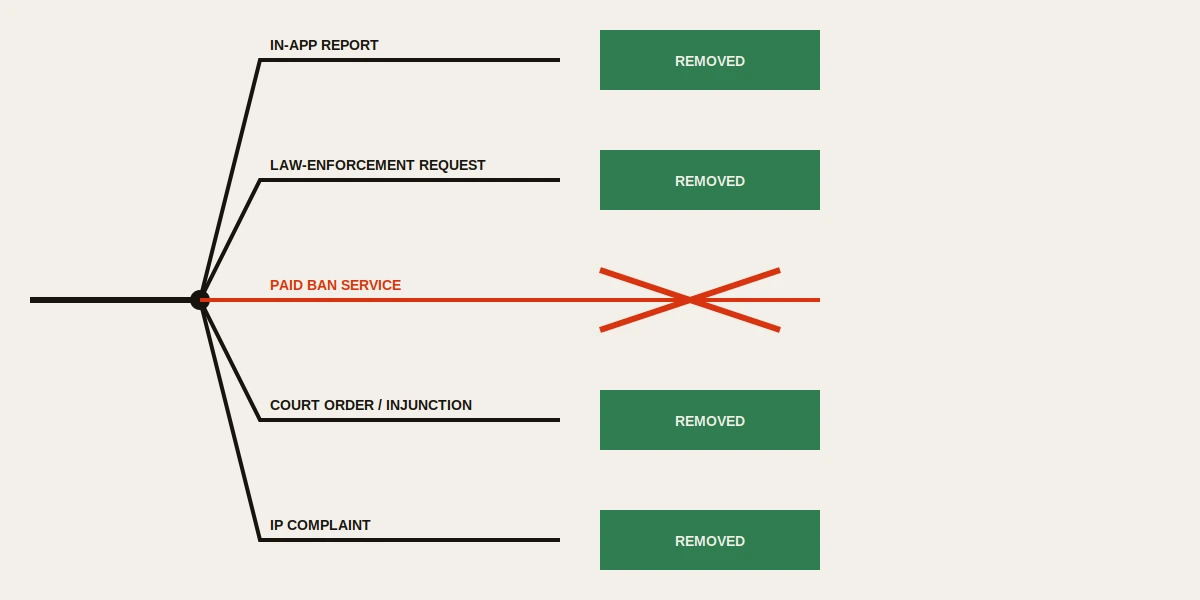
There is a version of a whatsapp takedown service that is real, and it deserves an accurate description, because it is what we do. Not access to a hidden enforcement channel. Four routes, chosen correctly and evidenced properly.
The in-app report, filed under the right category with the right five messages preserved. A law-enforcement referral, the only route that compels Meta to produce records, and one that runs through police rather than through any vendor. A civil instrument such as a letter before action, a harassment injunction, or in the UK a Protection from Harassment Act claim, which puts a named party under a court's authority rather than a platform's discretion. And an intellectual-property or defamation complaint aimed at a public surface: a Channel, a catalogue, a profile image, a group.
None of those is exotic. All of them are documented and available to you directly. What a competent desk adds is knowing which one fits, filing it without overstating the facts, and not spending three weeks on the route that was never going to work. That inventory logic is set out in full in our briefing on the instruments that take a Twitter account down, and its messaging-app equivalent in Telegram ban service and channel takedown routes.
Is buying a ban legal, and who carries the risk if it is not?
Paying someone to file an accurate report about genuine abuse is lawful. Paying someone to file a report you know to be false is not, and the exposure sits with you rather than with the seller.
In England and Wales, sending a message you know to be false with intent to cause non-trivial psychological or physical harm is an offence under section 179 of the Online Safety Act 2023. A sustained campaign against one person can meet the course-of-conduct test in the Protection from Harassment Act 1997. Separately, and in every jurisdiction, knowingly false reporting breaches WhatsApp's Terms of Service, which is the mechanism by which people who buy ban campaigns occasionally find their own accounts restricted instead.
There is a quieter exposure that catches business clients in particular. A company director who authorises a paid reporting campaign against a competitor's number is making a decision on the company's behalf, and if it surfaces later, in disclosure during an unrelated dispute or in a regulator's file, it recolours everything else the company has said about the relationship. A sound harassment complaint reads very differently once the other side can show the complainant was buying reports six months earlier. Clean hands are not a legal nicety here, they are what makes the next filing credible.
The commercial risk compounds the legal one. You have paid an anonymous counterparty in an irreversible currency to submit a document in your name, describing events you may not have described yourself. If that document is later scrutinised, the seller is unreachable and the filing is yours. We are explicit about where our own work stops in our disclaimer, and about who reviews it in our team's credentials, because on a question like this one the limits are the useful part.
If a paid campaign got your own number banned
Some readers arrive here from the other side of the transaction. Your number stopped working, the app shows an account-banned screen, and you suspect somebody organised reports against you.
Start by discounting the theory, because it is usually wrong. The June figures above show automated detection accounting for the overwhelming share of removals, and coordinated reporting is a comparatively rare cause. Most sudden bans trace to bulk messaging, an unofficial client such as a modified APK, a number recently recycled from a previous owner, or exports and broadcast lists that look like spam to a behaviour model. Any of those will do it without a single report being filed.
Whatever the cause, the route back is the in-app appeal, and there is exactly one of it. Open the app, tap Support or Request a Review on the ban screen, and write the plainest possible account of what the number is used for. WhatsApp documents the process on its account bans page. Do not reinstall repeatedly and do not register the number on a second device mid-appeal, because both muddy the signal you are trying to clean.
This is also where the $350 to $500 unban market feeds. Those sellers are charging for an appeal you can file yourself, and in the worst listings they ask for your registration code, which hands them the account outright. No legitimate party ever needs that code. If the appeal fails twice on honest facts, the account is generally gone, and the practical answer is a new number rather than a fee.
If the number is extorting you with images
This section is for one specific reader, and it belongs ahead of everything else on the page.
If someone is threatening to share intimate images of you, do not pay them and do not wait to see whether a ban lands. Report the account in WhatsApp, then use hash-matching, which stops the images spreading without anyone having to view or hold them: StopNCII.org if you are an adult, and Take It Down from NCMEC if you were under 18 when the images were made. Both generate a digital fingerprint on your own device and send only that fingerprint to participating platforms, Meta included. In the UK the Revenge Porn Helpline will act alongside you, free.
We triage these cases urgently and at no charge, and we will never ask you to send us the material. Nobody legitimate will. The evidence clock here is the one we describe for taking down a Snapchat account, only harsher, because on WhatsApp a message deleted for everyone is genuinely gone.
What we will not file for you
We do not send notices we cannot stand behind. No forged DMCA complaints over material that is not ours to claim. No bluffed threats of proceedings nobody intends to issue. No mass filings engineered to trip an automated threshold, and no requests for your WhatsApp account, your PIN, or your registration code. Anyone asking for those is taking your account, not defending it.
We also cannot make a true statement disappear because it is unwelcome. If someone is telling people something accurate about you on WhatsApp, no report and no fee removes them for it, and a takedown aimed at truthful speech tends to produce a larger audience than the original message ever had. Where removal is unavailable, the honest options are suppression of the public-facing traces, containment, and sometimes a considered silence.
What we will do is tell you, before you spend anything, which of the four routes fits your facts and what a realistic outcome looks like on each. Sometimes that conversation ends with us filing. Sometimes it ends with you filing, for nothing, in ten minutes, with better screenshots than you had an hour earlier. Both are fine results. The one outcome we will not sell is the comfortable fiction that a fee reaches somewhere your own report cannot.
All of that applies whether you bring the case to us or to someone else. If you want the rest of the series, the full library of platform briefings covers this ground for each major service, and every one of them ends in the same place. The platform decides, the evidence persuades, and the invoice is not part of the mechanism.